

Hello, everyone.
This is Enta.
It's already July!
It's about to get really hot!
The sooner you take action, the better, so let's get started right away!
Recently, I saw someone at work repeatedly giving the same warning to a young person, saying, “I told you this before, didn’t I!?”
Both the person saying it and the person on the receiving end understand this on a rational level.
But my body won't move.
I realized this is actually a pretty deep-rooted issue.
I’d like to use the phrase “Chikō Goitsu” as a starting point to reflect on safety and growth in the workplace.
"Knowing" and "doing" are two completely different things, after all.
What Is "Unity of Knowledge and Action"? | Knowing but not acting is the same as not knowing
Have you ever heard of the phrase “unity of knowledge and action”?
This is said to be a term from the school of thought known as Yangmingism, which was expounded by a man named Wang Yangming during China’s Ming Dynasty.
The meaning is simple: it seems to be the idea that “knowing” and “doing” are essentially one and the same, and cannot be separated.
Furthermore, Wang Yangming,Knowing something but not acting on it is the same as not knowing it at all.It is said that he said, "Da."
It is said that this phrase can be traced back to a passage in the *Analects*, and in Japan, figures such as Yoshida Shōin are believed to have been influenced by it.
I was really struck by the part that says, “Knowing something but not acting on it is the same as not knowing it at all!”
In practical terms, the ideal is not "knowledge action," but rather "knowledge = action."
Only when knowledge and action align perfectly can you truly say, “I get it.”
I think there’s probably no phrase that applies better than this to a construction site.
That’s because, when it comes to on-site work, simply “knowing” something won’t get you even a millimeter further.
Even if you have the blueprints perfectly memorized, you won’t be able to drill a hole unless you set up the drilling machine.
Even if you know the mix ratio by heart, you can’t make mortar unless you turn on the mixer and add the ingredients.
It’s not so much that knowledge directly leads to results, but rather a world where results only come about when you take action.
That’s exactly why I feel that people who put what they’ve learned into practice right away are the ones who grow the most on the job.
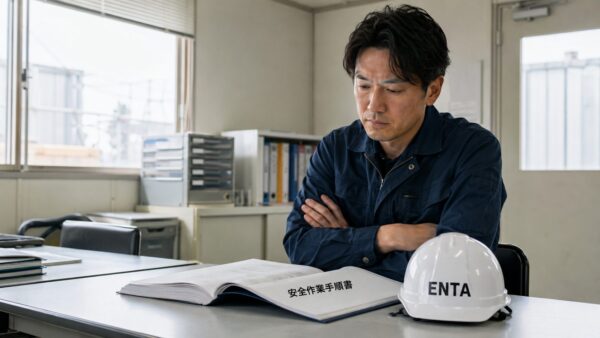
The scariest kind of accident on the job site is one where people “know what to do but don’t do it.”
During on-site investigations of workplace accidents, people often say this.
"I knew how to do it," and "I knew the rules," he said.
It seems to me that there are more cases where accidents happen not because people didn't know what to do, but because they knew what to do but didn't do it.
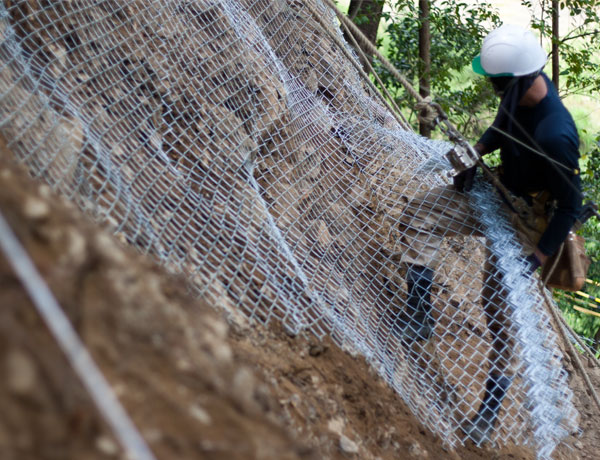
For example, working at heights on a slope.
Wearing a safety harness (fall arrest device) is just common sense these days, isn't it?
Another fundamental rule is to make sure the main rope is securely draped all the way to the end of the platform.
But I end up going out without putting on my lipstick, telling myself, “It’s just a quick trip” or “I’ll be back in a minute.”
Accidents happen the moment your actions drop to zero, even if your knowledge is perfect.
Incidentally, starting in 2022, the government is also tightening safety standards to require the use of full-body harnesses as a general rule for work at heights above a certain level.
Rules are increasingly being established from the perspective of "knowledge."
The issue is always on the "execution" side—that is, whether it will actually be done on the ground.
While expanding your knowledge is important, consistently putting what you know into practice is actually much harder.
Why do people “know what to do but still don’t do it”?
Based on what I’ve seen on the job and my own experience, I’ve come to realize that there are usually three reasons.
1. “Habit.”
The more times I've done a task—even hundreds of times—the more I tend to cut corners.
2. “I’m pressed for time.”
When the production process is demanding, people inevitably feel tempted to cut corners on safety.
3. “I think I’m fine.”
It's that whole "accidents never happen to me" mentality, isn't it?
The situation is most dangerous when these three factors coincide.
Those moments when you skip over something you already know usually fall into one of these categories.
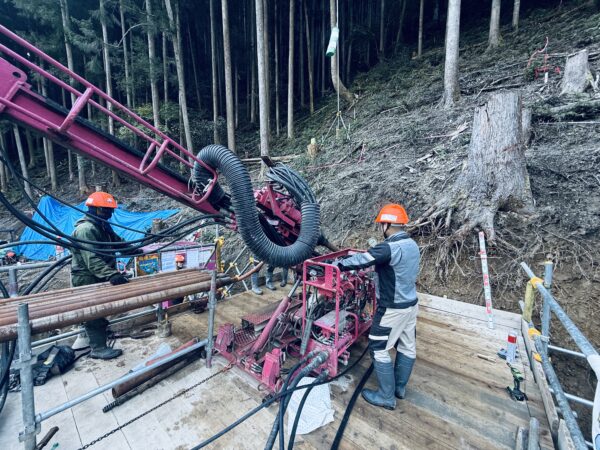
Knowledge only becomes your own when you put it to use.
This isn't just about safety.
New construction methods, new machinery, and new systems.
The world is overflowing with information, and we live in an age where anyone can simply “know” things.
Whether it’s CCUS (the Construction Career Upgrading System) or ICT-based construction, there are really a lot of people who just say, “Oh, I know about that,” and leave it at that.
But in terms of the principle of the unity of knowledge and action, knowledge that isn't put into practice is the same as not knowing it at all, isn't it?
Well, whether I do it or not is a different story, though.
Personally, there have been tons of times when I’ve just gone, “Wow!” at seminars or videos and that’s where it ended, lol.
In the end, it’s only after you’ve actually tried doing it yourself on-site—even just once—and made some mistakes that it finally clicks and you realize, “Oh, so that’s what this is all about.”
Learn, try, fail, and fix.
I think that only the knowledge I’ve put into practice will remain as my true asset.
To put it another way, perhaps the strength of a veteran lies not so much in the amount of knowledge they possess, but rather in the habit of “consistently applying what they know to the task at hand.”
That's exactly the case with new tools, too.
If you just find something at a home improvement store, buy it because it “looks handy,” and feel satisfied with that, nothing will change.
You've got to take it to the job site and actually try it out—you can't complain until you've used it in all kinds of situations lol
As a result, you’ll start to develop your own criteria for making decisions, such as, “This tool (machine) has a certain quirk,” or “It’s actually faster to do this part by hand.”
Manufacturers say, “Anyone can do it easily,” but in many cases, you won’t know if it’s actually usable in the field until you try it yourself.
Only those who have turned knowledge into action have the answer.
On the flip side, even though manufacturers can make their own machines and tools, it’s pretty surprising to hear that contractors are using them in such outrageous ways, lol.
Still, one of the great things about contractors is that they can bring out potential that even the manufacturers aren't aware of.
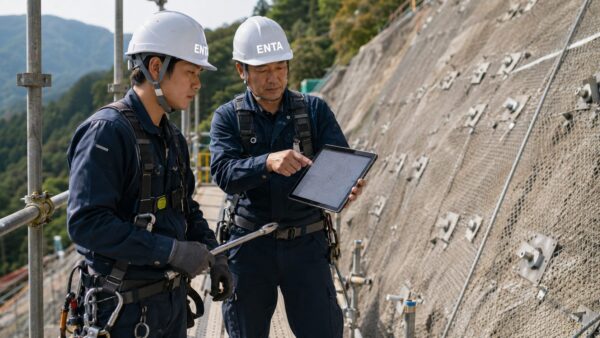
To be honest, gathering knowledge isn't that hard.
After all, we live in an age where there’s no shortage of books, the internet, and videos.
The hard part is actually putting what you know into practice every day on the job—and seeing it through properly without getting fed up.
Use the safety harness's lanyard, let the main rope hang down to the base of the structure, and follow the procedures outlined in the manual.
Something plain, ordinary, and common knowledge.
But the worksites that can consistently do this without wavering are, in the end, the ones with the fewest accidents and the highest profits.
Know it, then do it.
I’d like to keep steadily working on something as simple as that from now on.
Don't just be a "talking-only boss"!!
See you later.