

Hello, everyone.
This is Enta.
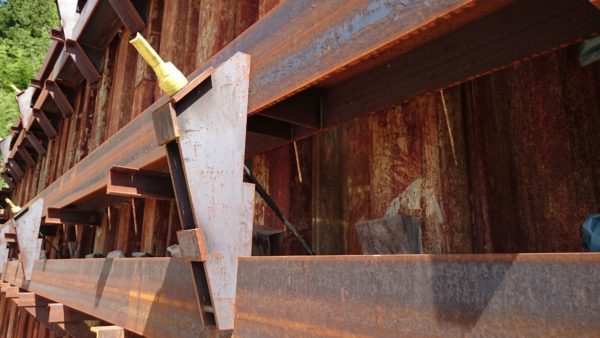
Have you ever used a standby anchor in ground anchor construction?
When you hear that, you probably think, “Huh?” right?
In ground anchor construction, there is a concept known as the design load.
For example, let's say the design load is 500 kN.
What kind of load is applied on site?
You might be confused by this question, but the answer is 500 kN.
That's because the design capacity is 500 kN.
However, depending on the outcome of discussions with the government agency, it may be possible to make this requirement less than 100%.
It is a fundamental premise that the loads applied during qualification and verification tests exceed the design loads.
Provided that the ground anchor work has been properly installed,
If there are no abnormalities in the mountain, applying a load that is less than the design load will result in,
The idea is to allow some leeway in the anchor body and put it into standby mode.
In the past, this way of thinking was taken for granted.
In some cases, the design specifications also indicated 80% or 70% of 500 kN.
In other words, we're assuming a scenario where the figure exceeds 100% when a geological disturbance occurs in the mountain.
When a landslide occurs and the tensile stress exceeds 100%, a highly dangerous state of overstress is reached, and
This means that, depending on the circumstances, there is a very real possibility that uneven loading could occur, leading to a fracture.
If a portion breaks or becomes damaged, the load distribution will change around that area, so it is entirely possible that this could affect the entire structure.
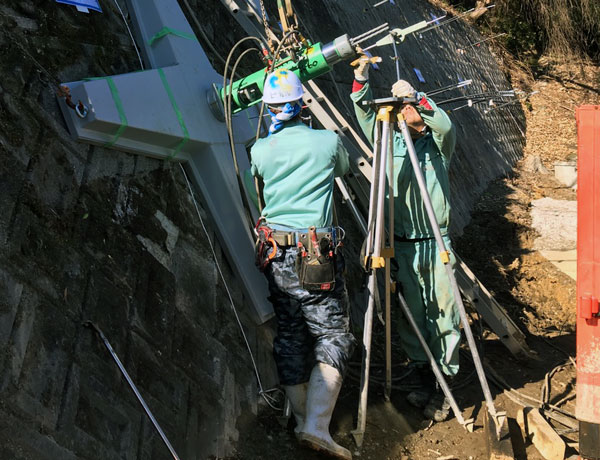
Set it slightly loosely overall, so that it will serve as an anchor that comes into its own when the time comes.
From a purely theoretical standpoint, if the safety factor for an anchor is set at 1.2, the authorities may not approve a value that falls below 1.2.
How that point is explained will depend on the terms of the agreement.
In my experience, there are plenty of situations where things are clearly too restrictive.
In some cases, over-tightening in a landslide-prone area has caused deformation in the anchor next to it.
If abnormalities occur and the muscle becomes overly tense, it may be necessary to relieve the tension and then re-tension it.
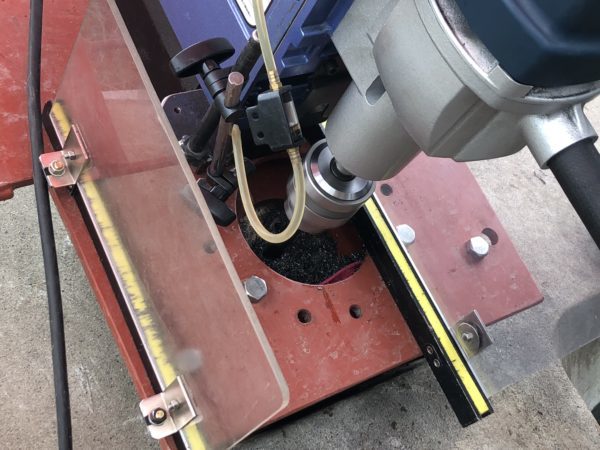
It's a difficult call, but please just keep in mind that you don't have to be 100% on edge all the time.
There are also standby ground anchors that can prove invaluable in an emergency, provided they remain undamaged.
Actually, it’s totally fine to just ignore set loss, lol.
It's good to take set loss into account, but please keep in mind that for the time being, the system is operating on the over-tension side relative to the design specifications.
I actually find myself wondering, “Do set losses really exist?”—and I’m actually one of those people, too~
The more I learn, the less I understand.
Civil engineering is really interesting, isn't it!!?
See you later.