Hello, everyone.
This is Enta.
I was in Akita until just the other day, and since there wasn't much pollen yet, it was incredibly comfortable and absolutely wonderful.
And now that I'm back in Aichi, it's pure hell!
It's a pollen nightmare!!

But that's beside the point.
I had completely forgotten that this series on calculating material requirements even existed, lol.
Up until last time, it was cement.
This time, it's sand.
Calculating Legal Framework Materials (Part 1) The Last Wire Mesh Episode
Calculating Legal Framework Materials (Part 2) Legal Framework: Vertical Beam Reinforcement
Calculating Legal Framework Materials (Part 3) Reinforcing Bars for Cross Beams
Calculating Legal Framework Materials (Part 4) Legal Framework: A Comprehensive Overview
Calculating Materials for Legal Frames (Part 5): Anchors
Calculating Materials for Legal Frameworks (Part 6): Cement
What we know so far is
A 1:4 mortar mix is used in just about every country, prefecture, city, and town.
Cement: Sand The mix ratio is
420 kg: 1,680 kg
Volume (in m³) of the legal framework in the calculation example
230.1 m × 0.3 m × 0.3 m = 20.7 m³
(Frame Length × Frame Width × Frame Height = Mortar Volume)
It's actually surprisingly easy when it comes to sand, but,
Since it's 1,680 kg per cubic meter,
20.7 m³ × 1,680 kg = 34,776 kg = 34.776 metric tons
will be.
In reality, if you factor in a reduction of about 20%, there shouldn't be a problem.
That's because we can't bring in the sand all at once.
At most, there are about four (large dump trucks).
You don't need to worry about it—just get a general idea and make the final adjustments later.
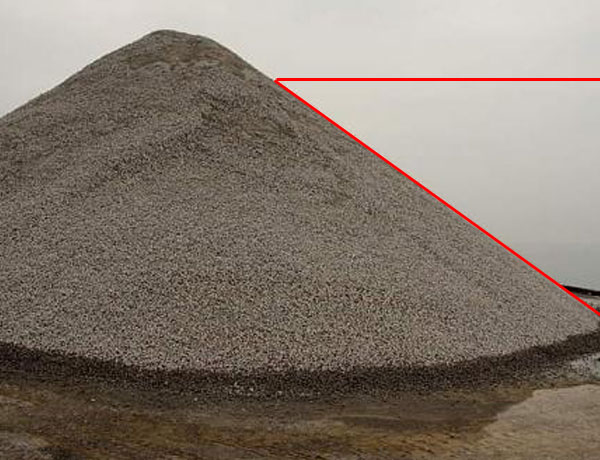
As an aside,
The angle of this slope on the sand dune isAngle of reposeis what they say.
The force that resists slippage and displacement is called frictional resistance, and
The Angle That Determines Whether It Will Collapse or NotをAngle of Internal Frictionis what they say.
Also,The force that binds soil particles togetherをAdhesive Strengthis what they say.
So this is what people often refer to as the mechanical properties of soil, isn't it?
Although it varies depending on the type of soil particles, if you saturate it with water in this state, it reaches saturation and crumbles.
Our job is to ensure that slope structures, such as retaining walls, maintain a safety factor of 1.2 even when the slope is subjected to external stresses or becomes saturated with water.
See you later.