



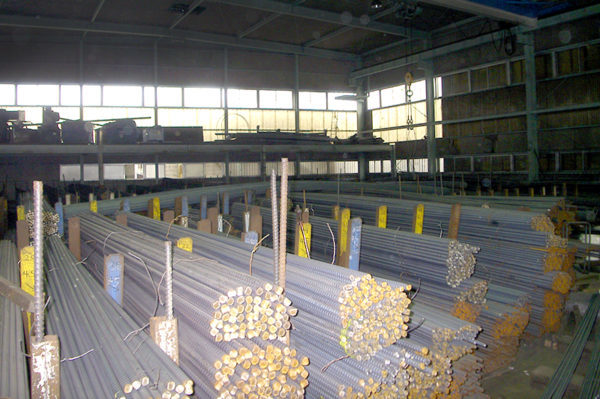
"The Ideal of a Construction Supervisor" vs. "The Reality of a Rebar Fabrication Shop" Regarding Reinforcing Steel
An issue has arisen regarding the rebar.
All too often, there is a gap between the “ideal” and “reality” at construction sites.
Which of these two perspectives—the “ideal construction supervisor” or the “reality of a rebar fabrication shop”—do you think the people on-site would relate to more?
Discovered in the presence of the construction supervisor
One day, when a manufacturer delivered materials to a rebar contractor’s fabrication shop, the construction supervisor came by to observe the delivery. This supervisor always came to observe every rebar delivery, but on this particular day, things were a little different.
After a moment, the construction supervisor looked puzzled and blurted out, “You’re not using the rebar that was delivered for this project!”
Indeed, when comparing the photos, it appears that the small-diameter rebar delivered to the processing plant during my last site visit is still there in its original condition. Since rebar has presumably been delivered to the site several times since that last delivery date, it stands to reason that the rebar should not still be present at the processing plant in the same packaging as the previous delivery.
Given this situation, it would be understandable if the construction supervisor concluded that “the rebar from the previous batch was not used—meaning that rebar delivered for another project was used instead.”
In fact, that is exactly the case.
The Reality of a Regional Rebar Fabrication Plant
The processing yards of local rebar suppliers aren't that big.
Perhaps companies that take on projects in major cities have large stockyards where they can keep materials neatly separated for each construction project.
However, the reality is that local rebar suppliers are already stretched thin just sorting the rebar by diameter and length.
If materials for another job site are delivered from the manufacturer and simply plopped on top of them, we have no choice but to use the materials on top first. That’s precisely why, before negotiating which rebar manufacturer to use, we check with the rebar fabrication and assembly contractor to confirm their “preferred manufacturer.” This is the reality for rebar contractors in rural areas.
The Construction Supervisor's Preferred Reinforcing Steel Materials
Of course, when it comes to relatively thick rebar used for main reinforcement and the like, material quantities are calculated by computer, and if the rebar is not used “exactly as calculated,” there is a very high likelihood of a surplus or shortage. For this reason, even at rebar fabrication plants where materials are occasionally mixed up, the likelihood that “the materials delivered to each job site are used correctly” increases.
However, when it comes to small-diameter rebar used for slabs and walls, the lengths actually used often vary depending on the foremen’s judgment on-site, so the reality is that things rarely go exactly as the construction supervisor intends. This inevitably leads to a situation where materials are used from the top of the stack down.
In severe cases, I’ve even heard someone from another job site—who had taken materials without permission—lament, “This is the only length left in large quantities, so I have no choice but to make the joint right here…”
To be honest, I can’t help but think that, given the size of the yard, it’s practically impossible to separate them by job site, and since any material we use should pass inspection on the mill sheet anyway, could you just cut me some slack?
However, from the perspective of someone supervising the construction, “We must use the materials listed on the rebar mill sheet!”
What are your thoughts on this gap between the “ideal vision of a construction supervisor” and the “reality at a regional rebar fabrication plant”?
P.S.
The comments on this article are pretty funny. It's interesting to see the different ways architects and civil engineers think, lol.


I look forward to your daily updates. The approach to rebar mill sheets differs between architecture and civil engineering, doesn’t it? For large-scale construction projects, where massive quantities of rebar are ordered, the mill sheets need to match reasonably well. For smaller-scale projects, however, stock items are often used, so they don’t always match. I was also asked about mill sheets during an inspection of steel pipe pile work for a civil engineering project. They were asking about discrepancies between the date on the mill sheet and the shipment date, and so on. I replied, “Come on, there’s no way they’re inspecting every single bar, right?” (half-smiling). “They’re probably inspecting them in batches of tens or hundreds per rod, so since the shipment date falls between the steel pipe inspection date and the rebar inspection date, shouldn’t that be fine?” The civil engineering inspector was satisfied with that explanation. If we were to nitpick every single pile, rebar, bolt, and nut, I think we’d eventually have to perform factory inspections on absolutely everything. The way of thinking in building construction and civil engineering is subtly different, isn’t it?