Hello, everyone.
This is Enta.
Now that the rainy season has begun, it’s that time of year when the schedule on-site keeps changing due to the rain.
At times like this, I spend more time at the office poring over blueprints.
And the humidity just makes me more and more irritable...
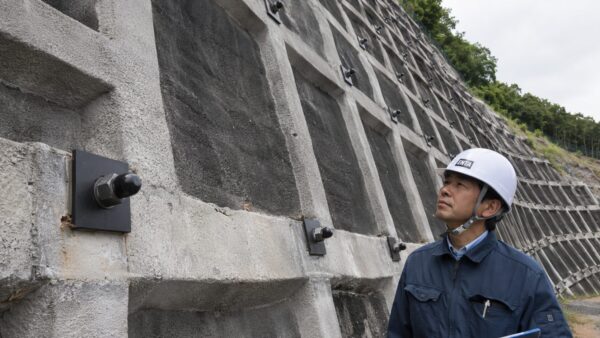
In this post, we’ll tackle a topic that’s surprisingly hard to answer when asked: “What’s the difference between rock bolts and rebar insertion work?”
Since this seems to be a common search topic, I’ll explain it thoroughly—based on my on-the-ground experience and a proper reference manual—rather than just giving a vague overview lol.
Are rock bolts and rebar installation "different things"? To cut to the chase, they're pretty much the same thing lol.
To get straight to the point, in the world of slope engineering,Rock bolting and rebar insertion are essentially the same construction methodsThat's it.
A lot of people search for it thinking it’s something different, but to be honest, what we’re actually using on site is the same thing. (This is common knowledge among industry insiders, right?)
According to a document from the General Incorporated Association for Slope Disaster Prevention Technology, rebar insertion work is also referred to in the literature by names such as “rock bolting,” “cut slope reinforcement,” and “natural ground reinforcement.”
In other words, there are simply four or five different names for what is essentially the same type of construction method.
Even on our drawings, even though the title says “Reinforcement Bar Installation,” I usually just tell the workers, “This is a rock bolt, you know,” lol.
On the job, nicknames are practically nonexistent.
Why the Names Differ | It's Simply a Matter of Which Standards Are Followed
"So why are there so many different names for it?" you might ask, but this isBecause the applicable standards are differentIt seems like that.
According to the Slope Association, it appears that they are generally handling the situation as follows.
・Rock bolt installation → Japan Road Association, “Handbook on Rockfall Countermeasures”
・Cut Slope Reinforcement → NEXCO “Design and Construction Guidelines for Cut Slope Reinforcement Methods”
・Natural Ground Reinforcement → Japan Road Association, “Guidelines for Road Earthworks: Cut Works and Slope Stabilization”; Japanese Geotechnical Society, “Manual for the Design and Construction of Natural Ground Reinforcement”
・Reinforcing bar inserter → A general term that encompasses the above
NEXCO (formerly the Japan Highway Public Corporation) has taken the lead in developing domestic standards, which are cited in many standard documents.
That’s why, when it comes to soil-based slope reinforcement systems, NEXCO’s guidelines inevitably tend to serve as a benchmark.
And since NEXCO actually has such a massive amount of historical data, I don't think it's an exaggeration to say that NEXCO is essentially the go-to source.
To be honest, from the perspective of those on the job site, it doesn’t really matter which term is used—it’s all the same to us. The management is the same, the materials are the same, and the construction methods are practically identical! That’s how it feels, anyway.
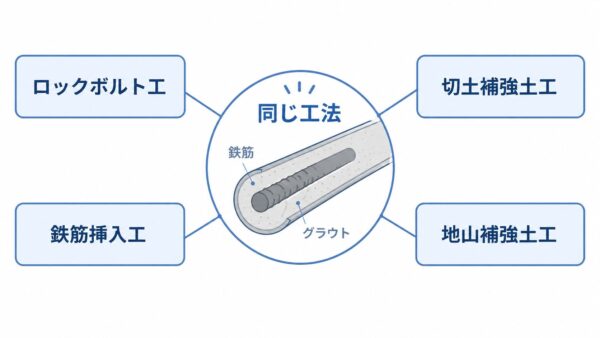
Structure, Materials, and Construction Are Largely the Same | A Construction Method That Secures Special-Shaped Steel Bars Along Their Entire Length
Even if the names are different, the structure is essentially the same.
According to several sources, a rebar anchor (i.e., rock bolt) consists of reinforcement, grout, a head, and slope stabilization work.
Specifically, it looks something like this.
・Reinforcement: Deformed steel bars (steel bars for reinforced concrete).
In an explanation of a certain slope design, SD345 and D19–D29 from JIS G 3112 are used.
・Length of reinforcement: Typically around 2 to 5 meters, often set in 50-centimeter increments.
・Injection material: cement slurry or mortar.
・Head: Secured to the slope reinforcement using a plate (support plate) and a nut.
According to Toyama Prefecture's manual, the standard size is larger than 150 mm × 150 mm × 6 mm, and the material must be galvanized.
・Fixation method: “Full-length fixation,” in which the entire length of the reinforcement material is set with a cement-based hardener.
This is where rock bolts (rebar insertion method) differ significantly from ground anchors, asSince it is a full-surface bonding, the bonded layer does not necessarily have to be hard rock....that's the gist of it.
This is a topic that often comes up during design reviews, isn’t it? (Moving soil masses and stationary soil masses)
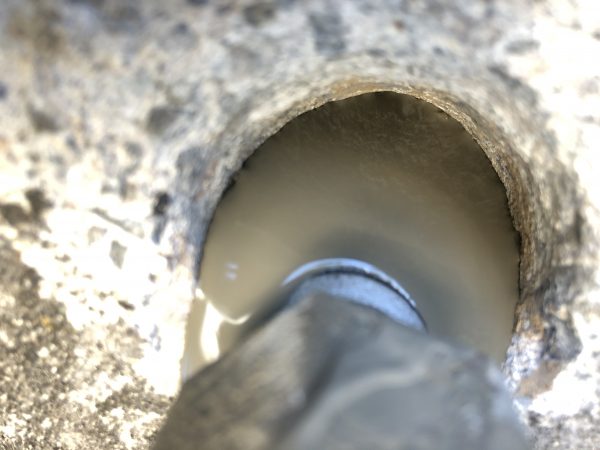
However, to be honest, when the ground conditions are poor and the borehole walls cannot stand on their own, grouting is often insufficient even when rebar is installed.
In fractured zones, cement slurry often doesn’t rise, so it’s frequently impossible to fill the hole without using a bag packer. (This is an area that relies on rule of thumb.)
That’s the thing about mountains—you can’t see what’s inside, so they never turn out exactly as planned, lol.
What really needs to be distinguished is the difference from a “ground anchor” (the presence or absence of tensile force).
Instead of worrying about the differences between rock bolts and rebar installation,The Difference Between Rock Bolts (Reinforcing Bar Insertion) and Ground AnchorsIt's much easier to understand if you know that.
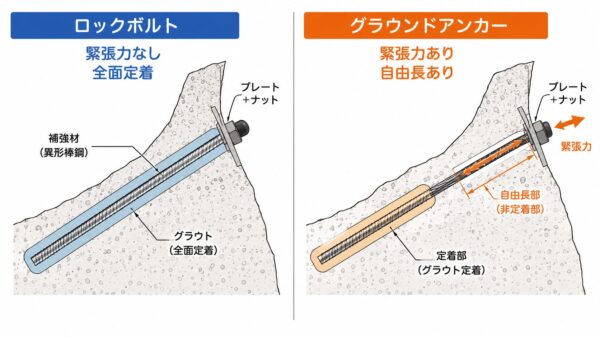
The biggest difference between the two is,Whether or not to apply prestressThat's it.
・Ground anchors: These apply a large tensile force to the inserted steel members (such as prestressed steel strands) to exert a compressive force on the natural ground. They are structures with a free length.
・Rock bolt/rebar installation: Do not apply tensile force. As the ground deforms, the reinforcement passively provides resistance. Full-length anchorage.
The Japanese Geotechnical Society also states that, due to their lack of prestressing, ground anchors—even if they appear structurally similar—operate on different principles and mechanisms of stability.
The guidelines for the scope of application are also different.
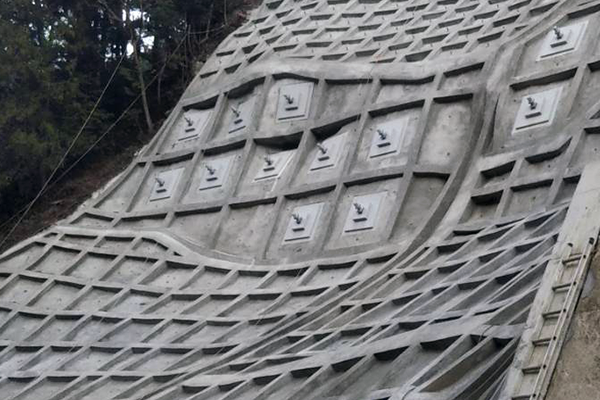
According to the Slope Association’s materials, a general guideline states that the required retaining force for reinforced concrete insertion work should be 300 kN/m or less; however, if the scale of the landslide is large, the retaining force may be insufficient or the method may become uneconomical, so it is necessary to consider alternative measures, such as ground anchors.
So, to put it simply,For minor or shallow collapses, use rock bolts (rebar insertion); for large-scale collapses requiring strong reinforcement, use anchors....which results in this division of roles.
A common point made by various companies was that, because anchors must maintain tensile strength over the long term, they require high-grade materials, corrosion protection, and strict construction management, which in turn leads to higher construction costs.
For large slopes, we conduct a cost-benefit analysis to determine whether it’s better to install 10 rock bolts or two ground anchors as retaining measures.
Terms Used on Site
Finally, here’s a mindset to help you avoid getting lost on the job.
First of all, the term “rock bolt” originated in the field of mine stabilization and became widely adopted through the NATM method used in tunnel construction; it is a term closely associated with rock mass engineering.
On the other hand, the term “rebar insertion work” has a strong connotation of being a method traditionally used to reinforce cut slopes.
So, there may be a subtle difference in nuance: in the context of bedrock or tunnels, it’s often called a “rock bolt,” whereas for cut slopes consisting of soil or soft rock, it’s more commonly referred to as “rebar insertion work.”
However, to reiterate,The materials being poured at the slope construction site are essentially the same.That's it.
Insert the irregularly shaped steel bar into the drilled hole and secure its entire length with grout. The process remains the same.
So, the way I see it, the name doesn't really matter lol
As long as the message gets across, that's all that matters.
At the end of the day, as long as the people on the job know what they're supposed to do, things just run smoothly lol.
If I had to point out one thing, it would be that with NATM (Natom), the material injected isn’t cement slurry, so please be careful!
See you later.
Let's Talk About Slope Stabilization Measures During Construction! (Part 1)