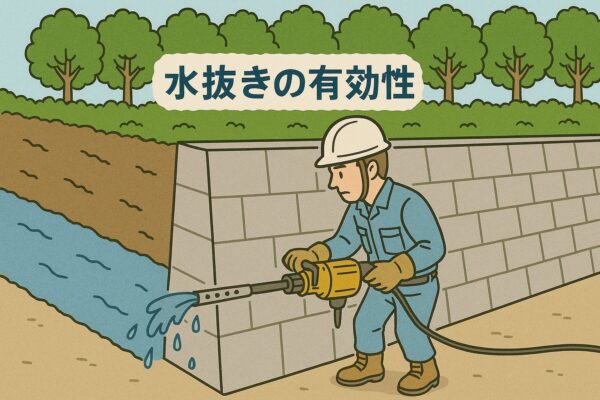
Hello, everyone.
This is Enta.
At a water collection and drainage boring site, you are bound to encounter one of these four situations.
① Co-rising of Perforated Pipes
② Jamming
③ The support pipes cannot be inserted due to a landslide.
④ The Slime Isn't Coming Back。
It's one of those moments on set where you're like, "Oh, so that's what it is this time, lol."
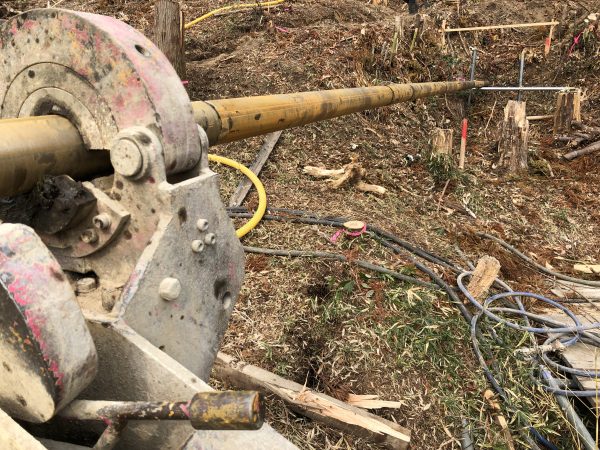
In this article, we’ll discuss the challenges that inevitably arise during the construction of drainage boreholes.The Four Major Problems and How to Address ThemI will outline countermeasures based on NEXCO guidelines and JIS standards, while also incorporating practical insights from the field.
What Is a Drainage Boring Worker? | Essential Basics to Know
The dewatering boring method (horizontal boring method) is a technique for draining groundwater by inserting a strainer-equipped casing into a borehole drilled at a slight upward angle from the horizontal.That's it.
It is also sometimes referred to as a groundwater drainage system.
The purpose is to reduce pore water pressure acting on the sliding surface and to lower the moisture content of the landslide mass (NEXCO Structural Construction Management Guidelines / Road Earthworks: Guidelines for Slope Stabilization Works).
Standard Specifications (Based on NEXCO Guidelines)
| Item | Standard Specifications |
|---|---|
| Drill Hole Diameter | φ90–135 mm(Standard φ90) |
| Drilling Length | 80 meters or less |
| Drilling Angle | Horizontal Within ±10 degrees(Slightly upward angle recommended) |
| Anchor Pipe | VP Pipe(JIS K6741, PVC pipe) Standard VP75 |
| Anchor Pipe | SGP Pipe(Gas line) Change: Landslide-prone areas only |
| Strainer Perforated Pipe | Outer diameter 48.6 mm (nominal diameter 40) or 60.5 mm (nominal diameter 50) |
*Source: NEXCO Structural Construction Management Guidelines; National Institute for Land and Infrastructure Management, “Slope Stabilization Works”
Problem 1 | Perforated Pipe Rising Together
In areas with high water flow,When the outer casing is retrieved, the perforated pipe (hole-holding pipe) is pushed back along with it by water pressure.This happens frequently. In dewatering drilling, it’s practically a “common problem.”
Preventing Slippage | Drive the top 1 m into the ground to secure it through friction
The approach I’ve been using on-site for many years involves the following steps (This is not explicitly stated in the NEXCO guidelines, but rather constitutes practical on-site know-how,)
- Outer Casingto reach the designed drilling depth
- Inner Casingand drill a single hole Add about 1 meterdo
- Remove the inner casing, andInsert a VP tube (perforated tube)
- VP Pipe'sInsert the tip into the single-drilled hole
- Friction makes it harder to come loose, preventing them from rising together
Since the perforated pipe extends about 1 meter deeper than specified in the design, if this concerns you,Order a larger quantity from the startIt's one option to do that.
However, as long as a hole-retaining pipe is in place on the inlet side, there are no structural issues (regarding insertion length); still, it is preferable for the hole-retaining pipe and the perforated pipe to be positioned roughly at the same level.
Reasons Why VP Pipes Crack | How to Choose Between VP and SGP Pipes
Since VP pipes (JIS K6741) are PVC pipes,If you press too hard, it will break.。
Since SGP pipes (gas pipes) are made of metal, they can be pushed in to a certain extent, but the cost goes way up.
According to the NEXCO guidelines, “Areas with Active LandslidesIt is stipulated that “SGP pipes shall be used when there is a risk of damage to the casing due to shearing or twisting after insertion,” and
VP pipes are the standard choice for conventional drainage work.
Instead of forcing it in carelessly, let it escape by adding the single hole mentioned above.Or, there's also the strategy of increasing friction, as shown below.
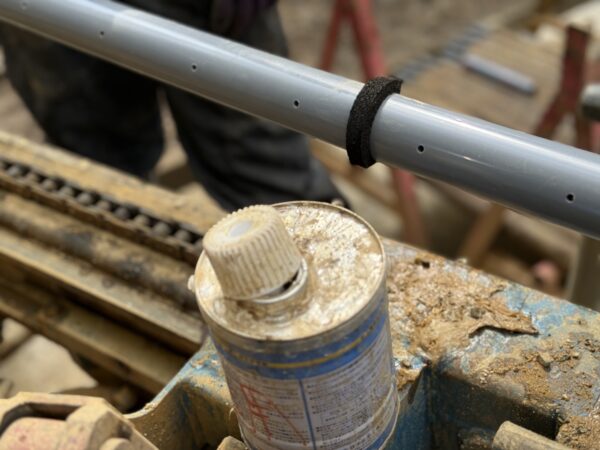
As I mentioned in a previous blog post, this is a soft, foam-rubber-like material called Eptsealer that’s used for slip resistance and waterproofing.
Wrapping it creates friction!
However, if you wind it too tightly, it will increase friction during insertion, making it difficult!
Don't overdo it. lol
Tips for Preventing Collapse During De-watering Boring Operations
Problem #2 | Jamming (Coring Rod Jam)
Definition of Jamming
"Jamming" refers to "a condition in which the casing rod of a drilling rig becomes stuck inside a borehole and is unable to rotate." The causes include:
- Collapse or extrusion of the borehole wall
- Hole Warping
- Poor Water Supply
- Slime Residue
include the following (“Dictionary of Civil Engineering and Construction Terms for Use on Site”). In short,A situation in which the drilling rod becomes stuck undergroundThat's it.
Countermeasures | Switch to Mud Drilling
The most effective method is Switching to Mud Drilling:
- Bentonite in Drilling FluidAddition (to stabilize the pore walls)
- orHigh-molecular-weight polymer-based materials, such as Super Coatto mix in
In my experience,About half the usual amount is enough.。
This isPractical know-how from the field, not manufacturer-recommended valuesTherefore, when using it for the first time, start with the standard amount specified in the manufacturer's manual and adjust it on-site.
Mud drilling isImprovements to Slime's ReturnHowever, since it can be difficult for those without installation experience or inexperienced workers to handle,
Switch over when an experienced person is presentThat might be safer.
Cleaning the Borehole Walls After Drilling Is Complete
After drilling with muddy water,After drilling is complete, remove the inner casing → flush the borehole wall by pumping water while rotating the outer casingI will.
If you skip this step, the slurry will clog the strainer section.Theoretical Risk...just in case (though I've hardly ever actually experienced a blockage).
The Option to Upgrade Your Machine to the Next Level
Another measure isUpgrade to a higher-end drilling machineThat.
This is certainly true, but in most cases, it’s not possible to change the machinery due to on-site constraints, soRealistically, mud drilling is the first choice.will be.
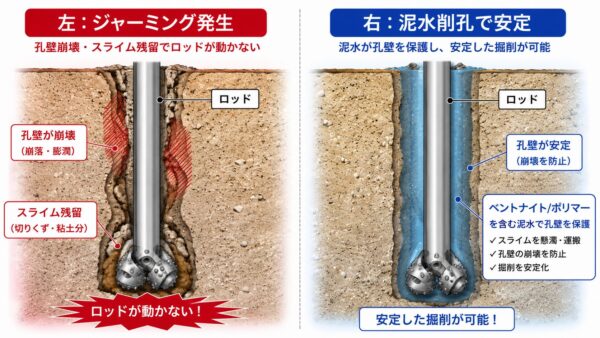
*Do not use a tricon bit for dewatering.
Problem #3 | Support pipes cannot be inserted due to a landslide
In soft natural ground, the borehole wall begins to collapse the moment drilling begins, andThe retaining pipe won't go inThat happens sometimes.
To be honest, this isThere is no fundamental solutionThat's right. What we can do is,
- Use a machine to gently push it straight in
- The most important thing is to keep pushing straight ahead.
- If the shaft wobbles, it gets jammed all at once.
This is something I still struggle with from time to time, but,If you push it at an angle in a hurry, it'll get even more stuck.So, just be careful and go straight—that's all there is to it, lol.
Problem #4 | The Slime Won't Come Back
It also frequently happens that slime (drilling cuttings) does not return from the hole.
This, too,If you switch to muddy water drilling, the slime will rise more easily due to buoyancy.Therefore, it is valid.
However,If the slime doesn't come back, it doesn't mean there was a construction defect.Please make sure to keep these points in mind.
In dewatering drilling operations, since the borehole diameter is 90 or larger and a large volume of water is flowing through it,It's easier for the crew if there's no slime cleanup.You can think of it that way.
(The criteria for making construction decisions differ from those for standard rock bolt installation or rebar insertion work.(So please be careful.)
4. Quick Reference Guide for Troubleshooting
| Problems | First-Choice Countermeasures | Additional Information |
|---|---|---|
| ① Rising Together | Add 1 m of single-hole drilling + VP pipe insertion | You can also order it 1 meter longer than the design specifications—use Eptsealer. |
| ② Jamming | Mud Drilling (Bentonite and Polymer) | Upgrading your equipment to the next level is also effective |
| ③ Landslide | Keep pushing straight ahead with the machine | No Fundamental Solution—Don't Panic |
| ④ Slime: No Return | Increased Buoyancy Through Mud-Water Drilling | To begin with, it's no problem even if you don't come back. |
As a construction company, the hardest part is when jamming causes a blockage—it’s really frustrating when the casing won’t come out!
"That's 50,000 per bottle! So 10 bottles is 500,000. It's a world where a bit costs 40,000..."
See you later.
[Related Articles]
- Drainage Boring Worker (Horizontal Boring)
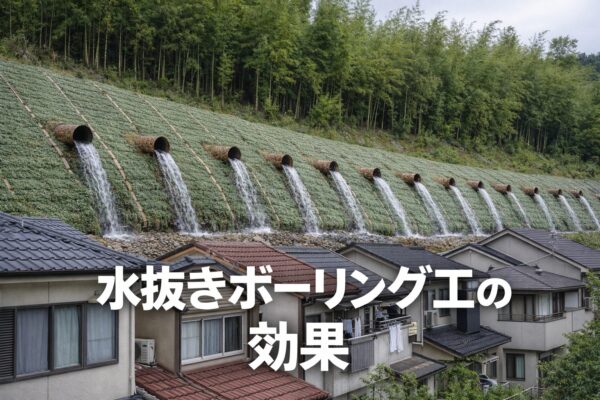
- The Effectiveness of Drainage Boring (Private Construction Projects)
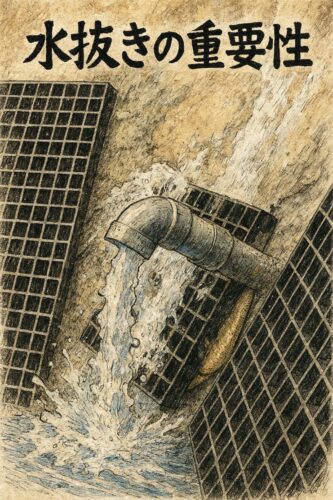
- The Effectiveness of Water Drainage in Surface Collapse
[References and Sources]
- NEXCO “Guidelines for Structural Construction Management” (Section on Drainage Boring)
- National Institute for Land and Infrastructure Management, “Guidelines for Slope Stabilization Works in Road Earthworks”
- JIS K 6741 "Rigid Polyvinyl Chloride Pipe (VP Pipe)"
- Japan Drainage Industry Association (General Incorporated Association) / Technical Data on Well-Maintenance Tubes for Water Collection Boring
- "Dictionary of Civil Engineering and Construction Terms for Use on Site" (Definition of "Jamming")
- National Federation of Geological Survey Associations, “Manual on the Finishing of Observation Wells for Groundwater Surveys (Draft)”