Hello, everyone.
This is Enta.
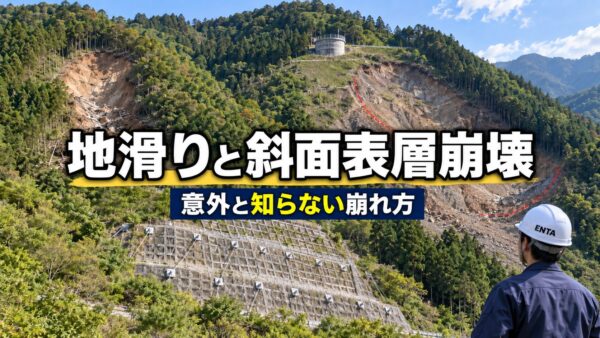
The slope collapses during construction.
Every slope engineer has had that moment of panic or disappointment at least once, right?
This time, I thought I'd write about the causes and solutions lol
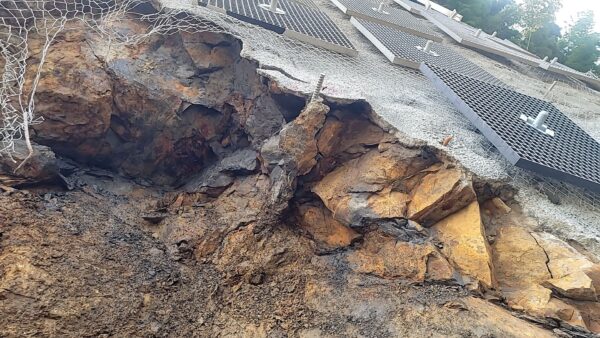
There are basically only three types of slope sites.
Roughly speaking, there are three types of slope construction sites, aren't there?
1. Slopes that have already collapsed
2. Slopes at risk of collapse (sites where abnormal conditions have been observed and the design assumes a collapse will occur in the near future)
3. Slopes newly created by open-cut excavation for the construction of structures such as bridges and tunnels
Generally speaking, that's all there is to it.
As for point 1, since it has already collapsed, it’s rare for it to collapse any further from that point.
Since it’s already fallen out, there’s nothing left to crumble, right?
So this time, I'll focus on points 2 and 3 lol
Construction Is the Most Dangerous—Here's Why
Steps 2 and 3 are the most unstable until construction is complete, aren't they?
The reason is simple: it's just "bare ground," lol.
Don't you feel a little uneasy when you take your clothes off? Though there might be some people who feel the opposite, lol.
The same is true for slopes: immediately after the topsoil has been cut away or the slope has been cleared and graded, it is completely bare, with no vegetation or structures.
It's weak.
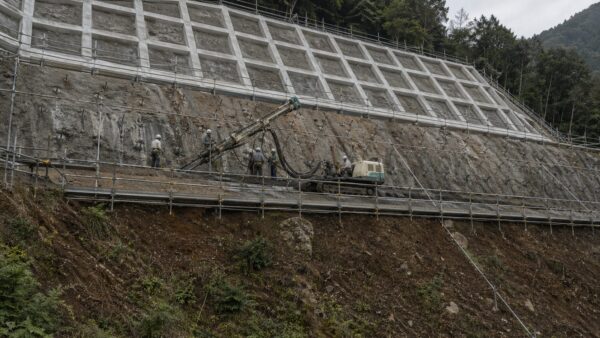
This tendency is particularly strong at sites where reverse-winding is used.
Why do it in the opposite direction?
Since cutting more than that at a time would make it unstable, we cut it little by little starting from the top and work our way down, securing each section as we go.
That's all there is to it.
To put it another way, the fact that they’re using a reverse-wrap design means that, at the design stage, they determined that “this mountain would collapse if cut all at once.”
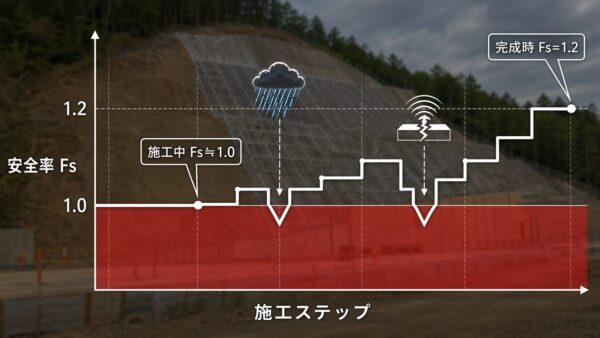
A safety factor of 1.2 applies only "upon completion."
In Japan, the general approach to the design of cut slopes is to ensure a design safety factor of at least Fs = 1.20 under normal conditions and at least Fs = 1.00 during earthquakes.
(Japan Road Association, “Guidelines for Road Earthworks—Cut Works and Slope Stabilization,” “Outline of Road Earthworks,” etc.)
But this is, after all,Finished stateThat's the figure that's secured.
That means it’s natural to assume that during construction, the value hasn’t yet reached 1.2—it gradually approaches 1.2 starting from around 1.0.
So, at that intermediate stage,
What if there's a heavy rain?
What if an earthquake strikes?
If Fs drops below 1.0 all at once, that would mean a collapse, right? (Opinions on this may vary somewhat among engineers.)
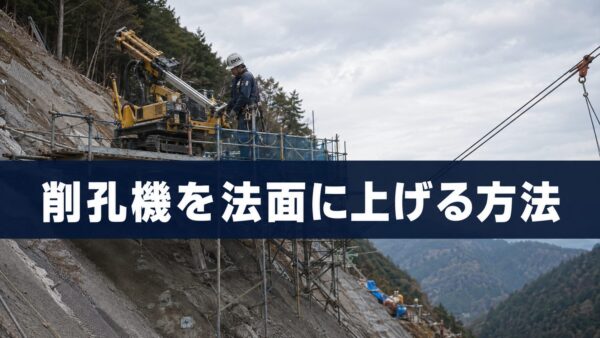
For rebar insertion and ground anchor work, the restraint force specified in the design is only achieved when the required number of elements is in place.
In other words, by the time the first shot is fired, only a small fraction of the overall intensity has been built up.
Even in the case of on-site sprayed retaining walls, the retaining wall structure alone serves merely as a load-bearing element to support the natural ground; it is only when combined with rebar insertion or anchors that it functions as intended in the design.
Even though this may look like it’s completed in an instant on the blueprints, on-site it takes days or even weeks to come together step by step.
This means that if heavy rain or an earthquake were to strike while the structure is still “in the process of being erected,” the likelihood of it being completely destroyed would increase.
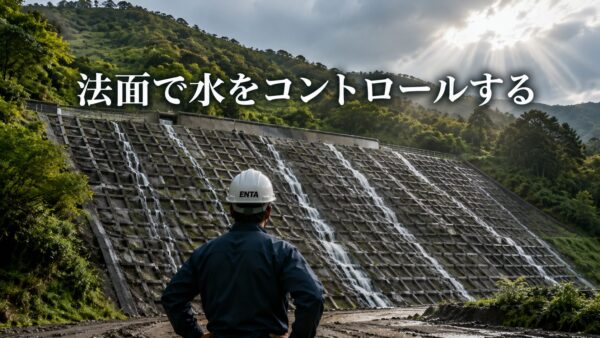
The cause of the collapse is almost entirely “water”
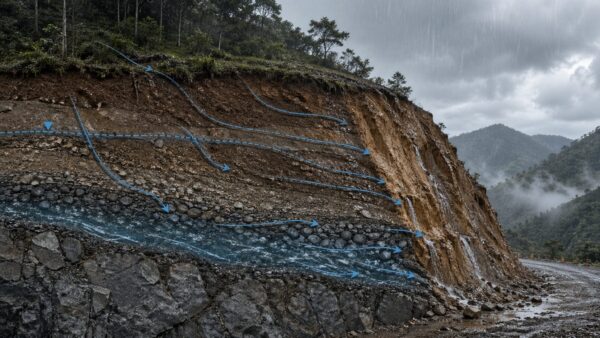
Personally, I think a collapse during construction isIt's almost entirely due to waterI think it's okay to say that.
I understand there are various factors involved, but the trigger for the collapse was water.
Because of the rain we've been having lately, when I went to the job site this morning, the formwork that was being sprayed on slipped right out.
Spring water is coming out of the hole where the rebar was inserted.
After it rains, this kind of thing happens all the time, doesn't it? lol
You do realize that water doesn't seep evenly throughout the entire mountain, right?
It is believed that Mizumichi will head toward the weakest point, the point where pressure is most likely to escape, or the point where the pressure has been released.
In other words, a slope that has just been neatly cut is more likely to become a path for water to flow through. (Water seeps out, doesn't it?)
I think it makes sense if you consider that the area, which had previously been confined by the overburden, is suddenly exposed, allowing it to serve as an outlet for the water pressure from the underlying rock.
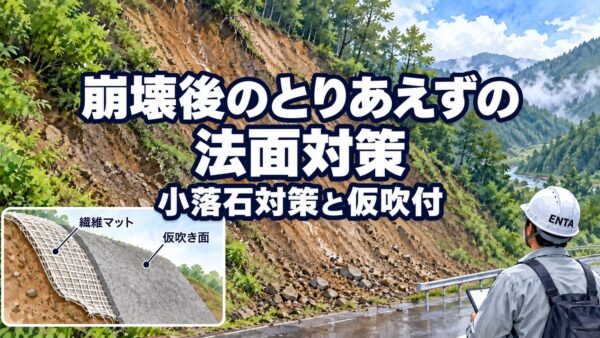
Covering the seat is only a temporary fix.
If heavy rain is forecast, cover the area with a tarp. This is the absolute basics.
However, when it comes to protecting the seats,It is not a fundamental solutionRight?
This is because, while the sheet can prevent rain from hitting the slope’s surface directly, it cannot stop water that has already seeped into the mountainside or water flowing around from higher up the slope.
Moreover, as I mentioned earlier, water tends to concentrate in the weakest spots.
It’s a sad truth that even when you think you’ve covered everything, it always ends up causing trouble right where you just cut it, lol.
It does happen that even when you put a sheet over it, it’s falling apart on the inside, doesn’t it?
The sheet is meant to "protect against today's rain," not to "stabilize the natural ground." (Though it's better than doing nothing.)
However, since we have no choice but to do it (various superficial measures are necessary), here are some tips for putting the sheet on:
Secure it firmly with sandbags!
Lean against the formboards, scaffolding materials, and so on!
Just this alone creates a deterrent effect there, lol.
See you later.