Hello, everyone.
This is Enta.
It's getting hot again this year, isn't it?
It feels like the muggy weather is setting in early...
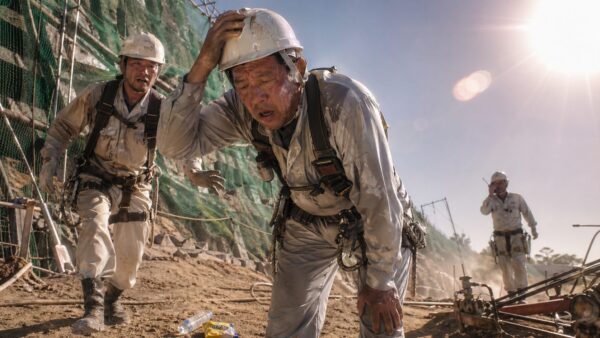
Since most slope construction sites are located at the top of steep slopes with nowhere to escape to, it’s really tough during the summer.
We always remind our kids to drink water in the morning around this time of year, too, but every year I can’t help but worry, “Is this really enough?” lol
But that's beside the point.
This time, we’ll be discussing “heatstroke prevention measures,” which are directly linked to the safety of workers on-site.
Personally, I just really want to say something about heatstroke!! lol
Seriously, I want to keep telling the craftsmen this until they’re sick of hearing it!! Please listen to me again this time, lol.
You know how the rules for heatstroke prevention have changed drastically over the past year or two, right!?
What used to be a “best-efforts obligation” has now become a “mandatory obligation” subject to penalties. (I’ve said this so many times already, lol.)
If we go into the summer without knowing this, not only will the people on the front lines collapse, but the company will also face legal trouble.
We'll compare the latest laws and regulations with Ebidance.

Heatstroke Prevention Measures Became “Mandatory” Starting in June 2025 | You Can’t Just Say You Didn’t Know
First, let’s start with the basic premise. According to a document from the Ministry of Health, Labor and Welfare, the revised Occupational Safety and Health Regulations, which were amended on June 1, 2025, have come into effect, making heatstroke prevention measures in the workplace mandatory and subject to penalties.
The newly added provision is Article 612-2 of the Occupational Safety and Health Regulations, titled “Work That May Cause Heat Stroke.”
Working conditions subject to mandatory requirements.
・Environments where the heat index (WBGT) is 28 degrees or higher, or where the air temperature is 31 degrees or higher ・Work expected to be performed in such environments for at least one continuous hour or for more than four hours in a single day
Almost all outdoor summer work on slopes and earthworks falls under this category.
In other words, we can’t just say, “It doesn’t concern us”—this applies to nearly all work sites.
Penalties have also been established: those who violate these obligations may face “imprisonment for up to six months or a fine of up to 500,000 yen,” and corporations may also be subject to a fine of up to 500,000 yen.
What's more, there are even cases where companies receive work stoppage orders from the Labor Standards Inspection Office!?
Furthermore, if it is determined that you have failed to fulfill the “duty of care for safety” under Article 5 of the Labor Contract Act, you may be held liable for civil damages...
Most recently, on March 26, 2026, the Ministry of Health, Labor and Welfare published new “Guidelines for the Prevention of Heat Stroke in the Workplace.”
The Reiwa 8 “STOP! Heat Stroke: Cool Work Campaign” is currently underway from May 1 to September 30, 2026 (with July designated as the key focus period).
Reality in Numbers | The Construction Industry Is a Recurring Leader in Heat Stroke Incidents
Some people might think, “Making it mandatory is a bit of an overreaction,” but when you look at the numbers, it’s no laughing matter.
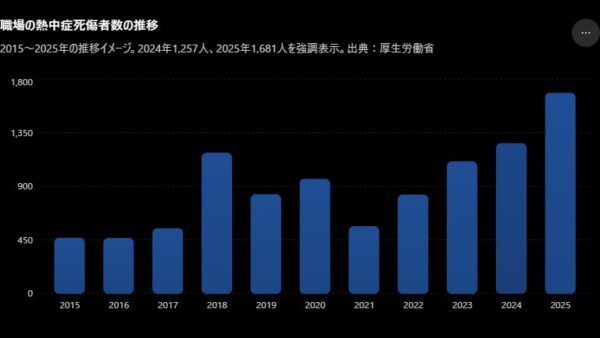
According to the Ministry of Health, Labor and Welfare’s “Reiwa 6 (2024) Status of Heat Stroke-Related Fatalities and Injuries in the Workplace (Final Figures),” it stated that the number of workplace heatstroke-related casualties (deaths plus absences of 4 days or more) in 2024 was 1,257, marking the highest figure since records began in 2005.
Of those, 31 died.
By industry, there were 228 people in construction and 235 in manufacturing; these two sectors alone reportedly accounted for about 40 percent of the total.
The construction industry, in particular, had the highest number of fatalities—10 out of 31—making it the worst-ranked sector!!
In 2025 (Reiwa 7), the numbers have gone up even more. (Last year’s heat was seriously out of this world!!!!)
According to preliminary figures from the Ministry of Health, Labor and Welfare, the number of fatalities and injuries in 2025 reached a record high of 1,681, with 278 of those occurring in the construction industry.
Although the number of fatalities fell to 15—down from the previous year—the construction industry reportedly accounted for the highest number of those deaths.
Among these, the following trend in particular made me think, “I need to be careful about this on the job, too.”
・About 80 percent are concentrated in the two months of July and August
・Most visits occur in the morning or around 3:00 p.m.
・More than half of the disaster victims are in their 50s or older
・Among the fatal cases in 2024, there were as many as 24 cases where it was not even possible to confirm the heat index (WBGT).
And something that’s often overlooked is “Post-Processing Mold"."
According to data from the Ministry of Health, Labor and Welfare, there are quite a few cases in which people who were fine during the day suddenly experienced a deterioration in their health and died after returning home or finishing work.
This is really scary.
The most dangerous thing is thinking, “I made it through today.”
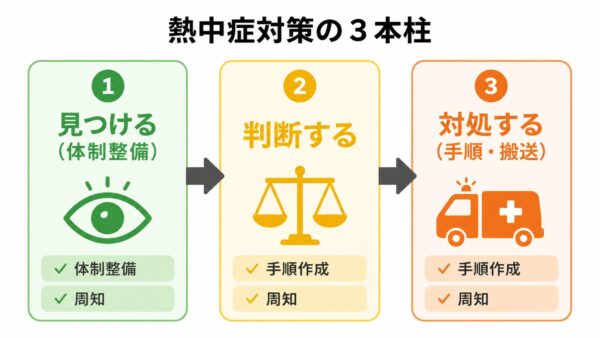
The three pillars of this duty are “identify, assess, and respond.”
So, what exactly do we need to do to fulfill our obligations?
As a basic principle, the Ministry of Health, Labor and Welfare"Identify → Assess → Respond"This outlines the process, and it appears that businesses are required to comply with the following three main pillars.
1. “System Development”
Establish an internal system to identify workers at risk of heatstroke at an early stage and report such cases immediately, and ensure that all relevant personnel are made aware of this system.
2. “Creating Procedures”
Determine in advance the emergency contact network, the hospital to which the injured person will be transported, and the relevant contact information, and establish procedures to prevent the condition from worsening—such as removing the person from the work site, cooling their body, and transporting them to a medical facility.
3. “Informing Relevant Parties”
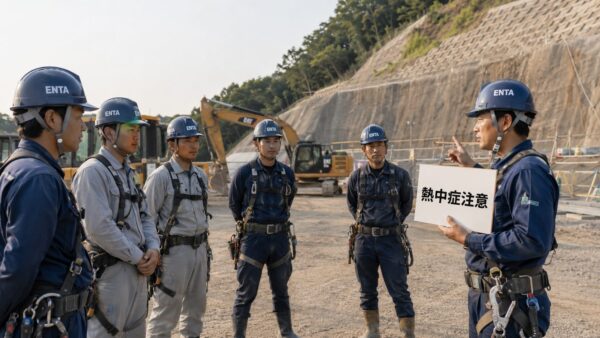
Employers are required to clearly communicate the established systems and procedures to all relevant personnel and to provide occupational health and safety training on the symptoms of heatstroke, prevention methods, and emergency response procedures.
One thing that is particularly important on slope and civil engineering sites is how to handle mixed operations.
At construction sites where multiple contractors work side by side in the same workspace, it appears that both the prime contractor and the subcontractors are required to take appropriate measures.
As a method of ensuring awareness, each business should jointly designate a single emergency contact number and post it in a location where workers can easily see it.
In short, it’s a good idea to clearly define who does what in case something happens.
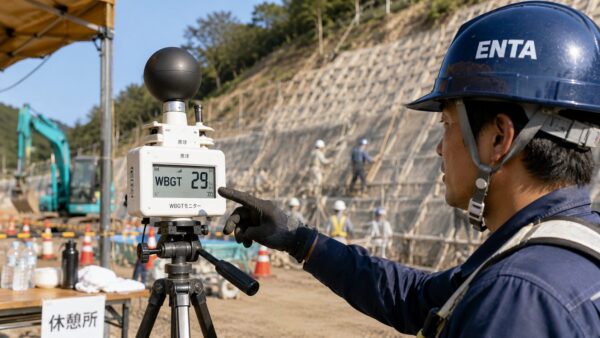
It All Starts with “Measuring” WBGT | Effective Preventive Measures on the Job Site
Various documents all agree that the first step in prevention is, above all, to “quantify the heat.” (Well, that’s typical of government agencies...)
It says that it’s not enough to just look at the temperature; you need to measure the heat index (WBGT), which takes into account humidity, solar radiation, radiant heat, and wind.
As mentioned earlier, since the WBGT wasn’t even recorded in many of the 2024 fatalities, it might be important to understand the situation through these figures.
Although, I feel like this is a little different from the numbers for the slope... (the discussion about reflected heat I wrote about earlier)
Specifically, the basic approach seems to be to install a WBGT meter (heat index meter) at the worksite and adjust the intensity of countermeasures based on the readings.
With that in mind, I’ll list the preventive measures mentioned in the new guidelines from March 2026 and the “Cool Work” campaign materials, focusing on those that seem likely to be effective in the workplace.
・Heat acclimatization (getting your body used to the heat): This is especially dangerous when working in the heat for the first time in a while, or when temperatures suddenly rise during seasonal transitions. Be especially careful with new employees and after summer break.
・Pre-cooling: This seems to be the concept of lowering your core body temperature in advance, either before starting work or during breaks. (Time for a cold bath!)
・Cooling the body through clothing: In addition to wearing moisture-wicking and breathable clothing, it is recommended to use clothing and helmets equipped with features that cool the body through airflow or water spray (so-called “fan-equipped” items). While this alone is not enough to prevent heatstroke—and should be combined with other measures—you should not rely on it exclusively.
・Facility Measures: Consider installing simple roofs or awnings to lower the heat index, providing rest areas equipped with air conditioning, and installing water sprinkler systems.
・Regular hydration and salt intake: Keep drinking water and salt candies on hand, and have them consume them regularly. (About once every 10 minutes—which means half the day is spent taking breaks, lol.)
・Frequent check-ins: Supervisors go around to ensure that employees are staying hydrated and that there are no health issues.
・Reducing or suspending work: When the WBGT is high, take more breaks and make the decision to stop work if it becomes dangerous. (I’m definitely going to measure the WBGT on the slope this year! lol)
Air-conditioned clothing—a given these days—comes as standard equipment.
When doing drilling work with machinery, though, you do need to be careful that your clothes don’t get caught in it.
The more convenient a tool is, the more likely it is to cause another accident if you don't teach people how to use it properly...
Once you start worrying, the safest thing to do is just not do anything, lol.
If Someone Collapses: Assessing the Severity and Providing First Aid
No matter how much we try to prevent it, we can't eliminate it entirely.
The first steps you take when someone collapses can mean the difference between life and death.
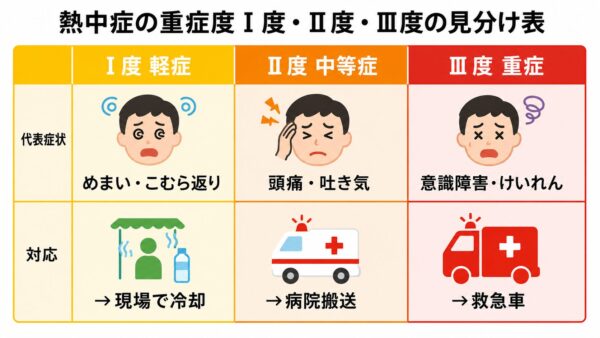
The “Heat Stroke Environmental Health Manual 2022” and materials from the Ministry of Health, Labor and Welfare state that heat stroke is classified into three severity levels: Level I through Level III.
・Grade I (Mild): The patient is fully conscious. Symptoms include dizziness, lightheadedness upon standing, numbness in the hands and feet, muscle cramps (pain), and profuse sweating. → In many cases, the situation can be handled with first aid at the scene.
・Grade II (moderate): A pounding headache, nausea and vomiting, body weakness (fatigue), and a “vague sense that something is off” with consciousness. → Moderate cases requiring transport to a hospital。
・Grade III (Severe): Unconscious; abnormal response to verbal stimuli; seizures; inability to walk or run in a straight line; body feels hot. → Immediate transport to the emergency room, hospitalization, and intensive care are required.
The first thing to check at the scene is, above all, “whether the person is fully conscious.”
If there's even the slightest sign of altered consciousness, call 911 without hesitation.。
The Basic Steps for First Aid.
First, move the person to a cool place and loosen their clothing.
Then, cool your body down (focusing on areas with large blood vessels, such as the neck, armpits, and groin).
If the person is alert and able to drink on their own, give them fluids and electrolytes.
However, if the patient is unable to drink fluids or take salt on their own, or if you suspect a second-degree burn or higher, do not hesitate to transport them to the hospital.
The worst thing you can do here is to keep waiting and seeing, thinking, “It’ll probably get better if I just rest a little.”
As mentioned earlier, the Ministry of Health, Labor and Welfare has pointed out that many of the fatalities were caused by patients ignoring early symptoms or delays in transportation to a hospital.
Even if the person says, “I’m fine,” it’s up to the people around them to decide.
As a site supervisor, the key points to keep in mind are:
If you're worried, even if it's just a mild case, head straight to the hospital!!
Heatstroke is a condition that can be prevented with the right precautions, and even if someone collapses, they can be saved if immediate action is taken.
At slope construction sites, workers are often on steep slopes with no place to escape, and it’s often veteran workers in their 50s and older who are putting their lives on the line.
We absolutely cannot afford to lose those people this summer.
Now that we have both the tools and the laws in place, the only question is whether each person on the ground can set aside their reluctance and take action.
We’re not quite there yet, but we’ll keep at it this year. And we’ll be using our tools more and more!
Ultimately, it’s the awareness of the people on the ground that protects their colleagues.
See you later.
New Facts About Heat Stroke | The Latest Prevention Information