

Hello, everyone.
This is Enta.
Lately, I've been writing nothing but about heatstroke prevention.
Every day, the more I write, the more I realize that the strategies I’ve believed in all this time were just “making me feel like they were working,” lol.
But that's beside the point.
Now that we know that work clothes with fans aren’t a fundamental solution to heatstroke (they’re merely a supplementary measure), what is the solution, then?
So I looked around there a bit.
When you think about it, there are actually quite a few.
In this post, I'll be covering drinks and physical cooling methods!
People say it's long, but it took me quite a while to write it, so please read it lol
I've been working on this article for three days now (a few hours a day, lol).
It's actually a lot of work to gather evidence, too~ lol
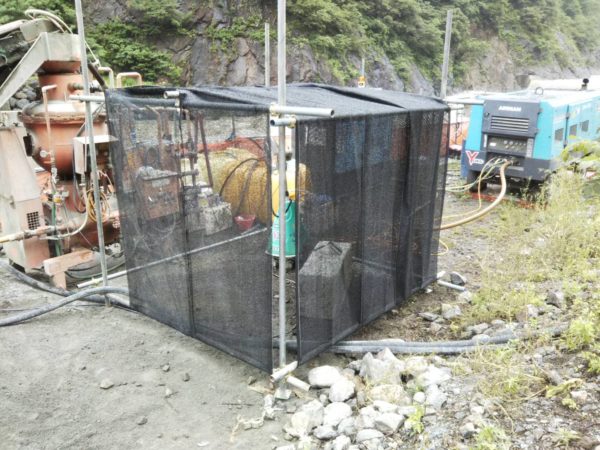
Work clothes with fans lower the skin temperature; the important temperature is core body temperature.
Workwear with fans is designed to make you feel "cool" by utilizing the heat of vaporization that occurs when sweat evaporates.
When the wind hits you and blows away your sweat, heat is drawn away from the surface of your skin in that instant.
That's why it feels cool.
This definitely works.
However, it is only the outer layer that is cold.
The temperature at the center of the body—what’s known as core body temperature—remains the same. (There’s plenty of information on this topic in my previous blog post and other research papers.)
Depending on the ambient temperature and the intensity of the work, your body temperature can keep rising even while you feel cool.
This is the worst of them all.
Even though she’s thinking, “It’s cool today,” as she works, her body is actually boiling inside. (It’s the “boiled frog” effect.)
For reference, according to data published by the National Institute of Occupational Safety and Health,
Although pre-cooling with a fan reduced core body temperature by 0.4°C at the start of work, it is reported that this method was less effective at lowering core body temperature compared to immersion in water.
So, there are limits to what you can achieve just by blowing air on it, right?
Furthermore, under the amended Occupational Safety and Health Regulations (Article 612-2), which took effect on June 1, 2025, when performing work that carries a risk of heatstroke,
Employers are now required to establish and publicize procedures in advance—such as “stopping work,” “cooling the body,” and “seeking medical examination or treatment as necessary”—as measures to prevent the condition from worsening.
The work in question is defined as work expected to be performed for at least one continuous hour or for more than four hours per day in an environment where the WBGT is 28 degrees or higher or the air temperature is 31 degrees or higher.
The text of the law also clearly states “cooling of the body.”
In other words, the government isn't just looking for ways to make people feel cooler—it actually wants to lower their body temperature.
By the way, at what point does a rise in core body temperature become dangerous?
According to the 2024 Heat Stroke Management Guidelines published by the Japanese Society of Emergency Medicine, the most severe category, Grade IV, appears to be defined as “a core body temperature of 40.0°C or higher and a GCS score of 8 or lower.”
GCS is a scale for assessing the level of consciousness, and a score of 8 or lower indicates that the patient is no longer responsive to verbal stimuli.
When you see the number 40°C, you might tend to think, “That hardly ever happens,” but for someone with a normal body temperature in the 36°C range, it only takes a rise of 3–4°C to reach 40°C.
On a slope under the blazing sun, wearing long-sleeved clothing that looks like protective gear, I climb the slope while carrying heavy equipment.
If you keep this up for two hours, your temperature will easily rise by about 3°C.
That's why it's not "cool it down after it rises," but "lower it before it rises all the way."
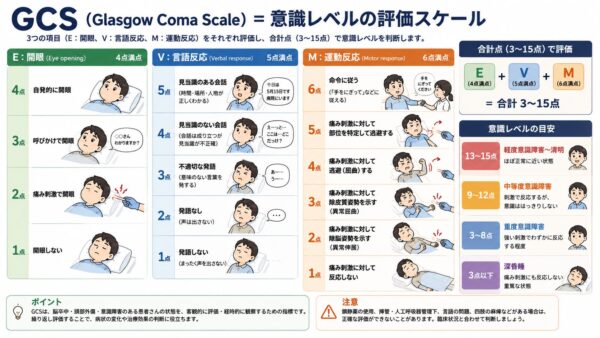
I think posting the chart of consciousness levels above in the workplace will come in handy when the time comes!
Drinks Edition | Ice slush works because it melts in your stomach
First up is the drinks edition.
Cold water or barley tea.
This works, too.
It's way better than not drinking at all.
However, what’s even more effective is a slushy-like drink—what’s commonly known as an “ice slushie.”
An "ice slurry" is a sorbet-like drink made from a mixture of finely crushed ice and liquid.
The key is how to keep it from dissolving in the stomach.
Since ice absorbs heat from its surroundings as it melts, the slower it melts in your stomach and intestines, the more heat it draws away from the inside of your body.
This seems to be important.
Well, I guess regular ice would work, but it’s actually pretty hard to get crushed ice on site, isn’t it?
Also, since chunks of ice don't go down easily, you can't eat a large amount all at once.
The reasoning seems to be that a more fluid slurry allows for a larger volume and provides a greater surface area in contact with the mucous membrane.
The figures cited in the research are actually quite conservative.
It’s not as if “drinking ice slurry will cause your core body temperature to drop sharply.”
According to a column published by the Japanese Society for Bio-meteorology, the maximum decrease in core body temperature resulting from the consumption of ice slurry was 0.36°C under hot conditions, 0.66°C under cool conditions, and 0.13°C under control conditions.
In other words, drinking it in a cool place makes it more effective.
When you drink in a hot place, the heat is transferred back to the outside air as you drink.
In practical terms, this means..."Make sure the break room is properly cooled before distributing the slurry."That's how it goes, lol
So, even if you spread the slurry at a materials yard under the blazing sun, it might only be half as effective, right?
In addition, according to findings released by a research group at the University of Tsukuba, consuming ice slurry before exercising in hot conditions results in,
It has been reported that, compared to the same beverage at room temperature, this beverage lowers core body temperature during exercise, reduces hyperventilation, and increases indicators of cerebral blood flow.
However, the report also noted that some participants experienced gastrointestinal symptoms such as abdominal pain and a sensation of diarrhea, and in those cases, no effect was observed.
Basically, it means don't chug it, lol.
Even on site, if we tell people, “It’s supposed to work, so just go for it all at once,” they end up with an upset stomach and actually drop out lol.
To be honest, the setup costs are crazy high.
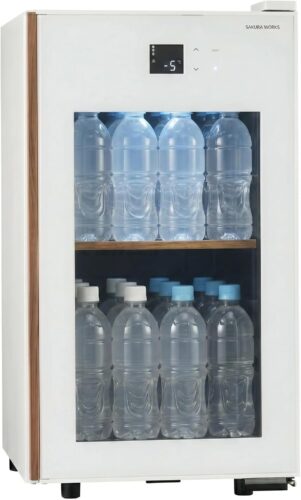
A special refrigerator is required to make the slurry.
At the construction site run by the general contractor we're working with, they've decided to implement this.
Actually, the lease payments are crazy expensive lol
Contracts must be for at least two months, starting at 100,000 yen per month.
Since the machine itself costs quite a bit, it seems like it would be better to rent one if you're only going to use it during the season.
To be honest, when I heard that amount, I thought, “Whoa.”
But when you consider the costs involved if someone were to collapse from heatstroke, be taken away by an ambulance, work at the site were halted, and the Labor Standards Inspection Office had to get involved—well, if this makes things even a little better, I guess it’s worth the price.
If a company is going to be making them all the time, that’s perfectly fine, and it does end up being cheaper when you consider the total cost.
Physics Edition | Cooling the AVA to Lower Core Body Temperature
Next, here is a method that involves physical cooling.
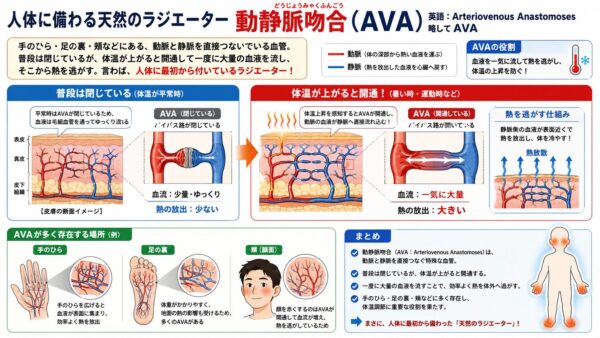
Have you ever heard of AVA?
Arteriovenous anastomosis, abbreviated as AVA.
Apparently, these are blood vessels found on the palms of the hands, the soles of the feet, and the cheeks that directly connect arteries and veins.
They're usually closed, but when body temperature rises, they open up to allow a large volume of blood to flow through at once, dissipating heat.
In a sense, it’s like a radiator that comes built into the human body.
The mechanism works by cooling the blood flowing through this AVA; as the cooled blood circulates throughout the body, it lowers the core body temperature.
This thermoregulatory mechanism is said to have been elucidated by a research group led by Professor Craig Heller at Stanford University.
Since I've covered AVA many times on this blog, for those of you who are familiar with it—this is also a bit of payback!
15 minutes in water at 12–15 degrees | It doesn't work if the water is ice-cold
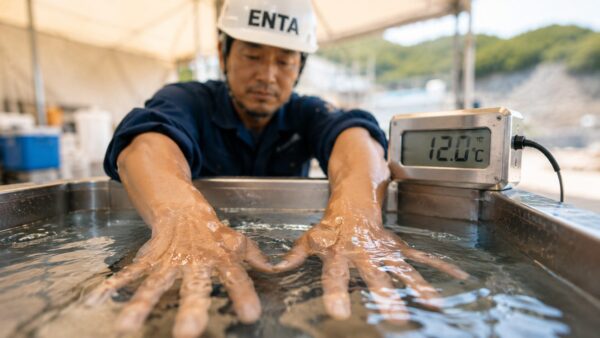
The method is simple.
Soak the palms of your hands and the soles of your feet in water at a temperature of 12–15 degrees for about 15 minutes.
That's all.
Based on several sources I’ve reviewed, it appears there are reports indicating that simply soaking in water at around 10–15°C for 5–10 minutes can lower core body temperature, and continuing for about 25–30 minutes can lower it by approximately 1°C.
The important thing to remember is that just because something is cold doesn't mean it's good.
If the water temperature drops below 9–10°C—what is commonly referred to as “freezing cold”—the blood vessels constrict and blood flow stops.
In other words, you end up blocking the radiator yourself after going to the trouble of opening it.
So, jumping into ice water actually does more harm than good.
Apparently, a lukewarm water bath—just cool enough to feel “refreshing”—is sufficient.
This is the exact opposite of what you'd expect on the job, isn't it?
We just can't help thinking, "The colder it is, the better it works," so we tend to pile in tons of ice, lol.
The great thing about it is that if there's a river at the site, you can cool off nicely! Mountain streams in the summer are especially nice and cool!
Surprising Facts About Heat Stroke | There Is No Body Temperature Threshold Defining "Mild Symptoms"
From here on, we'll be talking about simulations.
Before that, there was one thing that surprised me the most while I was doing my research.
There are actually no specific temperature thresholds defining “mild” or “moderate” cases.
Grades I through III of the Japanese Society of Emergency Medicine are all determined based on symptoms.
Dizziness and lightheadedness are classified as Grade I; headaches, nausea, and fatigue are classified as Grade II; and impaired consciousness and organ dysfunction are classified as Grade III.
Core body temperature is not included in the diagnostic criteria.
Body temperature is only listed in Level IV, which was newly established in 2024.
The definition of Grade IV is “core body temperature of 40.0°C or higher, and a GCS score of 8 or lower,” as stated above, and according to data from the Heatstroke STUDY, the in-hospital mortality rate for this grade is reported to be 23.5%.
This is actually a pretty important issue from a practical standpoint.
In other words, the conclusion that “since the thermometer read 36.8°C, I’m fine” is not medically sound.
Even if your body temperature is normal, if you have symptoms, it’s considered a second-degree burn.
So, the assumption we often make on the job—"I don't have a fever, so I'm probably fine"—was actually unfounded.
👇👇This is important!👇👇
Assess Based on Symptoms (Except for Grade IV) | That’s Why Reaching Out Is Effective
Put another way, this means that the only assessment we can make on-site is to “observe the symptoms.”
It's more about checking in with them than using a thermometer.
Their responses are strange, they're unsteady on their feet, their sweating has suddenly stopped, and the conversation doesn't make sense.
As soon as this appears, the person must be removed from the scene, regardless of their body temperature.
Ultimately, this is what the law means by “establishing a reporting system,” isn’t it?
The person experiencing symptoms and the people around them who notice them should decide in advance who to tell.
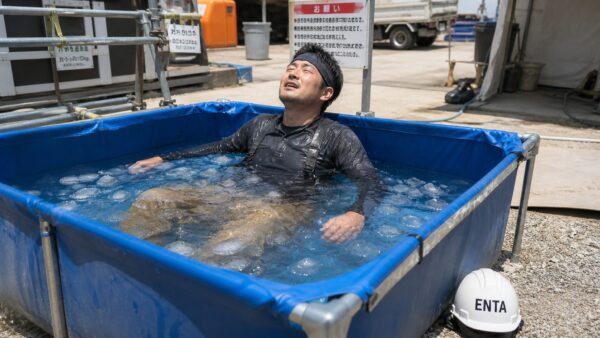
And if you definitely notice symptoms, call an ambulance right away and jump into an ice bath!
Limb Cooling Simulation | Useless in Severe Cases
I ran a simulation using AI.
After the AVA cooling mentioned earlier, how does core body temperature change after 15 minutes of cooling?
I calculated this based on the physiological guidelines (below 38°C = mild, 38–40°C = moderate, 40°C or higher = severe).
| Assumption | Start | 15 minutes later | Decrease | Ruling |
|---|---|---|---|---|
| Equivalent to Grade I | 38.0°C | 37.1°C | -0.90 | Return to near-normal body temperature |
| Equivalent to Grade II | 39.0°C | 38.1°C | -0.95 | Symptoms are subsiding, but you still need to see a doctor |
| Grade III–IV Range | 40.5°C | 39.9°C | -0.65 | I can't get out of the danger zone |
*This is an estimate based on publicly available research data. It is not an actual measurement taken from a real device.
It's probably already too late once the condition has become severe, so it's better to submerge your whole body in ice water.
Guidelines for heatstroke prevention recommend cooling the body at a rate of 0.15°C per minute or faster, but cooling the hands and feet can only achieve a rate of 0.043 to 0.063°C per minute.
That's about 30 percent of the recommended value.
Whole-body immersion in ice water—the standard treatment for severe cases—is classified as “cold water immersion,” with a cooling rate of 0.20 to 0.35°C per minute, bringing the body temperature down from 40.5°C to the target of 38.0°C in just 10 minutes!
Ice baths really are incredibly effective!
There's even a chance he'll recover before the ambulance arrives!!
Why does it stop working in severe cases?
The reason the rate of decline slows in the severe stage is that the body's ability to sweat breaks down, allowing heat to continue entering from the environment.
If your body temperature rises too high, the sweating mechanism itself shuts down.
When that happens, the body is unable to dissipate heat on its own.
Even if you cool only your hands and feet in that state, more heat will still enter your body.
It's like leaving the faucet running while trying to fill a bucket with water.
"Reset every time you take a break, so your temperature doesn't exceed 38°C in the first place."
Using the AVA cooling method, a temperature of 38.0°C—equivalent to Grade I—can be reduced to 37.1°C in 15 minutes.
I think these are quite impressive figures.
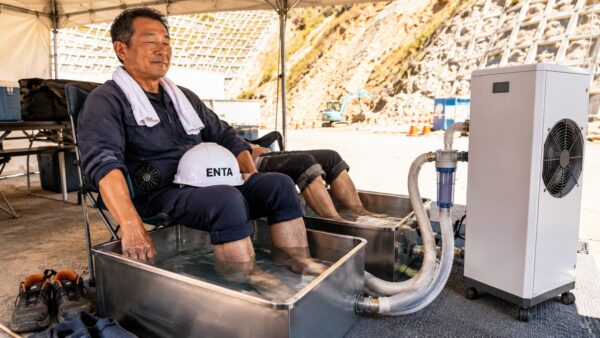
I was doing some calculations because I wanted to build a cooler like this, and then...
How much would it cost to install a cooling system at the site?
So, I did some research to see if I could build this AVA cooling system for use in a real-world setting.
Roughly speaking, it'll cost about 500,000 yen lol
The components include a box for the arms and legs, a chiller, a filter unit, and a power supply.
These are the four points.
Use a chiller to maintain the water temperature at 12–15 degrees, and filter the water while circulating it.
If there's a system on site that produces cold water, you can use it like a foot bath.
Every time I take a break, I stick my hands and feet in for 15 minutes.
You don't even have to take off your work clothes.
All you have to do is take off your safety shoes and socks.
I think this is quite practical for use at a field office.
However, when it comes to actually making it, there are a few things you'll need to consider.
First, let's talk about water management.
Since we're circulating water that comes into contact with many people's hands and feet, a filter is essential. (If there were a river, just circulating the water might be enough.)
If we don't make daily restocking and cleaning a rule, eventually no one will use it anymore, lol.
Next, the power supply.
Since we'll be running the chiller, the procedure will vary depending on whether we draw power from the on-site distribution panel or run the generator.
And where to put it.
If you leave it in the sun, the water temperature will rise so much that it’ll be unusable, so you’ll need a tent or some shade.
More than the 500,000 yen cost, it’s actually this “daily effort” that’s the real hurdle to adoption.
Everyone finds tasks outside of work a hassle.
Do you consider 500,000 yen to be expensive or cheap?
To be honest, just looking at the figure of 500,000 yen, I think, “That’s expensive.”
In construction terms, that's about the cost of erecting a section of scaffolding.
However, this device prevents only one or more people from leaving the site.
If even one person is taken to the hospital due to heatstroke, productivity for the day drops sharply—or, in the worst-case scenario, comes to a complete halt.
Accident report, briefing the general contractor, dealing with the Labor Standards Inspection Office, and arranging staff for the following day and beyond.
Once you calculate the losses incurred when operations are halted for a day, you’ll see that 500,000 yen takes on a whole new meaning, doesn’t it?
And above all, the fact that people get hurt is the greatest loss of all.
I don't think spending money on that is a waste.
After letting my core body temperature, which peaked in the morning, reset during my lunch break, I start the afternoon.
Whether or not we can do this should make a difference in the accident rate during the evening.
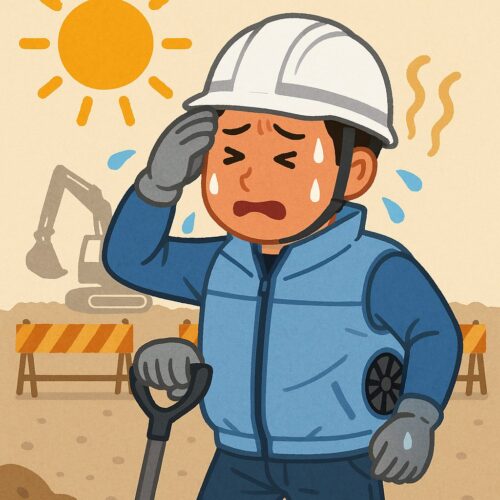
Ultimately, when it comes to heatstroke prevention, you have to clearly distinguish between “making yourself feel cool” and “actually cooling your body.”
We also need to distinguish between “tools for prevention” and “tools for treatment.”
People on the front lines tend to think, “This will do for now.”
We need work clothes with built-in fans, sunshade tents, and electric fans.
But those are measures designed to make it feel cooler.
If you want to address the root cause—core body temperature—try an ice slushie for drinks, or an AVA cooler for physical cooling (do those even exist??)
We just have to make sure to fit this in during our breaks.
We're also just feeling our way through this starting this year, so I'm sure we'll make all kinds of mistakes lol
It’s totally normal to get scolded for overcooling it, or to pay a lease fee only for nobody to use it, lol (Come on, use it!)
But you won't know anything unless you give it a try.
The folks on the ground will try it out and then post on the blog about whether it worked or not, along with some grumbling lol.
See you later.