Hello, everyone.
This is Enta.
The other day, a junior colleague asked me, “The article in the Zabuton section ends at a cliffhanger—what happens next?”
I got a phone call that was sort of like a complaint (lol)
Step-by-Step Guide to Making a Zabuton Frame
Step-by-Step Guide to the Zabuton Frame (A Failed Zabuton Frame)
It just kind of ends halfway through...
I had completely forgotten about it.
It would be hard to explain this article without drawing a picture, so I'll save that for next time (lol).
But that's beside the point.
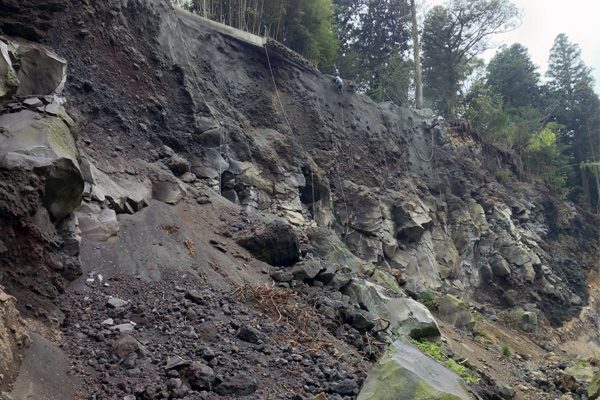
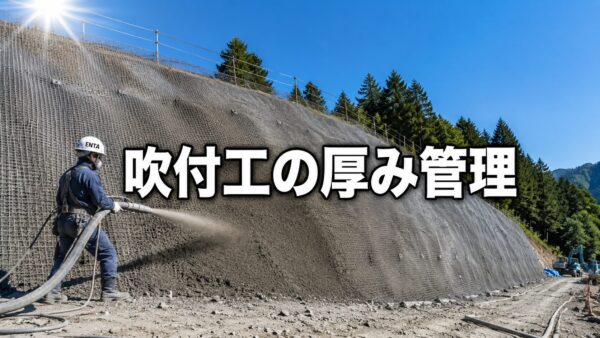
I've actually been to a volcanic rock spraying site like the one described above before.
In this case, the construction was carried out using a method that did not involve installing formwork.
Generally speaking, lath installation is the standard method, isn't it?
However, in some cases, instead of laying a final layer, sprayed mortar is applied.
What exactly do you mean by “depending on the situation”? (lol)
People often say that it's just too...When the mountain conditions are so bad that even the last one is in danger...it says.
That’s when you do a test spray (test spray without mesh), right?
When doing a test blow, blow lightly and roughly over the surface—just enough so it doesn't crumble.
Spray the material to a thickness that allows anchor pins to be installed later.
After that, we install the final layer and apply the main coat, but this is not at all practical for long, steep slopes.
In situations like that, doing the actual painting directly makes the process much more efficient.
That's because it's the same type of fiber that everyone uses all the time!
While that was partly to prevent cracking, it was also used in standard spray applications.
Recently, it has become particularly well-established as a crack-preventing material, but as far as I know, just under 20 years ago,
I believe these were used in place of formwork—without actually installing formwork—especially on long, sloping slopes in hazardous areas.
In addition, for areas where it is difficult to install formwork, we use sprayed mortar or sprayed concrete reinforced with fiber as a solution.
We were carrying out the construction work.
I believe each fiber manufacturer has its own specific formulation, but since it performs at the same level as lath, we use a fairly large amount of it.
This is quite a lot of fiber, and since the material is sticky, it’s a real headache for gunmen (lol).
Especially back in the day, the fiber quality wasn't great, so we had a hard time—it would clump into fiber balls or wouldn't mix well.
Recent models have been significantly improved, and since there are almost no lint balls, they're quite easy to blow into.
The reason it’s sticky (and hard to spray) is, after all, because the fibers absorb water.
Formulating the right blend is very difficult. Selecting a blend that’s easy to produce is especially challenging.
I'm not quite sure why this manufacturer recommends this formulation.
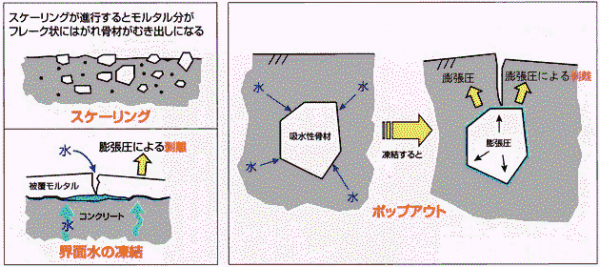
Even a small amount added to mortar sprayed in cold climates and similar environments can make a significant difference.
This is because, in cold climates, the freeze-thaw cycle causes cracks to form in the mortar, leading to delamination.
To withstand this natural phenomenon, it is indeed necessary to increase the ductility of the mortar and concrete themselves.
In addition, there is a risk of peeling and falling off, so fiber strands are effective in such cases.
We recommend using fiber for spray applications in extremely hazardous areas and for innovative solutions in cold climates.
Of course, you can also make design changes.
See you later.