What Is a Construction Performance Evaluation?
A construction performance evaluation is a system used in public works projects to assess the progress of construction and the quality of the finished product, among other factors, and to rate the project’s performance on a scale of 100 points.
I’ve written a detailed overview in a separate article, so please be sure to check it out (*’ω’*)
Related Articles:What Is the Performance Evaluation for Public Works Projects?
Here, we'll take a closer look at the scoring method.
Exam Items on the Grade Report
Let's start by explaining the report card!
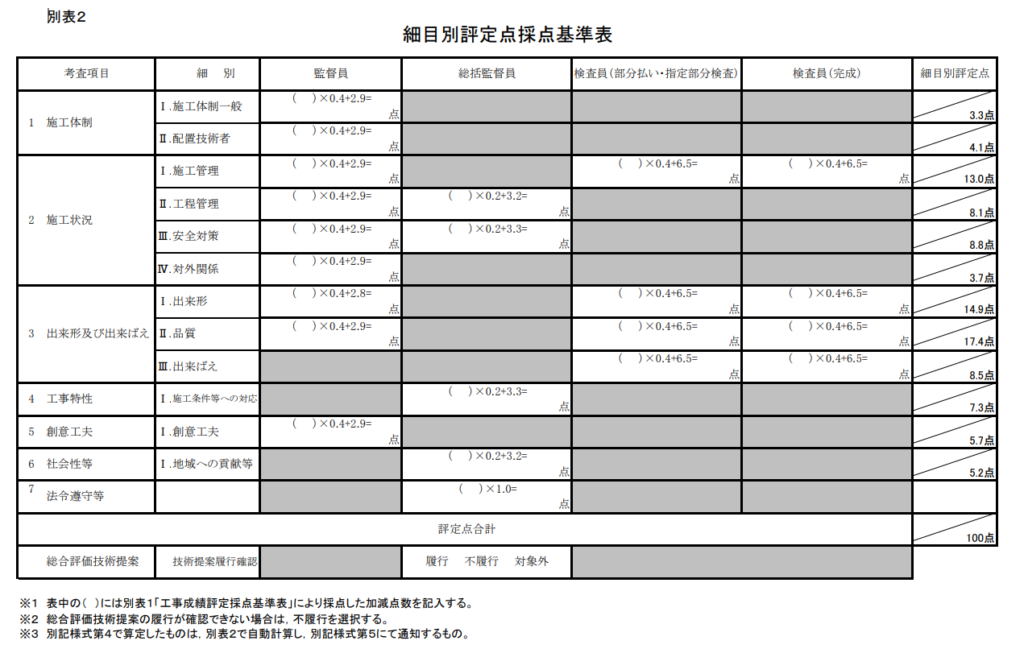
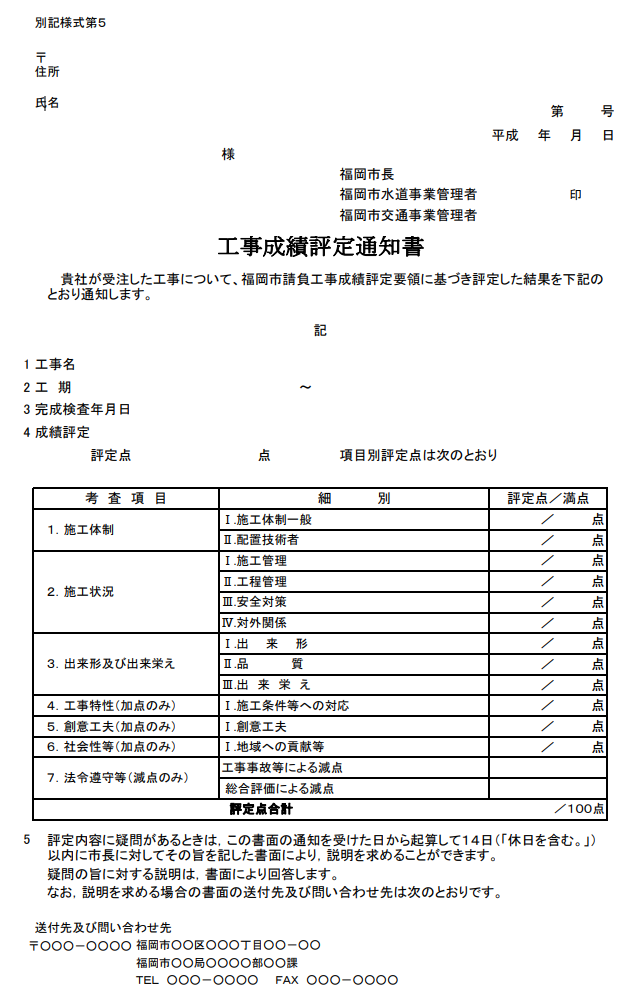
There are three types of performance reports—"① Construction Performance Evaluation Scoring Criteria," "② Itemized Performance Evaluation Scoring Criteria," and "③ Construction Performance Evaluation Form" (though there may be more)—but while they differ in how they’re presented, the scores are the same across all of them. I believe Form ③ is sent to the contractor as a "notification letter."
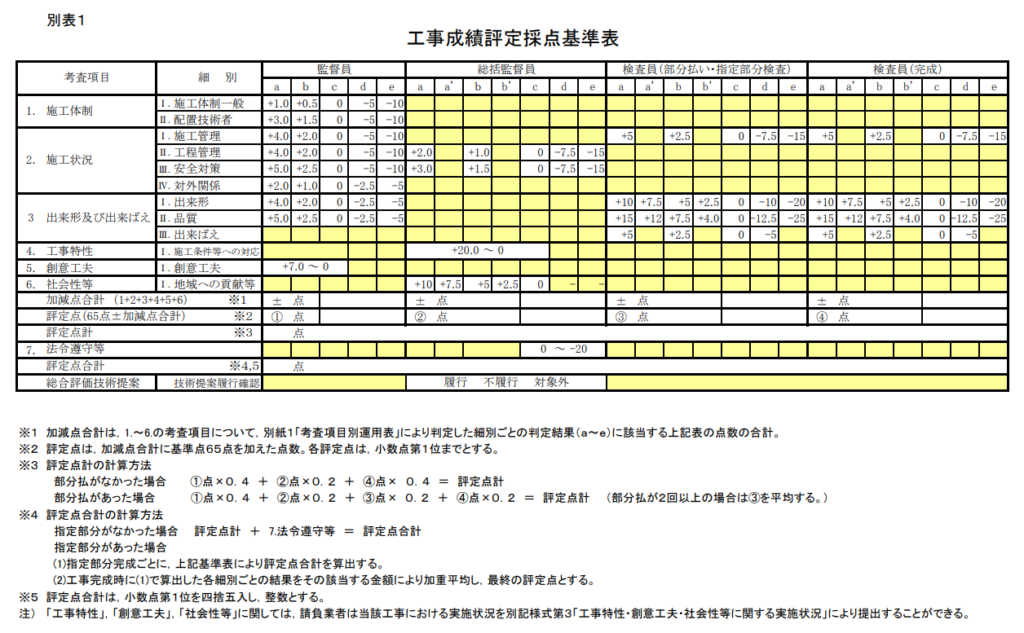
I'll start by explaining point ①.
The grading system is based on a baseline score of 65 points, with points added or deducted for each assessment item.That's right.
If you look at the categories in the left column, you'll see that scores are determined based on the following assessment criteria.
・General Construction Organization
・Field Engineer
・Construction Management
・Process Management
・Safety Measures
・Foreign Relations
・Finished Shape
・Quality
・Quality
・Adapting to construction conditions, etc.
・Creativity and ingenuity
・Contributions to the local community, etc.
・Compliance with Laws and Regulations, etc.
Each has a checklist titled “Evaluation Criteria,” and points are awarded if the items are implemented (as described later). Since all local governments adopt the national report card almost entirely as is, the system is likely the same across the board.
There are three evaluators.
There are three evaluators: the “Chief Supervisor,” the “General Supervisor,” and the “Inspector.”
Chief Inspector= Designated Staff Member (Supervisor)
Chief Supervisor= Section Chief or Unit Chief
Inspector= Staff members of the Construction Inspection Division (and other departments)
The way evaluators are addressed varies depending on the contracting agency, but I don't think you need to worry about it.
In addition, while some municipalities, such as Yokohama City, have separate positions for “Chief” and “Supervisor,” it appears that they are simply dividing the evaluation criteria for the “Chief” position between the two roles.
 Kamino
When a construction contract is signed, the client notifies the parties involved who has been designated as the chief supervisor and who as the general supervisor, right?
Grader's Scoring Criteria
Also, while this may not be widely known, each evaluator has a set number of points, as shown below.
Lead Inspector → 40 points
General Supervisor → 20 points
Inspector → 40 points
Total: 100 points
So, after the three of them each give a score out of 100, the chief supervisor’s score is multiplied by -0.4, right?
KaminoThis is pretty much the case nationwide.
Allocations may vary depending on the ordering agency (local government).
The scoring criteria differ by evaluator
If you look at the table, you'll see that the items each evaluator scores differ.
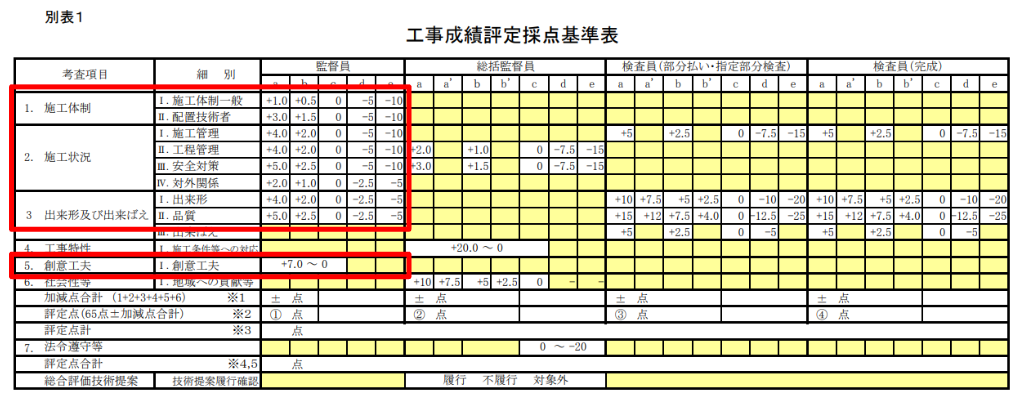
These are the evaluation criteria for the chief supervisor.
We’ll be grading the project as a whole, but the categories of “Overall Construction Organization,” “Assigned Engineers,” “External Relations,” and “Innovation and Creativity” will be graded solely by the Chief Supervisor. No matter how much you try to impress the inspectors, only the assigned staff member will evaluate these items ( ゚Д゚)
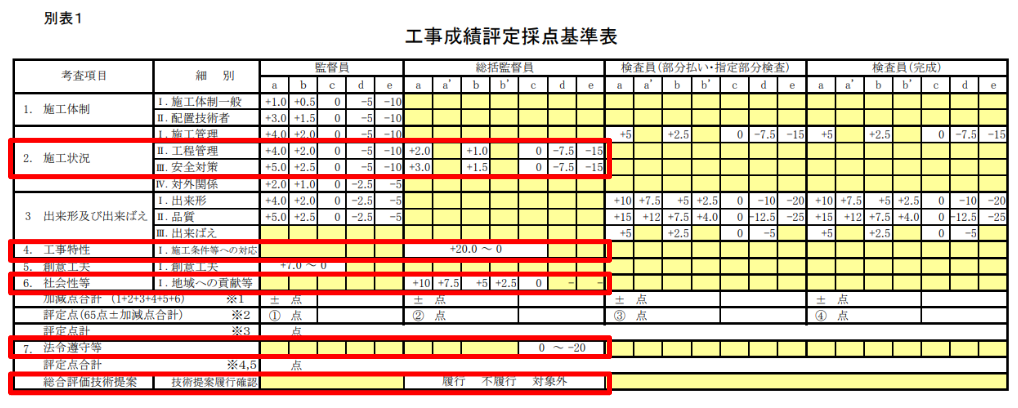
The Chief Supervisor has only 20 points to begin with (100 points are multiplied by 0.2).
Among these, the 20 points for construction characteristics (×0.2 = 4 points) carry significant weight. This is evaluated, for example, when the contractor successfully adapts to challenging site conditions (urban areas, natural conditions, ground conditions). Conversely, it could be said that points should not be awarded for simple construction projects. It would be problematic not to reflect the difficulty of the construction work here.
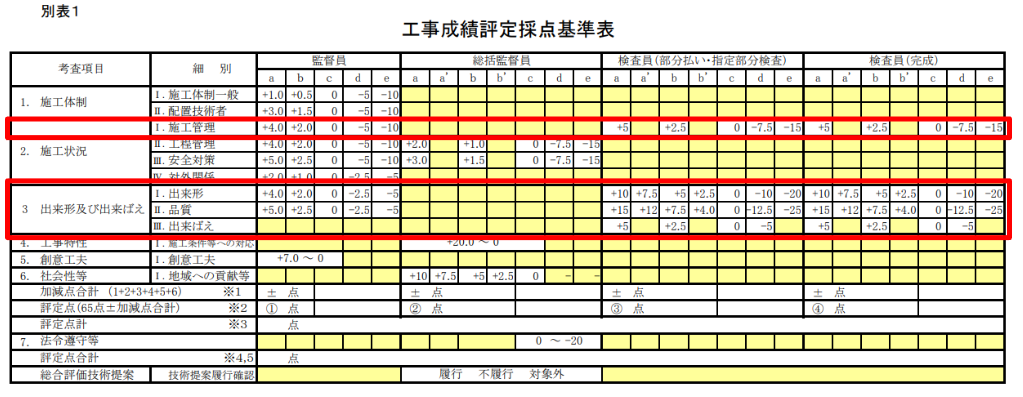
Inspectors evaluate only four areas: construction management, workmanship, quality, and finish.
Even though there are only four criteria, you won’t receive extra points unless you’ve thoroughly refined the final drawings. Also, while the quality of the work is verified during on-site inspections, since criteria such as aesthetics are subjective, the evaluation may be heavily influenced by the inspector’s personal preferences, values, and experience.
KaminoDid you notice that the grading criteria are different?
I have a pretty good idea of who gave what score
Based on the scores on the “③ Construction Performance Evaluation Form” sent to the contractors, we can generally tell who gave which scores.
By setting up an equation based on the score reported in Step ③ and the scoring formula listed in the “Step ② Detailed Score Evaluation Criteria Table,” you can estimate the unknown (score).
 Kamino
If you want to know, try doing the calculation.
Grading Process
Next, I’ll briefly explain the grading process. That said, it’s really just two steps.
Keep records during construction process checks
First, as preparatory materials, supervising staff will"Construction Process" ChecklistCreate it.
This is what it looks like ↓
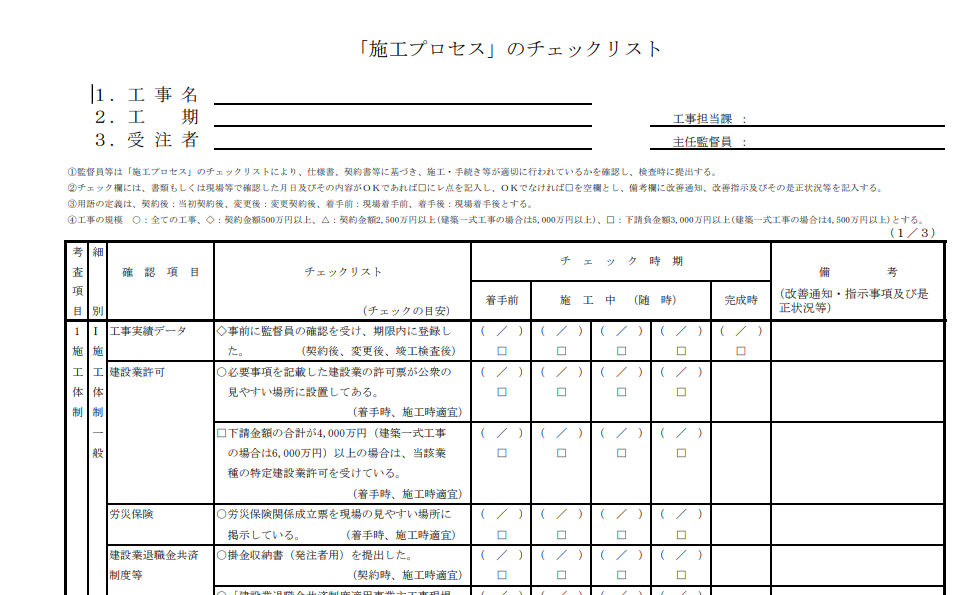
For example, suppose there is an item that states, “The qualifications (status and background) of the quality certifier are appropriate. In addition, documentation regarding the quality certifier has been submitted in writing.” In that case, you would record the date on which this was carried out. That serves as the basis for the evaluation.
This is a list intended for recording details step by step during construction, but some staff members may be compiling a checklist all at once upon project completion.
Well, to put it bluntly, it’s something that was created as a result of the “checklist syndrome” that’s so common in government offices.
 Kamino
Not every item on the checklist is linked to the Operational Table by Examination Subject.
Grade using the assessment criteria table
Next, we'll assign grades.
The grade report I just showed you is an Excel file. While there are commercial software options available, you can handle this using Excel automation, right?
Within the same dataset as the grade evaluation form, there is an “Assessment Item-by-Item Application Table.” When each evaluator checks the appropriate boxes in this table, the a, b, c, d, and e ratings are automatically determined and converted into numerical scores.
Once the chief inspector has finished, the form is handed over to the general supervisor for scoring, and the inspector will score it after the final inspection.
 Kamino
That automatically calculated the total score!
What is the Operational Chart by Examination Item?
Now, let me explain the important “Operational Chart by Assessment Item.”
The “Assessment Criteria by Subject” is published on municipal websites alongside the grade reports. Here are examples from Fukuoka City and Himeji City.
Fukuoka City: Fukuoka City Inspection Regulations, etc. (fukuoka.lg.jp)
What Is the Performance Evaluation System for Public Works Projects in Himeji City? (himeji.lg.jp)
There are three types of “Assessment Item-Specific Implementation Tables,” one for each evaluator, and
For example, here is the table for "Chief Supervisors" in Fukuoka City ↓
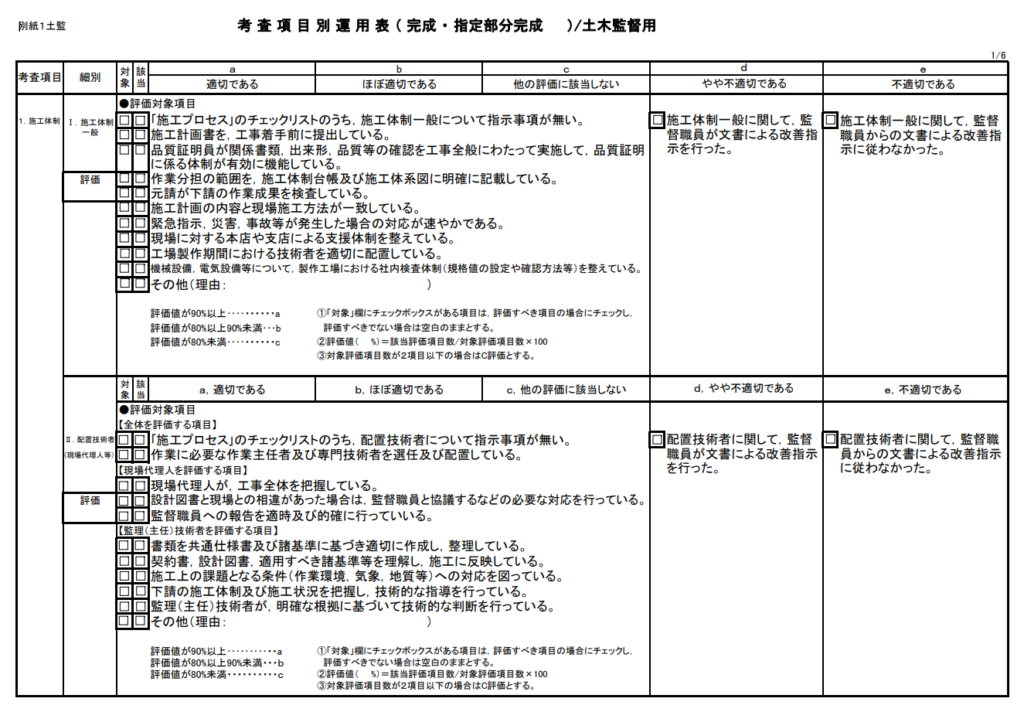
There are several pages of this, and you go through each item one by one.
What are the a, b, c, d, and e ratings?
As shown in the table above, there are approximately 5 to 10 “evaluation criteria” for each subcategory, and you should check the box (“✓”) if the criterion applies. For example, if “The construction plan was submitted before work began” applies, you should check the box.This system automatically assigns an A, B, or C grade based on the number (percentage) of checkmarks.
Normally, options d and e aren't possible. Options a and b earn extra points, option c is ±0, and options d and e result in point deductions. (Detailed scores are listed on the grading sheet.)
As noted in the Operational Guidelines by Assessment Item, the general evaluation criteria are as follows.
a... Rating of 90% or higher
b... Evaluation value of 80% or higher but less than 90%
c... Evaluation value less than 80%
d... I received improvement instructions from the supervisor.
e... Failed to follow the supervisor's instructions for improvement
For example, if a “Field Engineer” has 8 out of 9 applicable items checked (“Re” marks), that would be 8/9 = 88%, resulting in a “b” rating and +1.5 points.
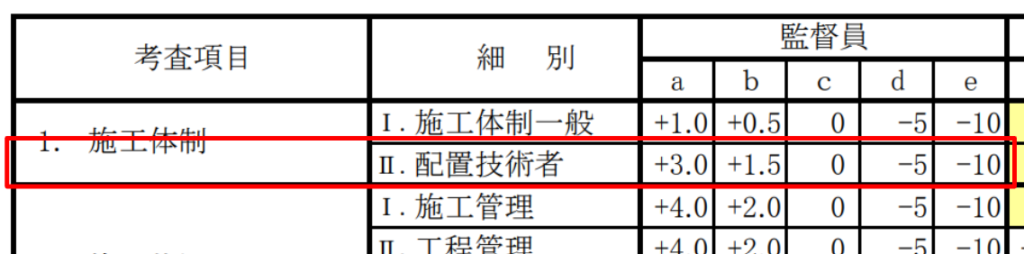
So, the score is determined based on the number of checkmarks.
By the way, be sure not to forget to exclude “Other” at the very bottom of the operational table for each examination item. I occasionally see people make this kind of careless mistake.
 Kamino
If even one box isn't checked, I'll end up with a "B" grade~
Basic Interpretation of Grade Evaluation
Now, let me explain the approach to take when actually grading.
First, as a general premise, since the items subject to evaluation are mostly contractual terms—such as the contract, relevant laws and regulations, and common specifications—there is a view that failure to implement them constitutes a breach of contract.
The contractor must fulfill the terms of the contract at its own responsibility and without guidance or advice from the client; normally,If the contractor does not perform the work themselves, it cannot be evaluated.。
It's okay as long as it's just the first time.
However, since it is practically difficult to handle all the various contractual matters on their own, many local governments,If an improvement was made based on the supervisor’s instructions or advice, a “Re” score may be assigned to the “Evaluation Item” for the first occurrence.It seems they have adopted this as their operating policy.
Conducted on their own initiative → Assign an “R” mark
Improved after the first instruction → Award an “R” grade
Improved after the second instruction → Do not mark the "Re" point
Improved after the third instruction → Grade D
No improvement after the third warning → Grade E
This is just one example, though.
I think few local governments have published their rules. Some local governments may not have established rules this clear...
KaminoThe more instructions and advice you give, the lower your evaluation will be. This is the basic principle.
There are various ways to give instructions
While the way instructions (requests for improvement) are issued varies by local government, civil servants—who tend to be very document-oriented—love to put everything in writing just to protect themselves. That’s why some local governments issue “instructions” or “notifications” via the meeting minutes right from the very first meeting.
But personally, I feel like if they went to that much trouble, I can’t give them a C (;´・ω・)
On the other hand, some local governments first issue a verbal request for improvement; if the issue is resolved at that point, it is considered acceptable. However, starting with the second request, they issue written instructions, and if even a single item is addressed via written instruction, the evaluation is classified as “d” or “e.”
 Kamino
Realistically, since you have to be prepared to give a rating of “D” or lower (with point deductions) when issuing a corrective action notice, it’s likely to happen only when the situation has escalated to a serious level.
"Items Subject to Evaluation" includes all of them
All right, I get the system now. So if we implement the “evaluation criteria,” we’ll get an “L” rating, which means bonus points!
But contractors are bound to wonder, “Aren’t the items listed under ”Evaluation Criteria’ a bit vague? How are they supposed to determine whether something was ‘implemented’?” To be honest, even the client doesn’t really understand it either (;´・ω・). The reason is that the “Evaluation Criteria” cover absolutely everything.
All laws, regulations, and design documents (Common Specifications) related to the “Items Subject to Evaluation” must be fully complied with, down to the finest detail....that's the gist of it.
Furthermore, there are almost no specific requirements regarding the format of the documents to be submitted.
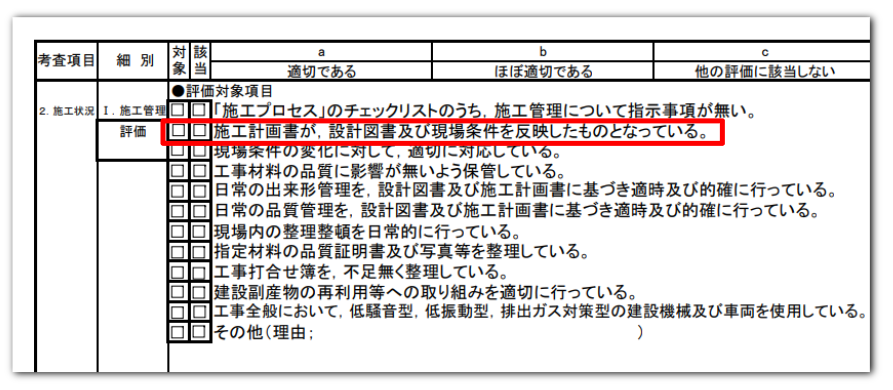
For example, according to a table from Fukuoka City,
"The construction plan reflects the design documents and site conditions."
There is an evaluation criterion like that, isn't there?
Regarding this, I believe a “Le” grade can only be awarded after verifying a wide range of items—such as checking the common specifications to confirm whether the submission deadline was met, whether all required information was included without omission, whether there are any deficiencies in the documentation, and whether the plan not only reflects on-site conditions but also complies with relevant laws and regulations. ← This is just my own speculation.
To achieve this, the client must also be thoroughly familiar with the specifications and relevant laws and regulations, and must take the time to review the submitted documents and as-built drawings. However, since junior staff members don’t have that level of knowledge or the time to do so, it ends up being the case that even the client doesn’t fully understand the situation (;´・ω・). Of course, continuous learning is essential.
KaminoIf these grading standards are lenient, it’s easy to get a “B” grade, which results in a higher score. There are probably some local governments (departments) like that.
This is how I grade the tests.
Although there are differences depending on the contracting authority (local government), I believe the rules explained so far reflect a generally common approach to evaluation.
However, since the city hall mainly works with contractors ranked B, C, or lower—and there are also contractors who don’t know how to prepare the necessary documents or who have trouble understanding instructions—things don’t always go as planned.
I'll write down a little bit about how I do it.
After receiving the as-built documents, the inspector first goes through them from start to finish, right? It’s not as if they’ll refuse to evaluate the documents outright if something is missing—instead, they’ll ask, “This is missing—didn’t you prepare it? Please submit it,” and request that the missing item be provided. This is because the inspection cannot proceed unless the minimum set of documents required by the rules is complete.
Once all the required documents are gathered, I check all the details—including specific numbers—and verify that there are no errors. During this process, I score the documents by comparing them to the assessment criteria checklist. I decide whether or not to give a “D” grade based on thoughts like, “Is there a document that shows I understand XX? Hmm, no. Is there really none? Nope. Is there really none? ... Nope! I won’t evaluate that!” That’s the kind of mindset I use to decide whether or not to assign a “Re” score.
If things aren’t organized properly, the person receiving the documents might overlook them—even if they’ve filed them away thinking they’re for ○○. Even if you’re told, “Don’t overlook them!” it’s too late once the grading is over. That’s why organization is so important.
In addition, to ensure consistency in evaluation criteria across supervisors, we compare scores with those from other projects. Specifically, we review projects from previous years that were carried out in the same region or involved similar work, and compare them against the evaluation criteria tables for each assessment item to verify that there are no inconsistencies in the evaluations.
We’ll also review the scores for the entire Business Division to determine the extent of any discrepancies. This doesn’t mean we won’t give high scores; rather, even if we do award high scores, we must explain to the division manager and inspectors what we evaluated and why.
Of course, top-tier A-rank contractors submit documents that are nearly perfect, but some inspectors will ask, “Can’t you lower the score a little more?” In response, you need to be prepared to explain, “Taking △△ into account, we’ve implemented ○○ and □□, so this deserves a high rating. Other contractors don’t document things to this extent. Here are the documents.” You need to be prepared to explain it that way. Inspectors who give high scores are essentially competing with each other internally.
To Get a High Score
As a bonus, I’d like to explain how to get a high score, but since I can’t say anything too specific, I’ll just give a rough overview (*’ω’*)
・Work carefully and diligently.
・If there is anything you wish to discuss, consult with the supervisor immediately, and even if it is not significant enough to be recorded in the meeting minutes, make a note of it in bullet points or similar format.
・Meet our strict internal standards and improve quality.
・Prepare records and materials relevant to the evaluation criteria.
・Organize your documents so they are easy to read. (For example, create a list of all documents with sequential numbers or prepare a checklist of items to submit.)
・When problems arise—such as those related to process management or changes in on-site conditions—even if they are minor, prepare explanatory materials that allow a third party to understand what happened, what actions were taken, and what was achieved (or corrected).
We follow a strict written-evidence policy; we do not—or rather, cannot—grade based solely on atmosphere or leniency.
 Kamino
Sorry for the abstract content.
I’ve seen guides on several websites titled something like “How to Score High on Construction Projects!”,Director Joe's BlogI'm including a link below to their explanatory article since it's easy to understand ↓

In Closing
Do you understand the rules for scoring the construction performance evaluation?
Since rankings can be reversed in a comprehensive evaluation bidding process, there’s no denying that points equal money; and as long as supervisors can manipulate the scores behind closed doors, all sorts of problems can arise.
To address issues related to such construction performance evaluations, let’s start by thoroughly familiarizing ourselves with the publicly available information on how government agencies conduct their scoring.
KaminoI hope this will be helpful to our younger staff members.
Well, that's all for today.
See you later (*’ω’*)ノ