Hello, everyone. This is Enta.
This is a continuation of the previous post.
Slope Collapse During Construction: Water Is the Primary Cause (Part 1)
In Part 1, I wrote that the safety factor (Fs) does not reach 1.2 during construction, that water tends to concentrate at the weakest points, and that covering the area with sheeting is only a temporary measure.
So, this time, we're talking about specific measures—like, "What should we do?" lol
The conclusion is that “draining the water” is the only option.
What I highly recommend is to, during installation,Drainage of Injected WaterThis is the method of keeping it there.
It doesn't have to be a long one. It can be 1 meter or 2 meters—either is fine.
It's far better than nothing, after all.
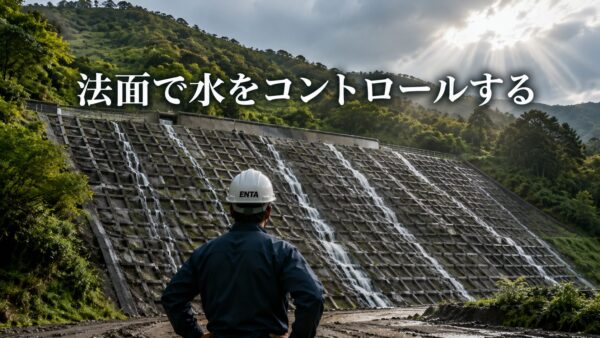
The principle is really simple: you just create an outlet for the pressure in the freshly cut slope beforehand—that's all there is to it.
Before water pressure builds up in the natural ground, drill holes in advance to release it.
I guess you could think of it as something like a normal floodgate on a dam.
Install a mechanism that allows water to drain continuously before the structure collapses—while it’s still weak.
This significantly reduces risks during construction and continues to be effective even after construction is complete—it’s like killing two birds with one stone!
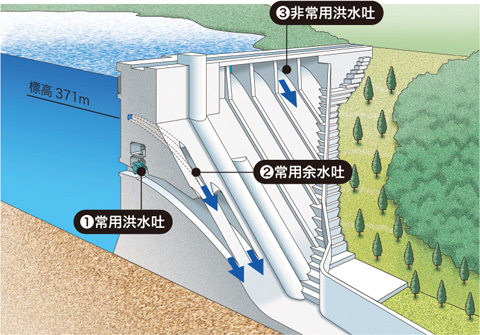
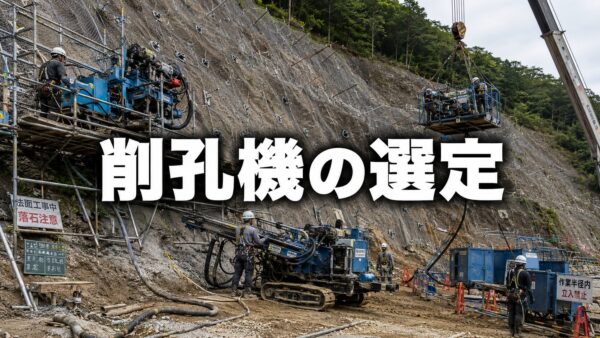
The key is knowing when to use it in conjunction with rebar insertion work
On a rebar installation job site, the timing of when to pour the grout is absolutely critical.
Personally,After all the rebar installation work for that floor is complete, the drainage work is done last.That order is best.
Why?
The reason is simple: if the drainage pipes are installed first, there is a risk that the cement slurry injected later during the rebar installation process will flow out through the drainage pipes.
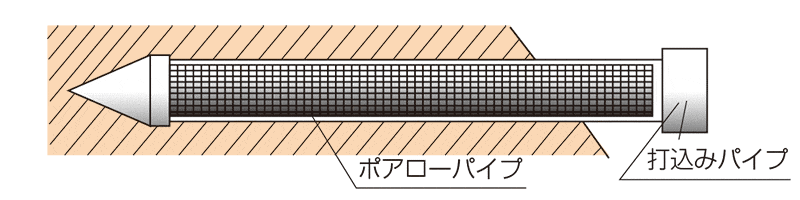
Since it's a perforated tube, the milk comes in through the openings. Then it hardens.
If you do this, all the work you put into draining the water will be for nothing, so I think the best approach on-site is to proceed in the following order for each section: “rebar installation → draining.”
By the way, here’s an article I wrote previously about the physical properties of cement slurry (What is the pressure condition at the fixation site during injection?If you read that (as well),
I think this makes it easier to visualize why the milk spreads more widely than expected.
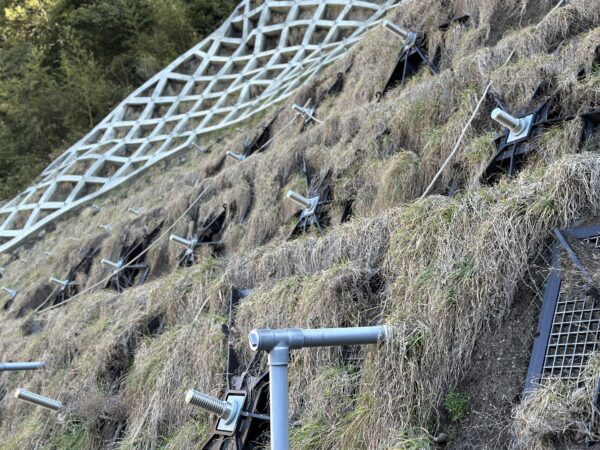
Whether it's 1 meter or 2 meters, it makes a difference.
You might be thinking, “Will such a short drain cycle really work?” but it does.
This is because the most common cause of collapses during construction isSurface CollapseSo, according to the Ministry of Land, Infrastructure, Transport and Tourism’s definition,A landslide in which the topsoil, approximately 0.5 to 2.0 meters thick, slides along the boundary with the bedrock layer.It is clearly stated that...
In other words, the collapses that cause the most trouble for slope engineers during construction tend to occur at depths ranging from 0.5 to 2.0 meters, right?
Furthermore, according to the Japan Road Association’s “Guidelines for Road Earthworks—Cut Works and Slope Stabilization Works,”Stress Relief Through Cut SoilIt is clearly stated that, due to the subsequent repeated cycles of drying and wetting, as well as freezing and thawing, the surface layer of the slope gradually turns into loose sediment, making it prone to collapse.
The on-site intuition that a freshly cut slope is the most dangerous is clearly stated in the guidelines as well.
Now that we've reached this point, the purpose of draining the water that has seeped in 1 to 2 meters deep becomes clear.
Depth at which surface collapse occurs: 0.5–2.0 m。
Areas prone to weathering and sedimentation due to stress relief = the surface layer of the slope。
Rainwater that has seeped in here creates excess pore water pressure, which reduces the frictional resistance on the slip surface and triggers a landslide.
The water we're trying to drain using a 1–2-meter-deep drainage well is, in fact,The Person Causing the CollapseThat means they're specifically targeting it.
The purpose of long-hole dewatering drilling is to drain groundwater from deep layers and water within landslide blocks, but all of these are connected to the surface as well.
I think drainage reinforcement pipes seem to have a significant market share in Japan.
PDR Method for Drainage Reinforcement Pipes
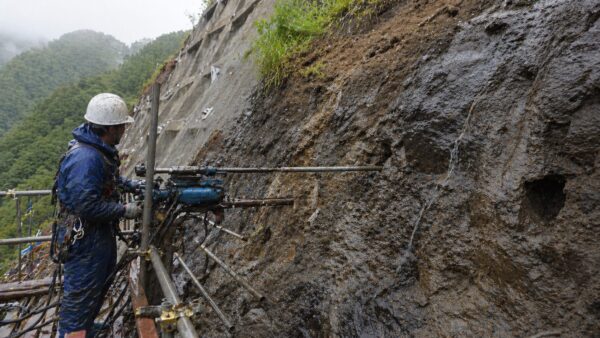
The realities that don’t appear in the design—that’s why “ingenuity” is needed
This is the sad reality of slope construction in Japan: drainage—as a preventive measure—isn’t even included in the design to begin with.
It's that old saying: "It's hard to get funding for projects to preserve things that aren't falling apart."
Not the slope protection work I often talk about, but post-collapse repair work.
The real work starts after it falls apart, lol
Of course, sites where landslide countermeasures are required or where clear signs of ground deformation are present are a different matter, but it’s extremely rare for the initial design of a standard cut slope to specify the installation of drainage pipes.
So, in our case, we do thisCreativity and IngenuityI'm including it on my own initiative.
Sites that appear suspicious, sites where there are signs of spring water, and sites where slopes remain wet after rain.
In situations like that, we make our own decisions and enter the data before we receive instructions.
It would be even better if the general contractor came up with a creative solution based on this and earned extra points.
This will reduce accidents during construction, which will ultimately protect the machinery, the job site, and the workers.
Even if it doesn't make money,It's a project worth doingThat's right.
Release the pressure before it collapses
I’ve written a lot, but personally, what I want to say can be summed up in this one line.
Release the pressure before it collapses.
Actually, the only construction method that actively reduces pressure on a slope (pore water pressure) is dewatering.
Whether it’s rebar installation, ground anchor installation, or formwork—it all comes down to sheer strength.Hold downConstruction methods.
However, when the pore water pressure within the natural ground is high, the shear strength of the soil and rock itself decreases, so
This means that no matter how much pressure you apply, the natural ground will keep sliding.
(Terzaghi’s principle of effective stress: σ’ = σ − u. As pore water pressure u increases, effective stress σ’ decreases, and shear strength also decreases.)
Conversely, if you drain the water to reduce the pore water pressure before applying pressure, the inherent shear strength of the rock mass will increase, and
This means that anchors and rebar inserts will function more effectively as intended.
While these measures are primarily intended for heavy rain or to prevent landslides during construction, they’re also highly effective for subsequent rebar insertion, ground anchor installation, and slope reinforcement work, aren’t they?
As for what you can do starting tomorrow at the suspicious site, please try installing a drain pipe—even just one will do.
If water comes out, it’s a “win”; if it doesn’t, it’s “insurance.”
No matter what happens, it will work forever!
For embankments or gentle slopes, a Poireau pipe works well if you're doing the work by hand.
See you later.