Hello, everyone.
This is Enta.
Since my last post, I've been writing about packer pressure.
I Tried Measuring the Limit of Packer Pressure!
I Tried Measuring the Limit of Packer Pressurization! (Part 2)
I Tried Measuring the Limits of Packer Pressurization! (Part 3)
I Tried Measuring the Limits of Packer Pressurization! (Part 4)
I Tried Measuring the Limits of Packer Pressurization! (Part 5) Simulator
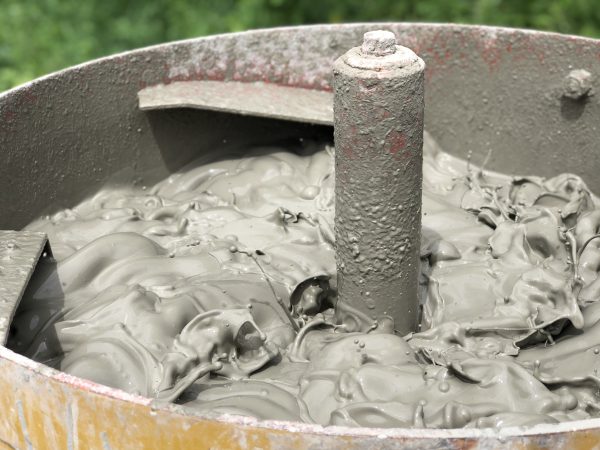
In this post, I’d like to consider how much pressure is applied to the bottom surface (the anchorage area) when cement slurry is injected.
We will base our calculations on a drilling angle of 30 degrees and the assumption that the material (anchor) extends halfway into the hole.
Calculation Conditions
- Drilling angle: 30 degrees (from horizontal)
- Exclude PC steel strands
- Unit weight of cement slurry: 18 kN/m³ (specific gravity approximately 1.8, typical value)
- Diameters: 90 mm, 115 mm, 130 mm; drilling length: 10 m
Since the borehole is 10 meters long and has a 30-degree incline:
- Vertical height H = 10 × sin(30°) = 5.0 m
- Filling length = 10 m × 0.5 = 5 m (half the borehole)
- Vertical height of the fill section = 5 × sin(30°) = 2.5 m
| Item | φ90 mm | φ115 mm | φ130 mm |
|---|---|---|---|
| Drill Hole Cross-Sectional Area (cm²) | 63.6 | 103.9 | 132.7 |
| 4 strands of PC steel wire (cm²) | 5.07 (General) | ||
| Effective Filled Cross-Sectional Area (cm²) | 58.5 | 98.8 | 127.6 |
| Volume of Cement Slurry (L) | 58.5 | 98.8 | 127.6 |
| Base Weight (kg) | 105.3 | 177.9 | 229.7 |
| Base Weight (N) | 1,033 | 1,745 | 2,253 |
| Hydrostatic Pressure (kPa) *General | 90.0 kPa = 18 × 5.0 m (vertical height) | ||
| Maximum Lateral Pressure (at the bottom of the well) | 90.0 kPa = 0.918 kgf/cm² *Applies regardless of diameter | ||
* Drilling depth: 10 m, angle: 30°, fully grouted / Based on 4 strands of 12.7 mm PC steel strands / Unit weight: 18 kN/m³
The cement slurry at the bottom is pretty heavy, isn't it?
And the lateral pressure is as follows.
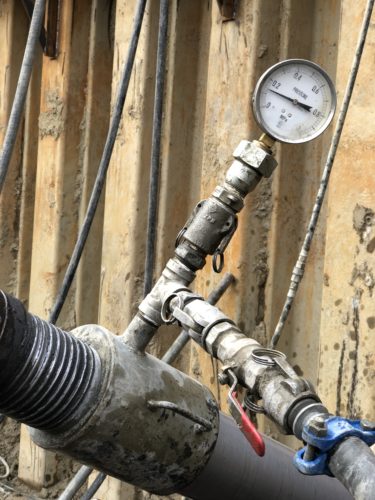
| Distance z (m) from the orifice | Distance from the bottom (m) | Lateral Pressure (MPa) | Lateral Pressure (kgf/mm²) |
|---|---|---|---|
| 7.0 m | 3.0 m (top edge) | 0.0630 | 0.00643 |
| 7.5 m | 2.5 m | 0.0675 | 0.00688 |
| 8.0 m | 2.0 m | 0.0720 | 0.00734 |
| 8.5 m | 1.5 m | 0.0765 | 0.00780 |
| 9.0 m | 1.0 m | 0.0810 | 0.00826 |
| 9.5 m | 0.5 m | 0.0855 | 0.00872 |
| 10.0 m | 0 m (bottom of the borehole) | 0.0900 | 0.00918 |
* Lateral pressure P = γ × z × sin 30° (γ = 18 kN/m³, drilling angle 30°)
* Unit conversion: 1 MPa = 1,000 kPa / 1 kgf/mm² = 9.807 MPa
This means that if the borehole length exceeds 10 meters, the concrete is always in a pressurized state.
The table above shows the pressure exerted on the side surfaces when the anchorage length is 3 meters.
Since the pressure remains constant until curing is complete, the load will not be released.
What I'm trying to say here is,The Need for PressurizationThat's right lol
I think I've been saying this for a long time: even if the pressurization doesn't go well, it's not a problem.
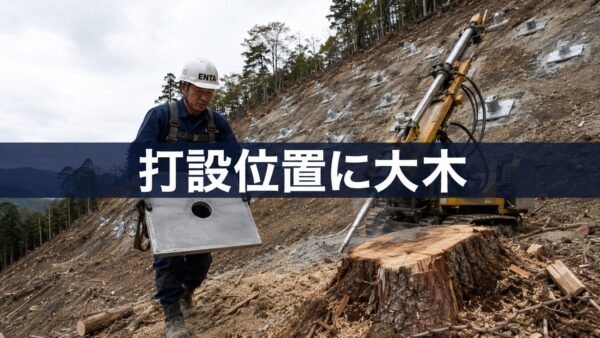
Personally, I don't think it's necessary, but since it's mentioned in the book, there's a chance it might be required... (I'll take a photo, lol)
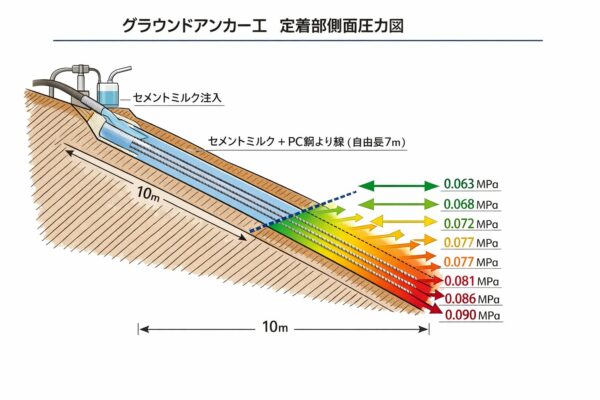
*The picture looks a little off, but I couldn't fix it lol (the AI wouldn't listen to me lol)
That said, as you can see from the outside, the cement slurry is heavy, so it’s only natural that pressure builds up.
As you can see from this real-world example, there’s really no need for a pressure of 0.2 MPa, right?
It’s not necessarily the case that you have to use pressure no matter what.
Even if pressure is applied to the anchorage section at 0.2 MPa or higher, ultimately only the weight of the structure will be applied as pressure. (Because the pressure is released.)
It would be a different story if we could cure it while maintaining pressure, but that’s physically impossible, isn’t it?
This means you don't need to worry too much about the pressure on the attachment area.
See you later.