Hello, everyone.
This is Enta.
Now that Obon is over, things are getting busy again at the slope construction site.
It's still hot during the day, but I feel like the air has changed a bit in the early morning... Not at all.
It's still freaking hot...
In about a month, the weather will be just right!
Let's wait a little longer.
But that's beside the point.
I’m writing this for young engineers to address the question: “Can backfill material be considered part of the natural ground?”
What exactly is the concept behind “treating it as a natural mountain”?
In slope construction, it is common to level out irregularities on the natural ground using mortar or soil before installing structures.
At this point, the leveled area is “artificially added material, not the original natural ground,” right?
One point that people with little experience often get hung up on here is, “So how is that part handled in the design?”
The answer is, if the conditions are met,It may be treated as the same as the natural ground.There is a school of thought that says...
This is what the phrase “regard it as Earth” means.
In other words, even if a material was added later, as long as it meets certain conditions, it can be treated the same as the original soil that was there from the beginning.
That's a "fill" kind of approach, isn't it?
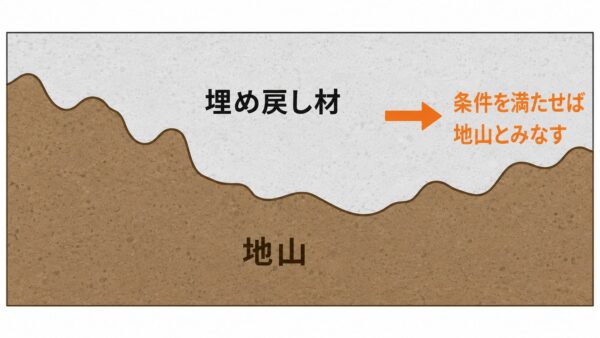
The key factors to consider are “strength” and “quality.”
So, what conditions must be met for a site to be considered natural ground? This is the most important point.
The "Textbook on Slope Protection Construction Management Techniques" published by the National Association for the Protection of Specified Slopes (General Incorporated Association) states that,
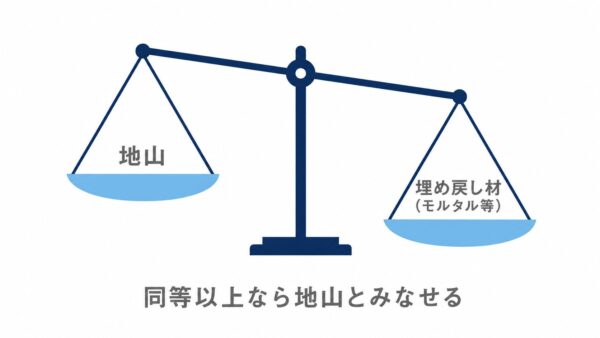
If the backfill material used to level out unevenness is of the same quality as, or higher in quality than, the natural ground, it shall be considered part of the natural ground.There is a statement to that effect.
To put it simply, “If you’re adding material that’s weaker than the original ground, you can’t treat it as natural ground, but—
The idea is that “if you’re adding material that is as strong as—or stronger than—the original soil, it won’t have a negative impact on the design.”
When you're still new to this, you tend to assume that "since it was added later, it must be weak," but,
In practice, materials such as mortar—which are stronger than the natural ground—are used more often, so I think this reasoning makes intuitive sense.
Real-Life Scenarios Where It Appears | Examples of Legal Framework Engineering
Since it might be hard to visualize just from the description, let's take a look at some actual photos from the site.

This is a job site where the formwork, which was supposed to be 300 mm thick according to the design, actually measured 500 mm when we checked it.
Because the frame was installed without following the natural contours (unevenness) of the ground, the thickness has increased in some areas.

The red areas are where the mortar has been refilled.
At job sites where the natural terrain is very uneven, this type of mortar is sometimes sprayed on to level out the unevenness before installing the formwork. This is what is known as “leveling mortar.”
Well, we just put the formwork together and sprayed it on, but it’s still just “leveling mortar” in concept! lol


In this case, the additional thickness consists of mortar, which is not a weaker material than the natural ground; therefore, it is deemed to be part of the natural ground.
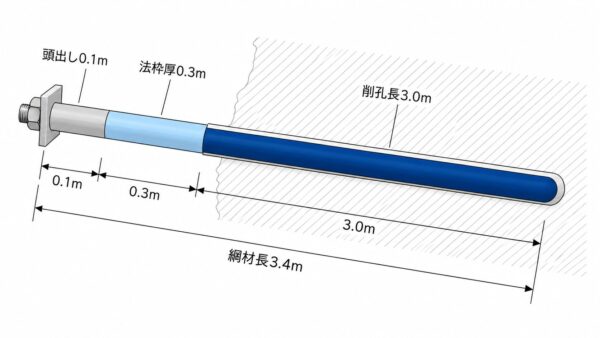
The drilling depth of the rock bolts (a figure determined by the formula: head protrusion + frame thickness + drilling depth = anchor length) is also,
According to this line of thinking, it does not mean that the foundation (solid mass of earth) is short; rather, it means that it remains unchanged.
Things Young Managers Should Keep in Mind on the Job
If you've read this far, you might be tempted to think, "So backfill can always be treated as natural ground," but you need to be careful here.
The important thing is, after all,A condition is that the strength and quality must be equal to or greater than those of the natural ground.That is the point.
This principle does not apply if the backfill material is weak or if there are quality variations due to poor workmanship.
The most dangerous approach is to mechanically memorize the rule that “since it’s backfill, it’s treated as natural ground.”
In addition, in cases where the rebar is thick or the natural terrain is extremely uneven, it may be necessary to individually verify the quality of the backfill.
If you're unsure how to proceed, don't make a decision on your own—please consult your supervisor.
In the beginning, get into the habit of checking each time whether a material can be considered "natural rock," as this will help you gain experience.
But when you're just a slope contractor, it usually ends with, "Mortar's good enough!" lol
See you later.