Hello, everyone.
This is Enta.
Even though we're already in the second half of September, it's still pretty hot during the day.
Since this is the season for autumn rains and typhoons, be sure to inspect slopes more thoroughly than usual after it rains.
But that's beside the point.
You often hear the terms “landslide” and “rockfall” on the news, don’t you?
Since both involve “soil sliding down a slope,” I think many people assume they’re the same thing.
Actually, even among young directors, there are quite a few who work without fully clarifying this point (or who confuse the two).
However, these two are completely different in terms of their causes and how they work.
And precisely because they are different, the order in which countermeasures should be taken and the “things you shouldn’t do” also vary.
In this post, I’ll try to write as much as possible based on the guidelines and without using difficult words.
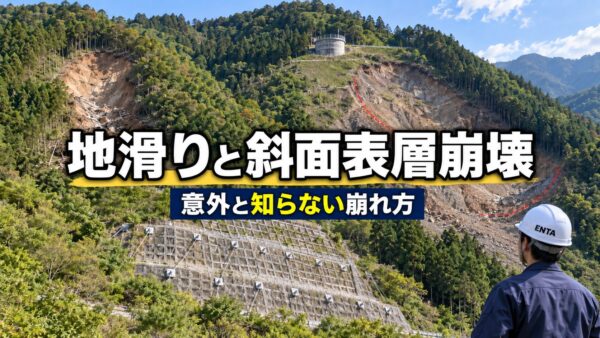
The difference between a landslide and a slope failure lies in “depth” and “speed.”
First, let's start with the meaning of the word.
A landslide is “a phenomenon in which a portion of the land slides due to groundwater or other factors, or a phenomenon in which the land moves as a result.”
The key points are"Groundwater"This is the part where that phrase appears.
On the other hand, steep slopes are defined as “land with a slope of 30 degrees or more.”
The key points here are"Steep Slope"。
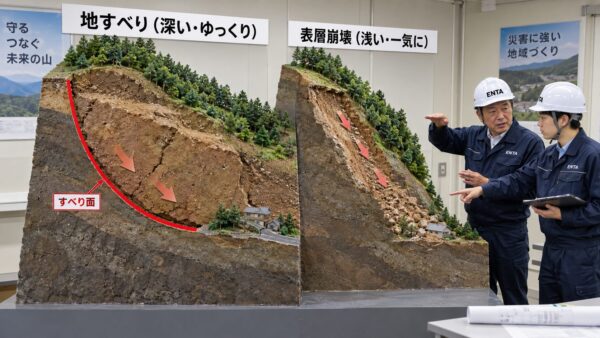
- Slope Collapse (Surface Collapse): A phenomenon in which soil and sediment slide down from relatively shallow sections of a slope. Triggered by water that has seeped into the ground—such as during heavy rain—this can result in shallow landslides with a depth of approximately 2 meters or less. These events are sudden and difficult to predict.
- Landslide: A phenomenon in which, at a certain surface deep underground, the mass of soil above it gradually moves downward. Unlike surface collapse, the movement is slow. Slopes with a gentler gradient than those seen in collapse move on a large scale, creating distinctive landslide topography.
To give you an idea, it looks something like this.
A "surface collapse" is like when only the frosting on the surface of a cake slips right off.
A landslide is like a cake slowly sliding across a plate, base and all.
This "border between the plate and the food" corresponds to what is commonly referred to asSliding surfaceThat's it.
Here's what it looks like in a table.
| Item | Slope Collapse (Surface Collapse) | Landslide |
|---|---|---|
| Where to Ski | Near the surface of the ground | A slip plane deep underground |
| Speed of Movement | Fast · Sudden | Slowly, Gradually |
| Slope Gradient | Common on steep slopes | It can occur even on slopes that are less steep than those prone to landslides |
| Main Reason | Water that seeped in due to heavy rain, etc. | Groundwater, etc. |
So, how can you identify the location of a landslide at the site?
- Higher up on the slope, there are cliffs shaped like horseshoes (horseshoe-shaped) and square-shaped cliffs (Slide Cliff: Katsuraku-gai), and the middle section below it consists of a flat, gently sloping area
- Dents, depressions, and cracks
- Ponds, marshes, and wetlands stretch out in a row
- The very bottom of the slope becomes steep, and you can see mounds and extrusions.
- Roads and railroads are curved, and structures are misaligned
- They are arranged in terraced rice fields
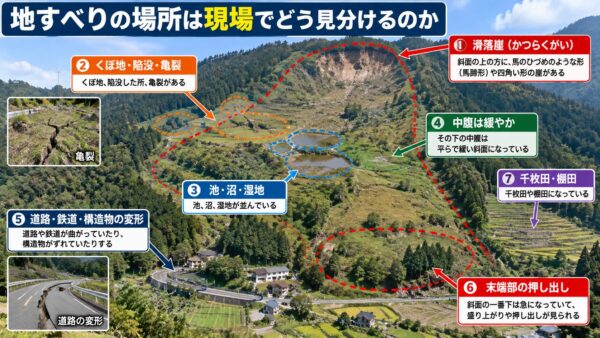
Even though it's deep in the mountains, there are flat terraces at the base of a steep cliff, with rice paddies and ponds.
This means that such places might be the remnants of landslides that occurred in the past.
Just be careful, though—it’s easy to mistake river terraces and the like for landslide features, lol.
If you come across terrain like this near a construction site, I think it’s a good idea to get into the habit of asking yourself, “Could this be a landslide-prone area?”
Incidentally, the Road Earthwork Guidelines state that “the boundary between rockfall and landslides is not always clear.”
I’ve heard that when a large-scale collapse occurs, it can sometimes be difficult to clearly distinguish it from a landslide.
Although landslides generally move slowly, it is said that some can move or slide down suddenly.
It’s not necessarily true that “landslides always happen slowly.”
So, it's okay if you find yourself wondering, "Which one is this?" while you're on the job.
Even pros get confused—in the end, it's all just guesswork lol (I get it right sometimes, though!)
Understanding the "Safety Factor" Helps You Understand Landslide Prevention Measures
One thing that always comes up when considering landslide countermeasures is"Safety Factor"That's the phrase.
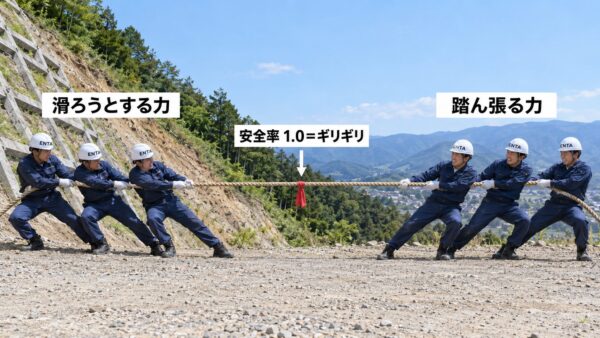
Simply put,How many times greater is the "braking force" compared to the "sliding force"?That's the figure.
It's easier to understand if you think of it as a tug-of-war.
- Safety factor 1.0: The tug-of-war ends in a tie. It’s a close call.
- Safety factor less than 1.0: The side trying to slide is gaining the upper hand. The slope is moving.
- Safety factor greater than 1.0: The side holding firm is winning. There is a margin of safety.
The planning safety factor in the Technical Guidelines for Landslide Prevention is determined as follows:
- The current safety factor (as-is safety factor) is assumed to range from 0.95 to 1.00, depending on operating conditions.
- Target safety factor after implementing countermeasures (Planned Safety Factor) is set to 1.10–1.20
- Even when ensuring immediate safety through emergency measures, the planned safety factor must be 1.05 or higher.
So, you start your calculations based on the assumption that “if they’re moving, it’s already a tie or a loss,” right?
The reason for the range of 1.1 to 1.2 is that this value is based on empirical data derived from past experience—including cases where landslides became more active simply because the safety factor decreased by approximately 5 to 10% in cut and fill slopes.
Incidentally, the Road Earthwork Guidelines state that the design safety factor should be set within the range of 1.05 to 1.2, and that 1.2 is typically used. (For major roads, the value is 1.2.)
Although the specific range varies slightly depending on the book, the general idea—to "increase it from around 1.0 to around 1.2"—remains the same.
This is a sentence from the Technical Guidelines for Landslide Prevention, but,
The safety factor referred to here is used to determine the scope of remedial work; it does not indicate the stability of the slope after the work is completed.
It doesn't mean, "Since it was designed with a safety factor of 1.2, there's absolutely no way it'll break," lol.
Young directors in particular tend to misunderstand this, so please keep it in mind. Especially you, Yakusho!!
In other words, measures to prevent landslides are,"What steps do I need to take—and to what extent—to increase a slope with a gradient of about 1.0 to 1.2?"It's a job where I determine things through calculations.
So, what about a typical cut slope?
In the design of slope stabilization works, empirical techniques are emphasized, with the exception of certain structural works. (As stated in the guidelines.)
A prime example of this is the classification system established for each type of soil and rock.Standard Slope GradeThat's it.
This is a guideline based on experience that indicates, “If this type of soil is used, maintaining this slope will almost certainly prevent major damage.”
To put it simply,
- Standard Slope:Past Achievements (Experience)This is often used to determine the slope and protective measures
- Landslides:Examine the sliding surface and calculate the safety factorand decide on countermeasures
Since we’re relying on calculations, we can’t even get started unless we know where the slip surface is.
They are calling for borehole surveys, slope stability surveys, groundwater surveys, and other investigations to be conducted in order to understand the mechanisms behind landslides.
That difference determines the “order of the countermeasures.”
The first step in landslide prevention is "draining the water"
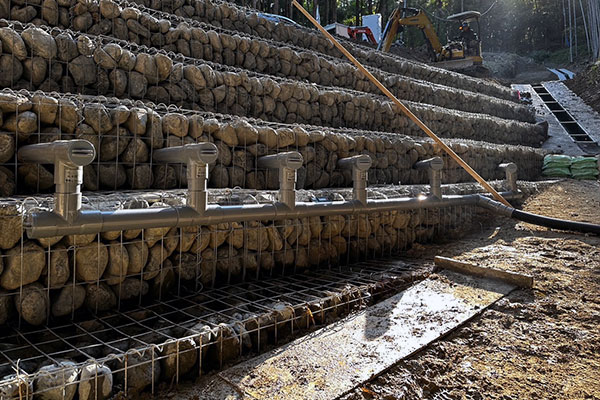
Landslide mitigation measures can be broadly divided into two categories.
| Category | Approach | Main Types of Construction Work |
|---|---|---|
| Retaining Structure | By managing water and terrain, we can reduce the very causes of landslides. | Canal construction, horizontal drilling, catch basin construction, drainage tunnel construction, spoil removal, and retaining embankment construction, etc. |
| Retaining Wall | Stopping Landslides with the Strength of Structures | Pile Work, Shaft Work, Ground Anchor Work |
*Guidelines for Road Earthwork: Cut Work and Slope Stabilization
To put it another way,"Suppressive treatment" refers to "treatment that eliminates the cause of a disease," while "immobilization treatment" refers to "treatment that involves immobilizing the affected area with a cast."It's something like that.
And the order is important.
When landslide activity continues at a high rate, as a general rule, preventive measures should not be implemented first; instead, they should be introduced only after the activity has been reduced or halted through containment measures.
In the case of fast-moving landslides, it is impossible to install retaining structures, and even if they are installed, they may fail; therefore, the key question is: “How can we control them!?”
So, the basic premise is to rely primarily on containment structures and combine them with deterrent structures as needed, right?
When movement is continuing gradually and steadily, not only can containment measures not be expected to be effective, but the construction work itself can also be dangerous, so,First, perform the restraint work to limit movement, and then...This means we will carry out preventive maintenance.
Regarding retaining pile work, if movement of 1 mm/day or more is occurring (or is expected), the piles will act independently of one another unless they are installed simultaneously as planned, and the desired effect cannot be achieved. Therefore, installation should not begin until it has been confirmed that landslide activity has largely ceased.
A movement of 1 mm a day is so slight that you can hardly tell it with the naked eye. (It might even be caused by the wind... lol)
Still, driving a pile would be dangerous, wouldn't it? lol
Flowchart for Reviewing Road Earthwork Guidelines
- ① First, drain surface water and groundwater (using drainage channels, horizontal drilling, collection wells, etc.)
- ② If this does not meet the planned safety factor, remove soil from the top (soil removal) and add soil at the base (backfill).
- ③ If that is still not enough, secure it with piles or ground anchors (retaining structures)
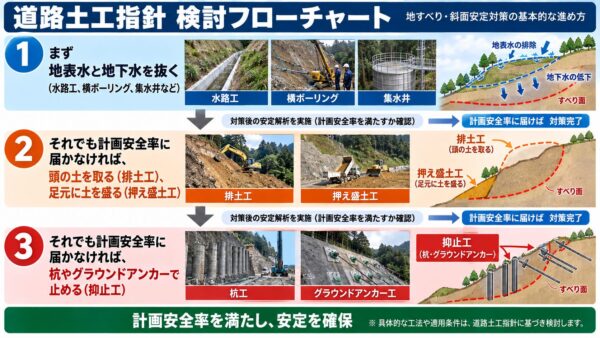
I'm sure you know that "groundwater" is included in the definition of the Landslide Prevention Act. (Nah, you probably don't, lol.)
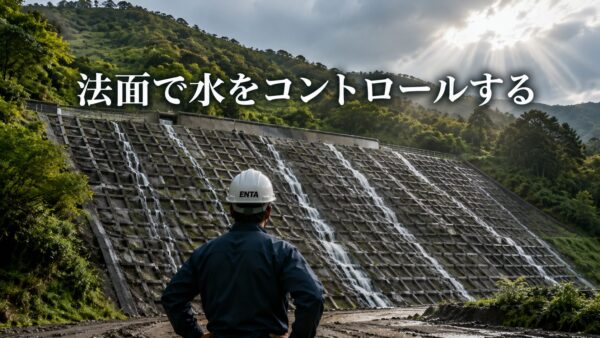
Eliminating the causes of landslides is generally considered the most effective countermeasure. Since many landslides are triggered by an increase in groundwater levels caused by heavy rain, prolonged rainfall, or snowmelt, surface water drainage and groundwater drainage works are regarded as the primary methods to consider.
If the problem is caused by water, drain the water first.
This is something I've been saying for a loooooong time, lol. Anyway, maybe I'll just drain some water first!?
This is the absolute basics.
By the way, when it comes to slope failures, the goal is to prevent them from occurring at the points where they might happen.Preventive EngineerAnd so, he caught the falling dirtProtective Measures (Preparedness Measures)It is common to consider this in terms of...
Since collapse happens all at once, the choice is: “Prevent it from happening, or brace for it.”
Since landslides occur slowly, the approach is to “reduce the causes and stop the rest.”
The difference in speed directly translates into a difference in how we approach the problem.
Since it might fall apart, “cutting it loosely” can sometimes backfire
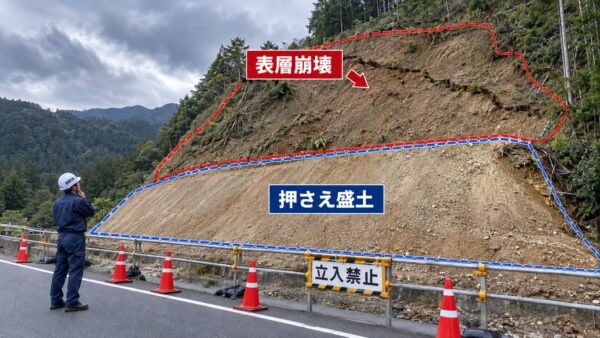
This is something I really want young directors to keep in mind.
When it comes to ordinary slopes, you’d naturally think, “If it looks like it’s about to collapse, just make the slope gentler,” right?
However, in the case of landslides, this can sometimes backfire.
When constructing a road through an area prone to landslides,Cut the top part (the head), and pile up the bottom part (the feet).That is our general policy.
Conversely, piling dirt on the head or cutting the base will significantly compromise stability, so these actions must be avoided.
To use a tug-of-war analogy,
- Cutting off the lead = reducing the number of people trying to overtake
- Strengthening the base = increasing the number of people providing support
- "Cutting off someone's footing" = overtaking the person who is holding their ground
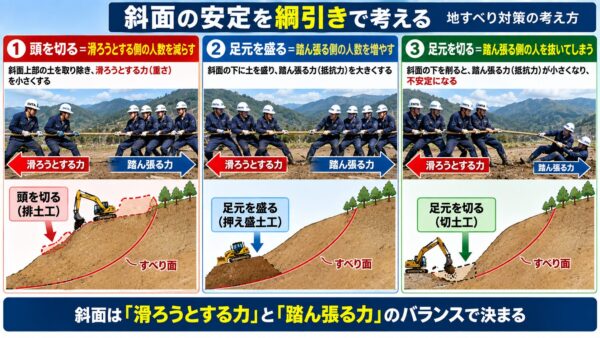
In reality, when trying to make a road pass through a landslide-prone area more quickly by gently re-contouring the entire slope, it may appear safer at first glance, but this actually removes the soil at the base of the landslide, which can make the slope even more unstable and lead to a recurrence.
The same applies to the soil and debris that have collapsed onto the road: if you rush to clear it all away, you’ll remove the “anchor” at the base of the landslide, which could cause the collapse to extend further inland.
From the general public's perspective, people probably think, "Just get it over with and let us through!" but actually, that's all part of preventing it from happening again!
In fact, removing it can sometimes lead to dangerous consequences.
And even the backfill method—where soil is piled up at the base—is not a one-size-fits-all solution.
In many cases, the soil at the base of an existing landslide is disturbed and soft; the weight of the fill can cause the ground to collapse or block the flow of groundwater, which can in turn trigger a landslide.
Retaining embankment work isWell-drained soilSince this involves piling material at the base, it’s standard practice to incorporate groundwater drainage measures, taking into account the rise in the groundwater level behind the embankment.
And, as expected, “water comes first” here, too.
There are also precautions to take when performing topsoil removal.
When planning earth-excavation work, it is necessary to conduct a thorough investigation in advance to ensure that it does not trigger a landslide hidden within the slope above; if a landslide is present on the slope above, this construction method should be avoided.
Landslide Mountain—if you cut off the top of Landslide Mountain, the slope above it would start sliding too, and that would be a problem, lol.
When working on a slope, it’s easy to focus only on the slope right in front of you and think about “how to stabilize it.”
However, at a landslide site, that slope may be just a small part of a much larger mass of soil.
"Where are the slippery spots?" "Where does the water come from?" "Which construction measures are most effective, and in what order?"
Just by keeping these three things in mind, you'll understand the role that the collection wells and anchors you're currently working on play within the overall system.
Instead of just following instructions to the letter at the specified location, if you ask yourself, “Why here?” while you work, the job site becomes many times more interesting.
I hope that young directors, in particular, will cherish this sense of “Why?”
When my boss says, “That’s just how it is,” he’s really just saying he doesn’t know, lol.
In that case, let's learn more about it!
It'll make your work—and slope work—even more fun!!
See you later.