Hello, everyone.
This is Enta.
Now that Obon is over, I imagine things on site have finally returned to normal.
The weekend is just around the corner!
Let's do our best, lol
But that's beside the point.
I wrote an article some time ago about tension control in ground anchor construction.
Is tension control in ground anchor construction really pointless after all!?
After writing this article, I had the opportunity to speak with some certified engineers.
Talking about stress management, specificallyThe Meaning of Aptitude TestsThat's it.
I shared my thoughts, and surprisingly, they seemed to agree with me lol.
Well, since they’re people in positions of authority, I imagine this isn’t something they can say in public, but I get the feeling that, deep down, that’s probably how they really feel.
Building on that discussion, I’d like to share my honest opinion—that “I personally don’t think aptitude tests (multi-cycle) are meaningful”—and explore the question of “what really matters, then?”
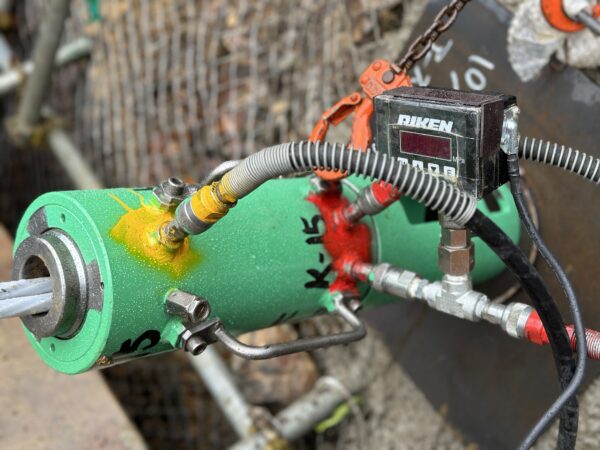
Why are aptitude tests and confirmation tests conducted in the first place?
Let's start by clarifying the criteria.
According to the “Design and Construction Standards for Ground Anchors” and its explanatory notes (JGS4101-2012, Japan Geotechnical Society),
We have established "qualification tests" and "verification tests" as tests to evaluate the quality of the anchors we manufacture.
The qualification test covers the volume of construction work5% and 3 or more bottlesTargeted at,Multi-cycle loading of 5 cycles or moreThis method involves conducting tests and using the load-displacement characteristics to determine whether the design and construction are acceptable.
The confirmation test excludes the anchors used in the suitability test.TotalTargeted at,1-Cycle LoadingIt is used to verify the safety margin against the design anchor force.
For details on dwell time and threshold values, see our previous article, “How to Shorten the Time Required for Ground Anchor Qualification and Verification Tests"I've drawn it in the table, so please take a look at that as well."
Thoughts from Talking with Certified Engineers | As Long as You Pull It Out, It’s Fine
To put it simply, here’s what happened back then.
An aptitude test is a test that examines load-displacement characteristics in detail over multiple cycles, butIn actual field work, the conclusion is usually that “as long as the anchor doesn’t pull out under the ultimate anchoring load, it’s acceptable.”That's it.
No matter how detailed the data collected during the cycle is, it all boils down to a simple matter: as long as there are no gaps at the end, it’s fine; if there are gaps, it’s a failure.
After I shared my thoughts, the teachers seemed to agree, with a sort of “Well, I guess that’s how it is, after all” vibe lol.
I imagine those of you working in construction management probably have a vague idea of this, don't you?
The fact that the aptitude test (multi-cycle) doesn't really mean much in terms of data.
However, this is merelyMy personal opinion, based on my own feelingsThat said, I am not suggesting that aptitude tests are unnecessary.
Since these standards have been established, the basic premise is that we must adhere to the test methods as they stand at this time. I really hope there’s no misunderstanding about this, lol.
I'll do what I've decided to do. But I guess I have that side to me, too, lol.
Why do you think the maximum load holding time during testing is important?
So, when it comes to what I think is important, IHolding at Maximum Load During TestingThat is my belief.
The maximum test load is specified as 1.25 times the design anchor force (Td) for Rank A and 1.10 times for Rank B, and
The minimum measurement time for the final cycle is generally considered to be about 5 to 15 minutes, depending on the soil conditions.
The criteria are as follows: for sandy soil and bedrock, displacement must be 0.2 mm or less over a period of 2 to 5 minutes; for cohesive soil, displacement must be 0.25 mm or less over a period of 5 to 15 minutes; and the creep coefficient α must be 2.0 mm or less.
The creep coefficient is defined by the following equation.
α = (Sb – Sa) ÷ log(tb/ta)
Sa and Sb represent the anchor head displacements (mm) at times ta and tb, respectively.
The way I see it,During this period of maximum load retention, allow sufficient time for the rock mass and the anchor to settle into place and for some plastic deformation to occur.I believe there is meaning in everything.
My view is that as long as we can maintain this properly, it should be sufficient for practical purposes.
To be honest, the data from the middle of the aptitude test cycle... who really cares? lol
Since we need to collect data, we’ll gather it as test data for now, but
Rather than spending time and effort on that,Ensure a secure grip when carrying the maximum load.I feel that this approach is far more practical.
In fact, if you're unable to obtain good data, stretching the material firmly to its maximum load tends to result in better data in subsequent measurements.
This is just a rule of thumb based on my own experience—it’s not something explicitly stated in the manual—so please take it as nothing more than my on-the-job intuition (not that I’m making excuses, lol).
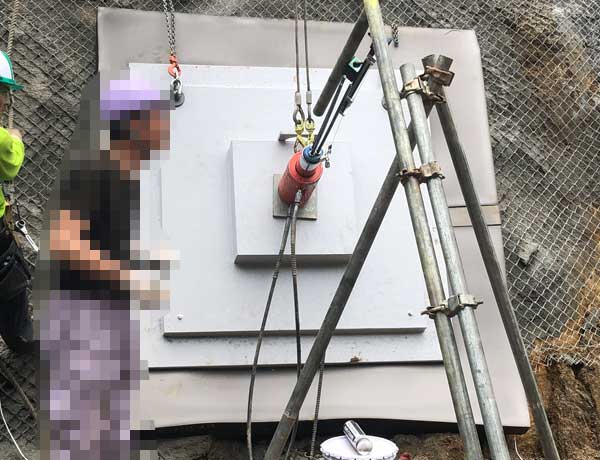
Why We Still Follow the Standards | The Struggle with Fixed Points
Up to this point, I’ve been honest in saying that I think “aptitude tests are pointless,” but that doesn’t meanThis doesn't mean we should do away with the exam altogether.。
For now, test methods have been established as standards, so,Conduct in accordance with the standard test methods, based on the judgment of the responsible engineer.It is necessary.
This is a fundamental premise.
What I'm trying to say is about "the significance of data from mid-cycle measurements," not that "you don't have to take the test" (this isn't an excuse, lol).
Ultimately, I believe that “ensuring the structure holds firmly under maximum load and fully settles into the surrounding rock” is more important than “taking time to accumulate data over multiple cycles,”
I believe it is highly effective for ensuring safety in practical situations.
This is by no means a call to ignore the standards, but rather a matter of prioritizing what is most important within those standards.
Do you pay close attention to your hold time?
The reason you can't get good data might be that the fixed points aren't secure, or
If you apply the maximum load and then return it to the initial load, and the measured displacement is too short or too long, I think the holding time at the maximum load won't be long enough.
I think opinions on this vary depending on the workplace and experience, so if you’re up for it, I’d love to hear what your experiences have been like on the job lol.
See you later.
Simple Tension Management | Improving Anchor Installation Efficiency