

Hello, everyone.
This is Enta.
Last weekend, I went to Kinkazan for the first time in a while.
A few days later, my calves were totally swollen lol
It's true—if you don't go regularly, you lose your touch...
That's especially true because the body doesn't lie.
Let's keep using both our minds and bodies all the time!!
But that's beside the point.
Previously, when I wrote about stress management for ground anchor workers—specifically, that “you can compress or shorten the test time”—
I received several questions asking, “Where is that written?” and “How does that interpretation lead to that conclusion?”
So this time,Design and Construction Standards for Ground Anchors, and Explanatory Notes (JGS4101-2012, Japan Geotechnical Society)While actually opening it,
I’ll explain which parts of the aptitude and verification tests can be shortened, and which parts absolutely must not be shortened.
To get straight to the point,The holding times listed in the manual are "guidelines" rather than "absolute" requirements., andThe authority to make such changes lies with the engineer in charge.It all comes down to that one point.
However, you can only shorten the process if "measurements confirm that the control limits are being met." If you misunderstand this part, you're in trouble, lol.
To begin with, what is the difference between an aptitude test and a confirmation test?
Before we get into the topic of reducing working hours, I’d like to clarify this point first, since quite a few people are managing their operations without a clear understanding of it.
Design and Construction StandardsChapter 8 classifies anchor tests into “Basic Investigation Tests (Pull-out Tests and Long-term Tests)” and “Suitability Tests and Verification Tests.”
To put it simply, the Basic Survey Exam isTests for Design Purposes, Aptitude tests and verification tests areA test to determine whether a manufactured anchor meets the specified quality standardsThat's it.
The compliance test examines whether "the design and construction were appropriate."
In the performance test, the anchor to be actually put into service is subjected to multiple load cycles, and the suitability of the design and construction is evaluated based on the load-displacement characteristics.
The number of5% of the total quantity installed, or at least 3 units(Standard 8.4). The number of cycles is generally considered to be five or more.
Verification tests are conducted to determine whether the system is safe in relation to the design anchor force.
The verification test is a one-cycle loading test designed to confirm that the system is safe with respect to the design anchor force.
The target audience isAll items except for the anchor used in the aptitude test(Standard 8.5).
In other words, since verification tests are the most common type of test performed on-site,If each one is shortened by 5 minutes, it adds up to hours of difference overallHere it is.
If we extract only the rows from the comparison in Explanatory Table 8.1 (p. 104 of the same standard) that are likely to be used in the field, the result looks like this.
| Item | Aptitude Test | Confirmation Test |
|---|---|---|
| Purpose | Verify that the design and construction were done properly | Verify that it is safe with respect to the design anchor force |
| Implementation Period | Early Stages of Construction | During Construction |
| Number of Books Covered | Number of units installed × 5%, with a minimum of 3 units | All cases except those covered by the aptitude test |
| Number of load cycles | 5 cycles or more | 1 cycle |
| Design Maximum Load | Rank A: 1.25 Td / Rank B: 1.10 Td | Rank A: 1.25 Td / Rank B: 1.10 Td |
| Duration of the new load | 1–180 minutes (depending on the ground conditions) | 1 to 15 minutes (depending on the ground conditions) |
| Hold Time for Loads in the History | 1 to 2 minutes | 1 to 2 minutes |
Source: Design and Construction Standards for Ground Anchors, Commentary on the Standards, Explanatory Table 8.1
In this table,The bottom row...This is the main point I want to make today. I'll come back to it later.
Where does it say, “It’s okay to shorten the time”?
The main question here is, “Where is this written?” Let’s go through the relevant sections of the standards manual one by one.
(1) The holding time for the pull-out test is explicitly stated as a "guideline."
First, the section on the loading method for the basic investigation test (pull-out test).
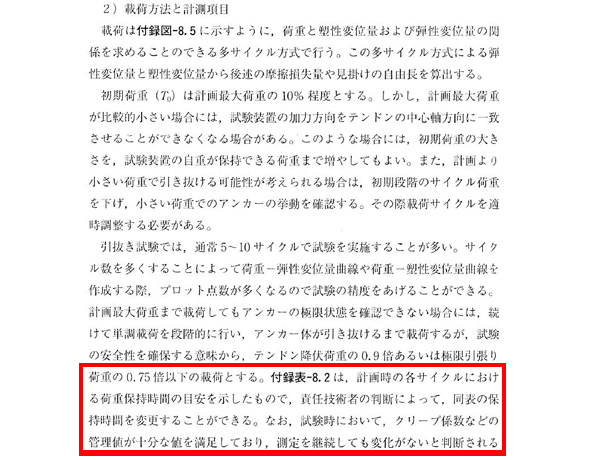
Here, Appendix Table 8.2 is"Guidelines" for Load Holding Times in Each Cycle During Planningand,
The retention periods listed in the table may be changed at the discretion of the responsible engineer....it says.
Furthermore,If, during the test, control values such as the creep coefficient are found to be sufficiently high and it is determined that continuing the measurement will not result in any changes, the holding time may be shortened.It clearly states, “,”
② The definition of “stability” for displacement is 1 mm over 3 minutes
So, how do we determine what “no change” means? That’s explained here, too.
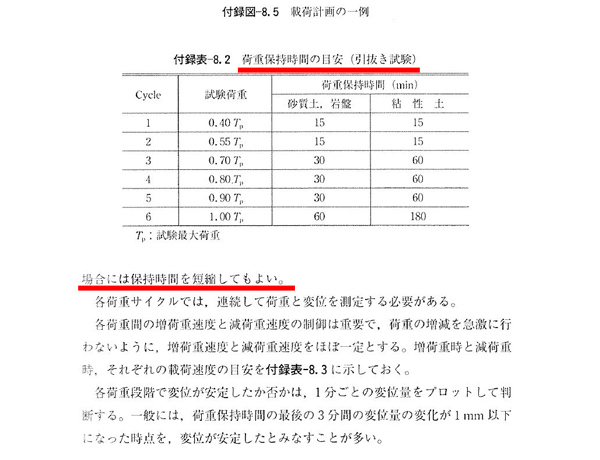
Whether the displacement has stabilized at each load stage is determined by plotting the displacement values at one-minute intervals, and
Generally, the point at which the change in displacement during the final 3 minutes of the load-holding period becomes 1 mm or less is defined as,
It is often considered that the displacement has stabilizedIt is said that...
In terms of on-site operations,1 mm in 3 minutesSo, I guess we should just use that as a yardstick.
Incidentally, in Explanatory Table 8.1, the “Stabilization of Displacement” column for the pull-out test and the verification test also states “1 mm/3 min or less.”
③ It says that the duration of the aptitude test can also be shortened.
And now for the aptitude test. In Appendix 8-4, under “3) Load Holding Time,” it says the following:
"Depending on the results of the pull-out test in the basic test, the load holding time during the test may be shorter than the values shown in Appendix Table 8.6."
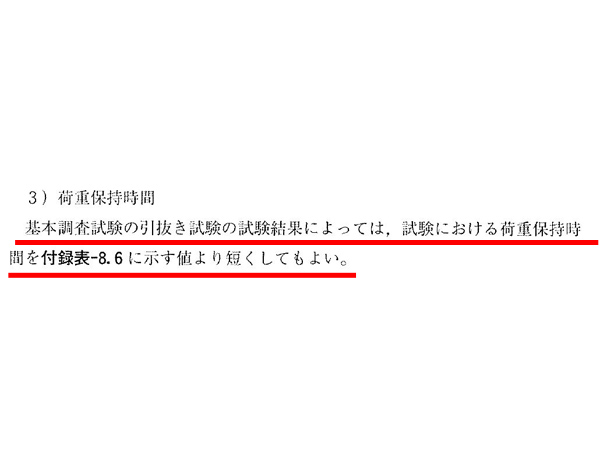
In other words, if you've conducted a pull-out test in advance and have a good understanding of how the soil behaves, then,The duration of the aptitude test may be shorter than specified in the standard table.This is what the standards manual recognizes.
There are truly many workplaces that treat the fractions in the table as if they were sacred texts—and won’t allow them to be changed even for a single second—without understanding this point.
I used to think that too, lol.
Where Exactly Do You Save Time, and How Much? | 4 Ways to Save Timeト
Now that we understand the theory, let’s look at exactly where and by how much the process is streamlined in practice. I’ll describe it in the order I follow when working on-site.
Point 1 | The holding time for the load should be 1 to 2 minutes (this is the most important part)
The qualification test consists of multiple cycles. It always proceeds as follows: 0.4Td → unloading → 0.6Td → unloading → …, and so on.Passing through a load stage already experienced in the previous cycleI will.
In Explanatory Table 8.1, the holding times are categorized into “new loads” and “loads in the history,” andThe load holding time for the load in the history is 1 to 2 minutes.It is said that...
At a point where the load range is simply being repeated after having already been experienced once,It is not necessary to stop the time for the new load.That's the point.
With a 5-cycle aptitude test, you’ll go through the screening process a fair number of times.
Depending on whether you stop here for 15 minutes each time or just pass through in 2 minutes, the time spent per trip will be completely different.
To put it simply, be careful only when taking on new loads while climbing, but go full throttle on the way down.
Point 2 | Check the rank settings first
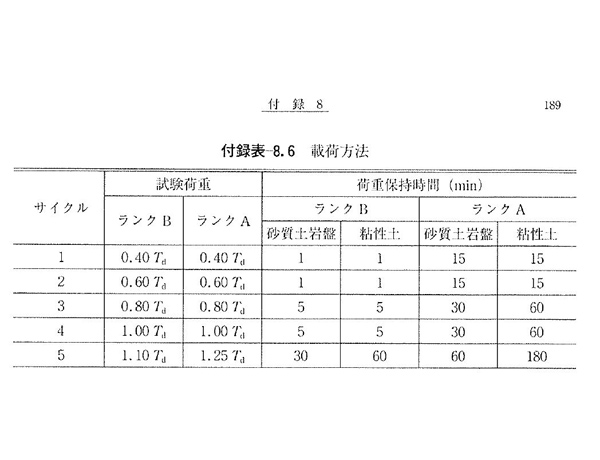
Looking at the loading method for the qualification test (Appendix Table 8.6), the minimum measurement times for Rank A and Rank B are completely different.
| Cycle | Test Load, Grade B | Test Load, Grade A | Minimum Measurement Time: Grade B (Sandy Soil, Bedrock / Cohesive Soil) | Minimum Measurement Time: Grade A (Sandy Soil, Bedrock / Cohesive Soil) |
|---|---|---|---|---|
| 1 | 0.40 Td | 0.40 Td | 1 minute / 1 minute | 15 minutes / 15 minutes |
| 2 | 0.60 Td | 0.60 Td | 1 minute / 1 minute | 15 minutes / 15 minutes |
| 3 | 0.80 Td | 0.80 Td | 5 minutes / 5 minutes | 30 minutes / 60 minutes |
| 4 | 1.00 Td | 1.00 Td | 5 minutes / 5 minutes | 30 minutes / 60 minutes |
| 5 | 1.10Td | 1.25Td | 30 minutes / 60 minutes | 60 minutes / 180 minutes |
Design and Construction Standards for Ground Anchors, with Commentary: Appendix Table 8.6 (Loading Methods for Suitability Tests)
For Rank B sandy soil and bedrock, the total is 42 minutes; for Rank A, the total is 150 minutes.
A difference of more than three timesThat's right. For Grade A cohesive soil, the final cycle alone takes 180 minutes—a full three hours.
Since the rank is determined by the classification based on the service life and importance of the structure (Explanatory Table 6.1),It's not something the field staff can just decide to drop on their own.。
However, whether Rank A is appropriate at the design stage is an issue that is well worth discussing in detail with the client and the designer before construction begins.
I’ve listed these points here because they are things you should check before submitting the test plan.
That said, even the government officials are completely clueless when they see these numbers, so it just slips right through lol.
Point 3 | Since the design maximum load is an “upper limit,” it can be reduced
The maximum load specified in the plan for the qualification and verification tests is,
Rank A Design Anchor Force (Td) × 1.25
Rank B Design Anchor Force (Td) × 1.10
It is stipulated as follows.
And in Appendix 8-4,"The maximum design load specified in the standards is an upper limit; since testing is conducted using anchors that will actually be used in service, the responsible engineer may, based on the actual site conditions, set the load at a value below this limit."It is clearly stated that...
I make my decisions based on the condition of the mountain and the circumstances during drilling, but at many job sites,1.20 timesWe use [...].
The reason is simple: if you know something won’t come loose under the anchoring load, is there really any need to keep pulling on it with even more force?
The criteria for the suitability test are based on the principle that "the planned maximum load is set higher than the design anchor force, and if the structure can withstand this load, the design and construction are deemed suitable."
That said, since situations where large, temporary (instantaneous) loads are applied—such as during an earthquake—do occur in reality, the question is where to set that upper limit, after ensuring an adequate safety margin.
Point 4 | Physically Shortening | Using Two Jacks
From here on, we’re not talking about the standards manual—we’re talking purely about on-site procedures.
The process of securing the tension itself is,Increase the number of jacks to twoThat's the clearest and most effective way.
Even if we can’t reduce the measurement time on the testing machine itself, we can process the waiting time for setup, sample replacement, and dismantling before and after the measurement in parallel, which directly increases the number of tests we can perform in a day.
Of course, this requires proper staffing and coordination on the counterforce side, and at many job sites, it’s simply not possible to use two machines on a narrow slope.
Rather than simply "reducing measurement time," "reducing wait time" first yields results with zero risk.
Please keep in mind that this is one option if you want to save time.
On the other hand, there are places that absolutely must not be shortened
We’ve been talking about cutting things down so far, but there are also clear lines that must not be crossed. If you go beyond those lines, the exam ceases to be an exam.
If the displacement exceeds 0.5 mm, the only option is to “extend” it.
In the evaluation of the performance test, if the displacement exceeds 0.5 mm at the elapsed time specified in Appendix Table 8.7 when the maximum test load is applied,Extend the test duration in Appendix Table 8.6It is stipulated as follows.
| Rank | Geology | Elapsed Time | Displacement |
|---|---|---|---|
| A | Sandy Soil and Bedrock | 20 to 60 minutes | 0.5 mm |
| A | Cohesive Soil | 60 to 180 minutes | 0.5 mm |
| B | Sandy Soil and Bedrock | 10 to 30 minutes | 0.5 mm |
| B | Cohesive Soil | 20 to 60 minutes | 0.5 mm |
Design and Construction Standards for Ground Anchors, with Commentary: Appendix Table 8.7 (Guidelines for Extending Test Duration)
The maximum test duration, including any extensions, is set at 120 minutes or more for sandy soil and bedrock and 360 minutes or more for cohesive soil in Rank A, and 60 minutes or more for sandy soil and bedrock and 120 minutes or more for cohesive soil in Rank B, and
At that time,Creep coefficient α of 2.0 mm or less"If that is the case, then it is acceptable"—that is the conclusion in Appendix Table 8.8.
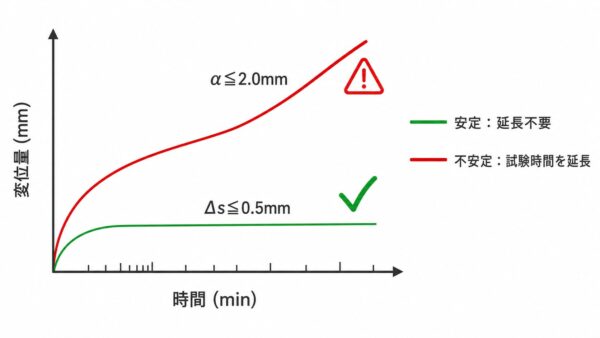
The creep coefficient is defined by the following equation.
α = (Sb – Sa) ÷ log(tb/ta)
Sa and Sb represent the anchor head displacements (mm) at times ta and tb, respectively.
In other words, "cutting time without ensuring stability" is a no-go, andWhen things aren't going well, keep extending the timeThat is the correct answer.
I think it’s reasonable to set a standard maximum of about 30 minutes, with the option to extend if necessary.
Well, to be honest, once the movement stops completely, there isn't much activity after that, so you can just shorten it from that point on.
The criteria for the verification test are strict, down to the minute
Click here for information on the loading method and evaluation criteria for the verification test (1 cycle).
| Cycle | Test Load, Grade B | Test Load, Grade A | Minimum Measurement Time (Sandy Soil and Bedrock) | Minimum Measurement Time (Clay) |
|---|---|---|---|---|
| 1 | 0.40 Td | 0.40 Td | 1 minute | 1 minute |
| 2 | 0.60 Td | 0.60 Td | 1 minute | 1 minute |
| 3 | 0.80 Td | 0.80 Td | 1 minute | 1 minute |
| 4 | 1.00 Td | 1.00 Td | 1 minute | 1 minute |
| 5 | 1.10Td | 1.25Td | 5 minutes | 15 minutes |
Design and Construction Standards for Ground Anchors, with Commentary: Appendix Table 8.9 (Loading Methods for Verification Tests)
The determination is as follows for sandy soil or bedrock:Displacement of 0.2 mm or less over a period of 2 to 5 minutes, if it's cohesive soil,Displacement of 0.25 mm or less over a period of 5 to 15 minutesTherefore, the creep coefficient is 2.0 mm or less (Appendix Table 8.10).
As you can see by now, the confirmation test isIt was a fairly short exam to begin withThat's it.
Since this is an exam where every question counts, there’s almost no room to cut any more questions.
If the verification tests are taking a long time, it’s not a matter of measurement time but rather a setup issue.
Don't rush the loading speed
One factor that’s surprisingly often overlooked is the loading speed.
In Appendix Table 8.3, a constant rate of the design maximum load divided by (10–20) kN/min is recommended for loading, and a constant rate of the design maximum load divided by (5–10) kN/min is recommended for unloading, and
Avoid sudden increases or decreases in loadIt is clearly stated that...
Saying, “I want to finish quickly, so I’ll run the pump at full speed,” may not actually save time and could potentially corrupt the data.
If you're not getting good results, I think it's a good idea to pay attention to the up and down movements and try to keep them consistent each time.
Decisions regarding shortened procedures must always be made in the name of the engineer in charge.
All the abbreviations I've written so far are"At the discretion of the engineer in charge"This is based on the premise that...
- In the test plan, include the following statement: “The holding time shall be based on Appendix Table 8.6, but may be shortened at the discretion of the responsible engineer if the control values are met.” (*This is mandatory.)
- Whenever readings exceed the thresholds of 0.5 mm or 0.2 mm, record the extension without hesitation (this is partly due to the influence of the underlying rock, so for now)
If you keep these two together, even if someone asks later, “Why is the time so short?” you’ll be able to explain it with the records.
Even so, does anyone actually know we cut the schedule short? Even if the general contractor knew, it’s fine as long as we put “we’ll cut the schedule short” in the project schedule plan.
I often see people at the gym who, even though they’re stable, keep holding the position for exactly 60 minutes.
I'm not saying it's bad.
However, once it stabilizes, the data won’t change, so,Those 30 minutes didn't do anyone any good.What's up, lol
On the other hand, it's not acceptable to stop just because the time is up, even though the action is still ongoing.
The manual isn't saying, "Be on time"; it's saying, "Make sure everything is stable."
Don't look at the clock; look at the displacement gauge.
In the end, that's what it all comes down to.
I'm not saying we're perfect enough to talk down to others, but I'd really like to stop working just by watching the clock—lol.
See you later.
Know Your Limits to Avoid Overworking | Staffing at Slope Construction Companies