Hello, everyone.
This is Enta.
Haven't you found yourself thinking, "Huh?" more often lately when it comes to the prices of materials?
When it comes to the situation in Russia and Ukraine, or the Middle East, to be honest, when you're working on the front lines, it all feels like something far removed from your daily reality, but,
The prices of construction materials are being affected—and not just gradually, but quite significantly, aren't they?
How is war related to the materials used by slope stabilization contractors?
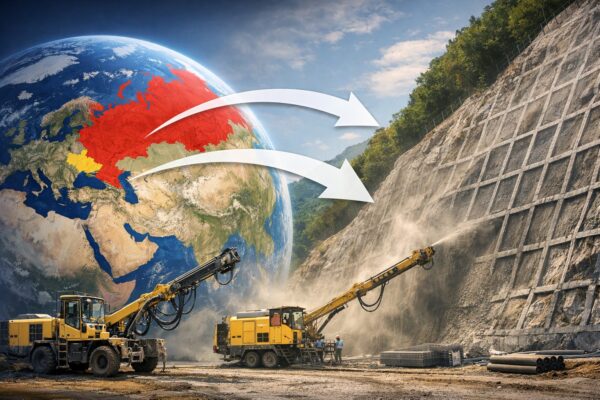
Following Russia's invasion of Ukraine in February 2022, global prices for resources such as coal, natural gas, iron ore, and steel fluctuated.
All of these are raw materials directly used in the manufacture of construction materials.
And now
According to data from the Japan Construction Industry Federation,The Construction Materials Price Index (Civil Engineering Sector) rose by approximately 411 TP3T compared to January 2021 (as of December 2025).
It’s not just the war; the weak yen, rising transportation costs, and labor shortages are all compounding the problem, so,
It’s not exactly a simple matter, but it’s certainly true that the situation in Russia and Ukraine is one of the triggers...
Commentators on the news are always saying all sorts of things, but I just don't know what's going on anymore... (It's pretty complicated.)
Part 1: Cement — An Essential Material for Civil Engineering
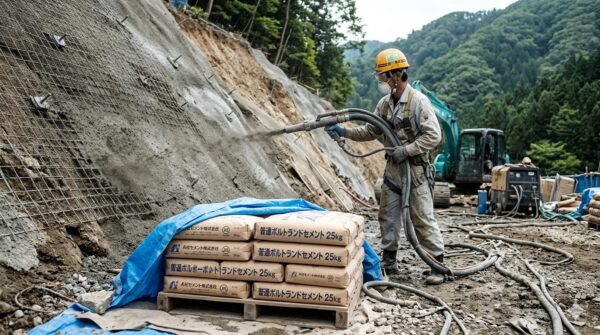
Sprayed mortar work, on-site sprayed formwork, grouting for rebar insertion, ground anchors……
There’s hardly any type of construction work that doesn’t use cement, is there?
That cement is quite expensive.
According to the Bank of Japan’s Domestic Corporate Goods Price Index, the price of cement rose by +56.61 TP3T compared to 2020 (as of May 2025).
As I mentioned in a previous post, it’s becoming common for retail stores to charge 1,000 yen per bag.
It reportedly takes about 130 kg of coal to produce 1 metric ton of cement, and there was a period after the invasion of Ukraine when coal prices temporarily rose to nearly five times their levels from the summer of 2021.
Furthermore, it is said that transportation costs account for more than 30 percent of the price structure for cement, and the surge in fuel costs is directly reflected in that figure.
It is reported that major cement companies have been implementing price increases of around 2,000 to 2,200 yen per metric ton since April 2025.
Based on 25 kg per bag, a 1-metric-ton price increase of 2,000 yen equals a 50-yen increase per bag. That’s how the current price has built up, isn’t it?
The ordinary cement we commonly use costs about 700 to 1,000 yen per bag.
Even if you buy in bulk, prices start at 650 yen, so it seems to me that the market price just isn't keeping up anymore.
It's going to go up even more this year!
Part 2: Special-Shaped Steel Bars (Reinforcing Bars) — Reinforcing bars used extensively by reinforcing bar installers and formwork carpenters
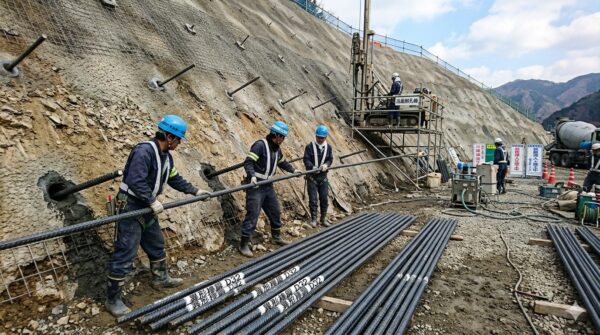
Reinforcement bar installers primarily use deformed steel bars ranging from D19 to D29.
Russia is the world's second-largest steel exporter, and Ukraine is also a major steel-producing region.
Just as prices had begun to rise following the "iron shock" caused by the COVID-19 pandemic,
An online news outlet reported that, compounded by the situation in Ukraine, steel production and transportation costs have risen even further.
In March 2025, the Trump administration imposed an additional 25% tariff on all imported steel and aluminum, and in June of the same year, it raised this to 50%.
If the price per metric ton fluctuates by a few thousand yen, the cost changes by tens of thousands of yen, so the impact is more noticeable at sites with a large volume of units.
The benefits of placing lot orders are already starting to disappear.
If the government agency doesn't adjust unit prices to account for soaring material costs after awarding a contract, both the general contractor and the subcontractors will go under...
Part 3: PC Steel Strand — Tension Members Used in Ground Anchor Construction
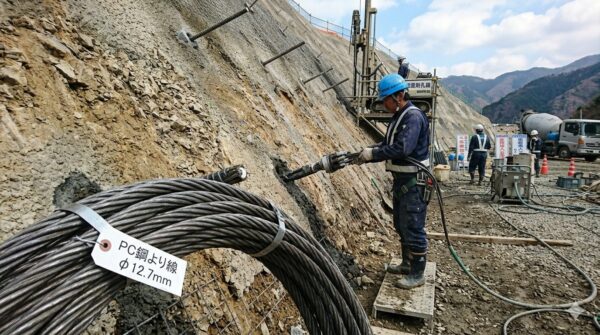
The PC steel strand (JIS G 3536) used for tendons in ground anchor construction is a special steel material with significantly higher strength than standard reinforcing bars.
It seems that high-strength steel requires a lot of energy to produce, and the surge in coal and natural gas prices is said to have a direct impact on manufacturing costs!
Since many of the accessories required for permanent anchors—such as dual anti-corrosion coatings and sheaths—are also made of steel, prices are likely to keep rising overall!
A sales representative from their company will be visiting us soon, so I'll ask them about it.
Since ground anchors are a type of construction work where the unit price per anchor is relatively high, even a slight change in the material ratio can easily affect the profit margin.
The problem of estimated unit prices failing to keep pace with rising costs
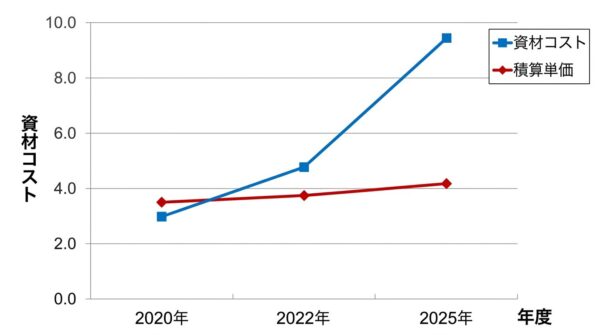
According to an article on the Japan Construction Industry Federation’s estimates,
When you combine the increases in both material and labor costs, this yearTotal construction costs in the civil engineering sector rose by 28 to 321 TP3T compared to 2021It is believed that this may be possible.
On the other hand, the revisions to the cost estimation standards have not kept pace with the rate of increase in material costs in many areas, and
I think that gap is directly placing a burden on the construction company.
Even if all the wars were to end, it seems it would be quite difficult for trade and energy ties with Russia to return to normal right away.
Personally, I think it’s getting a little tough to just say, “Something like last time,” when getting a quote.
The war is happening over there, but commodity prices are still fluctuating today.
Stagflation—when inflation and deflation occur simultaneously!
As a result, even if the construction budget remains the same as last year, the number of construction projects will decrease because prices have risen.
I feel like that's happening right now.
There are no jobs anywhere.
It seems like the only places we see are disaster sites and large dam construction sites.
When I read articles online and look into things like this, I just end up feeling kind of down.
Even when I have AI search through the literature, not a single good story comes up lol
You can’t help but wonder if this year is going to be tough again, can you?
As I mentioned the other day, the number of bankruptcies this year is off the charts!!?
See you later.