Hello, everyone.
This is Enta.
It was the height of summer in the Ogasawara Islands the other day.

But that's beside the point.
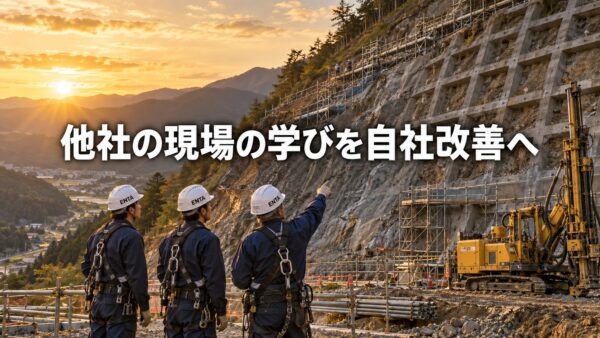
This is about how to turn insights gained while providing support at another company’s worksite into improvements for your own company.
Weaknesses in Our Own Company Revealed by Observing Other Companies' Support Operations
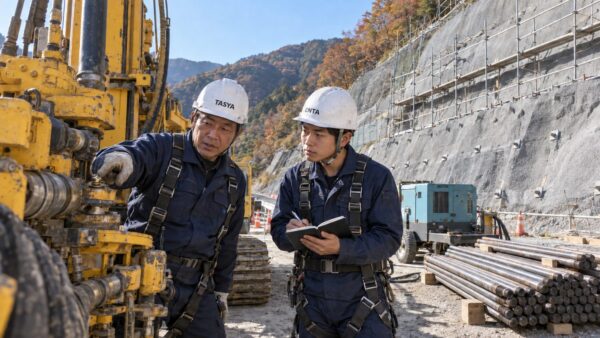
Occasionally, I go to other companies' job sites to lend a hand.
When I was just starting out, every time I visited a senior colleague’s worksite, I was reminded just how naive our approach was.
"This one lasts longer than that grease."
"This part is damaged, so fix it when you get home."
It’s the kind of thing people just say, isn’t it?
There are many things you’d never realize if you just stayed at your own company’s worksite.
It’s because we do things this way at our company every day, so it’s become “the norm.”
It’s only when you visit other companies’ worksites and compare them that you begin to see your own company’s quirks.
For example, here are some places that are fun to check out when you're cheering on your favorite team:
- How to store materials and drilling casings, and preparations for the next task
- Daily Maintenance of Drilling Machines and Compressors, and the Lubricants Used
- How to Conduct Morning Meetings and Hazard Prediction Activities (KY Activities)
- How to Clean Up at the End of the Workday and Prepare for the Next Day
However, there's a catch here.
About two or three days after I get back from cheering, I’ve already forgotten most of what I saw, lol.
Since it’s only in the mind of the person who noticed it, nothing’s going to change for the company lol
It's the forgetting curve, lol.
A System for Reflection and Sharing to Take Insights Home
So, how can we bring about improvements in the company?
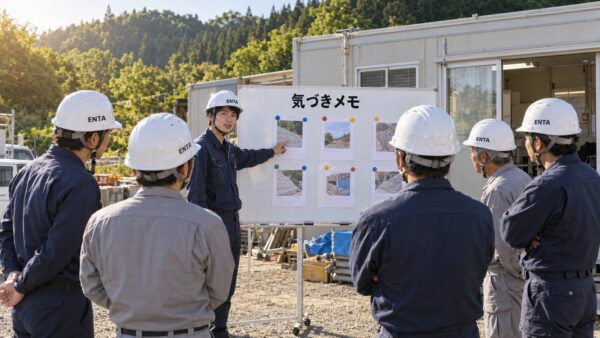
It’s about “capturing your insights on paper or in photos and creating a space to make decisions.”
A small slope-construction company like ours simply can't take on such a huge undertaking, and it wouldn't be sustainable anyway.
Even so, I believe the process of “keeping,” “reviewing,” and “recycling” can also be applied to improving technology.
What follows is just my suggestion.
- Take photos at the event and share them with everyone on LINE
- "At which job site?" "What did you see?" "How would we handle it?" "Can we make it right away?"
- I'd better make it right away before I forget!
The key is to implement it quickly.
If we just go ahead and build it before anyone can say a word, it'll be ready for practical use right away.
If it's a good product, it will catch on.
It’s kind of a perk of being a small company—our agility really makes a difference.
When it comes to grease, something like, “The team I root for uses this grease. I hear it lasts a long time, so I’m going to buy some right away!” is plenty.
We'll try it on one machine, and if it works well, we'll roll it out to all the machines.
If it doesn't work, I'll put it back.
Just this alone will transform these insights into a company asset.
We repay the debt of gratitude we owe by passing on our company’s technology to the next generation.
When it comes to teaching, there’s a quote often attributed to Einstein that goes...
"Teaching should be something that makes the student feel that what we offer is not a burdensome obligation, but a precious gift."
A sentence along these lines is often cited.

Meaning: It expresses the essence of education: that, for learners, acquiring knowledge and instruction should not be a painful obligation, but rather should be conveyed as a source of joy and value—a gift—that enriches the heart.
It’s not part of our job to have our senior colleagues come by to cheer us on and teach our craftsmen various things.
It's purely out of goodwill.
In that case, it would be a waste to keep the items we received within our own company.
Now it’s our craftsmen’s turn to teach the young workers and technical interns.
We take what we’ve learned, shape it into our company’s own way of doing things, and pass it on to the next generation.
I think that's the best way to repay them.
And there's one thing I'm careful about.
Don't simply copy what other companies do.
Machine models, the number of employees, specifications, and areas of expertise vary from company to company.
Even if a method worked well at the company you were supporting, if you don’t adjust it to fit the scale of your own company, it can actually make it harder for the front-line operations to run smoothly.
So, we’ll tailor it to our company’s needs, put some real thought into it, and refine it further.
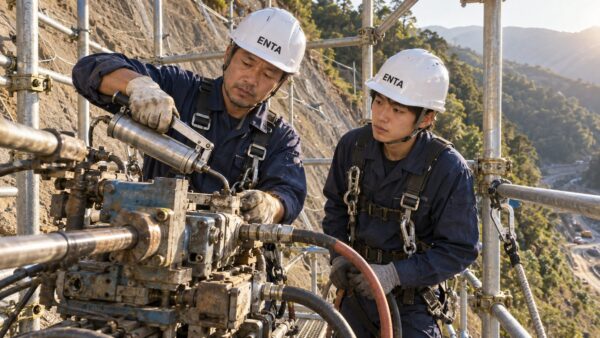
To be honest, I don't think it's a bad thing to make a fool of yourself on another company's job site.
The more embarrassment I went through, the more I realized what our weaknesses were.
The problem is leaving obvious weaknesses unaddressed.
Learning begins when a company—or an individual—acknowledges what it or they cannot do.
Whether it’s a single note, a photo, or even just three minutes during the morning meeting, share the insights you’ve brought back with your colleagues.
It would be great if I could keep building on that little by little and someday catch up to my seniors.
When that time comes, I hope my seniors will be there to support me warmly lol
See you later.
I Hate Salespeople Like This lol | Honest Thoughts from the Field