

Hello, everyone.
This is Enta.
It just occurred to me, but,
Is a construction foreman considered white-collar or blue-collar?
Since he wears a helmet on the job site, he comes across as more of a blue-collar worker.
But when you take a objective look at the actual job duties, the main focus is on managing finished products, quality, processes, and costs.
"Huh? Isn't this a white-collar job?" That's the kind of conversation that comes up, lol.
A site supervisor's job actually consists solely of "administrative duties"
Here’s a list of the tasks a director does on a daily basis.
Workmanship control, quality control, process control, and cost control. They’re all forms of “control.”
Meetings, drafting documents, poring over blueprints, organizing photos, safety paperwork… It’s more on the desk-work side, if anything.
Of course, there are site visits and surveying tasks, but I imagine many supervisors spend most of their working hours doing desk work at the main office or a temporary office.
From a craftsman’s perspective, a director is still necessary
On our slope-construction sites, to be honest, there are moments when it looks like things could run smoothly even without a foreman, right? lol
This is something I feel partly because I have a background in directing, but the perspective changes when you look at it from a craftsman’s point of view.
Reviewing drawings to verify heights and the scope of work; carefully reading the special specifications; holding meetings with the general contractor and the client; and preparing as-built and quality documentation.
There are many aspects of this that are difficult unless you're the director.
That’s why the site supervisor is in a gray area between blue and white. Personally, I think “Hybrid Color"I'm in a position where I'd almost want to call him that, lol."
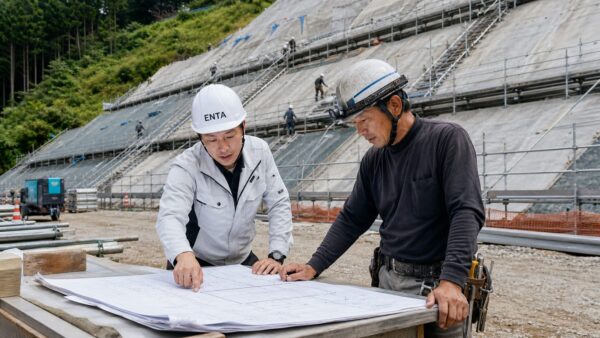
The former manager also did some hands-on work.
In the past, on construction sites in rural areas, it was common for foremen to also perform the work of skilled tradespeople.
I used to work my butt off on construction projects back when I was young, too.
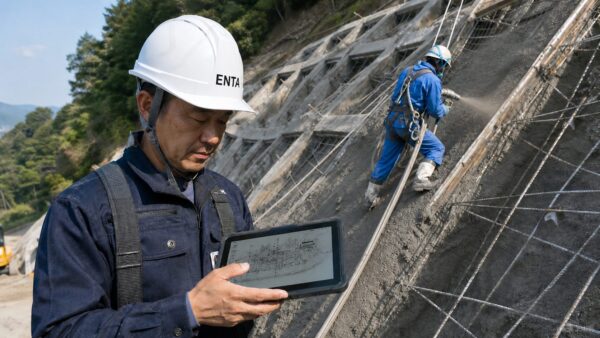
Install the formwork, set up the framework, and spray using the nozzle.
We didn't do much work on the anchors, but we did a thorough job on the slope.
Looking back now, this was a major experience.
The Essence of Experience EngineeringIt comes from the sense of understanding you gain by doing it yourself.
However, in today's world, there is a complete division of labor.
Major companies generally outsource all construction work.
On the other hand, there are still cases where local contractors include their own labor costs for construction and supervision, and this type of worker—who serves as both supervisor and craftsman—is incredibly versatile.
The Reality of Wages and Work Intensity—A Look at the Data
Let's take a look at the numbers here.
Ministry of Health, Labor and Welfare “Reiwa 6 Basic Survey on Wage StructureAccording to [...], the average annual income in the construction industry is5.653 million yen。
This is approximately 380,000 yen higher than the average for all industries.
However, the peak in wages in the construction industry isAges 45–49。
They tend to reach their peak about five years earlier than those in the manufacturing sector (ages 50–54).
(Ministry of Land, Infrastructure, Transport and Tourism: Status of Wages, etc., in the Construction Industry / Ministry of Health, Labor and Welfare: Basic Survey on Wage Structure).
| Category | Average Annual Income |
|---|---|
| Construction Industry: Overall Average | 5.653 million yen |
| 10 to 99 people | 4.993 million yen |
| 1,000 or more people | 7.364 million yen |
*Reiwa 6 Basic Survey on Wage Structure
Despite the high workload, there are few applicants.
There are a lot of applicants for low-stress office jobs. …It’s kind of strange, isn’t it?
Even though they say they want higher pay, they’re reluctant to work in the construction industry...
And thenPeople are flocking to administrative jobs that are increasingly being automated, while hands-on jobs that are difficult for AI to replace are being completely overlooked.The fact that there is a tendency.
And this trend is likely to accelerate.
Personally, I think this is partly the fault of certain politicians and the media, but I’m hoping we can somehow turn things around for the better!
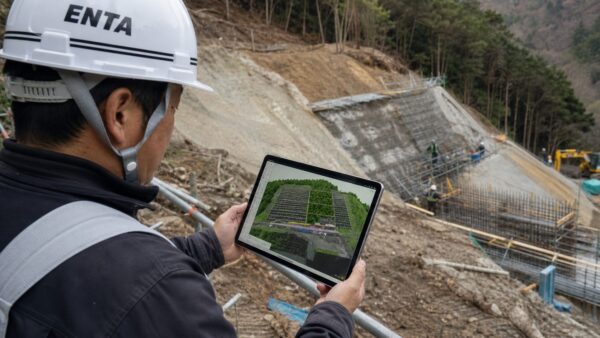
How Will the Role of a Construction Supervisor Change in the BIM/CIM Era?
The Ministry of Land, Infrastructure, Transport and TourismApplication of BIM/CIM Principles to Directly Administered Civil Engineering Operations and Construction Projects Starting in Fiscal Year 2023We have started
(Ministry of Land, Infrastructure, Transport and Tourism, “BIM/CIM-Related Standards and Guidelines, etc.”)
Furthermore, according to the Ministry of Land, Infrastructure, Transport and Tourism, “i-Construction 2.0"The report sets targets of a 1.5-fold increase in productivity and a labor-saving rate of 301 TP3T by 2040."
The BIM drawing review system is expected to be phased in starting in the spring of 2026.
In other words, we’re entering an era where government blueprints will be instantly converted into 3D models and displayed on smartphones and tablets, allowing us to see the construction area at a glance.
Up to a certain level of management, it is possible that work will proceed even without supervisors being constantly on-site.
That’s when the question comes up: “How does a director add value?” lol
What will remain from now on is “hybrid color.”
I think there’s a possibility that half of a director’s job could eventually be replaced by AI or smartphone apps.
You’ve probably already seen ads from various companies promoting AI-powered estimates and AI-based management, right?
So the only weapon left is “Construction Capabilities". This is the true essence of blue-collar work."
A hybrid color that’s half white and half blue. For short,High CollarOr something like that, lol
Being a director has its ups and downs—there are busy times and slow times, right?
Studying for exams and preparing documents are important, but in the meantime, try to get the construction work up to a certain level.
I believe this is a worthwhile investment in the long run.
To be honest, the craftsmen might not be too happy about this, lol
As a slope engineer and civil engineer, the foundation of my career lies not only in drawings and documents, but also in the experience I’ve gained through hands-on construction work.
In the future, should project managers be the ones to learn about construction!?
I think companies with managers who can ride that wave will definitely become stronger.
See you later.