
Hello, everyone.
This is Enta.
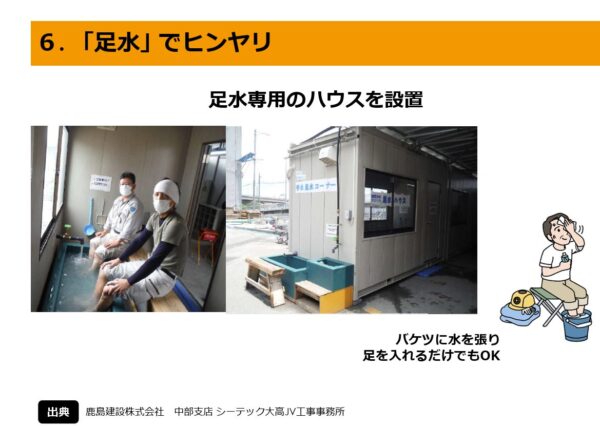
The other day, the Ministry of Health, Labor and Welfare’s"A Heat Stroke Guide Workers Can Use Right Away"I was reading it.
In that article, they featured an initiative called “Cool Foot Baths” run by Kajima Corporation, a major general contractor, and I thought it was really great.
I immediately started looking for a product based on a similar concept that could be used on-site, and I found one.
To begin with, the revised Occupational Safety and Health Regulations took effect on June 1, Reiwa 7, making heatstroke prevention measures in the workplace a mandatory requirement subject to penalties.
This applies to work performed for at least one continuous hour or for more than four hours in a day when the WBGT is 28 or higher or the air temperature is 31°C or higher.
If you violate this rule,Imprisonment for up to six months or a fine of up to 500,000 yenwill be imposed.
(Ministry of Health, Labor and Welfare “Strengthening Heat Stroke Prevention Measures in the Workplace”). This means there has been a clear shift from a “best-efforts obligation” to a “legal obligation.”
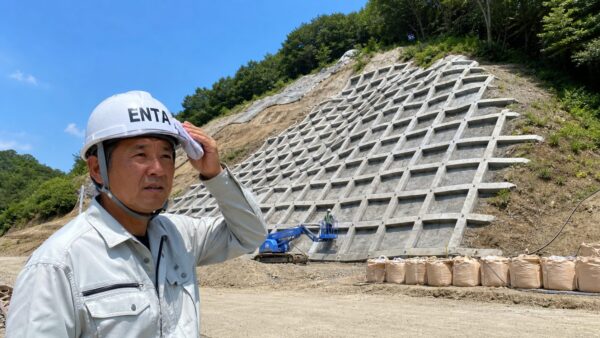
Why "Whole-Body Cooling"—Endorsed by the Ministry of Health, Labor and Welfare—Is Necessary in the Field
The key to saving a life when someone collapses from heatstroke is “Cool First, Transport Second”—in other words, cool the person’s entire body at the scene before calling an ambulance.
The Japanese Society of Emergency Medicine'sGuidelines for the Management of Heat Stroke 2024However, in cases of severe heatstroke or when there is a suspicion that the condition may progress to severe heatstroke,
It is generally considered best to immediately cool the entire body in an ice bath (cold water bath) at the scene.
The reason is simple: water conducts heat about 20 times better than air.
Even if you move them to an air-conditioned rest area, their core body temperature won't drop easily, but if you submerge them in water, you can quickly lower their body temperature.
The “three-point cooling” method—which involves applying ice packs to the back of the neck and under the arms—has too small an area of contact with the skin and is largely ineffective against severe heatstroke.
The average time from the call for an ambulance to admission to the hospital is47.2 minutes(Reiwa 5: Data Released by the Fire and Disaster Management Agency, Ministry of Internal Affairs and Communications)。
During heatstroke season, response times may be even longer due to high demand for ambulances.
I think the only option is to cool the area immediately before the brain and organs undergo protein denaturation (becoming like hard-boiled eggs).
"P-PEC"—Installs in 3 Seconds
That's when I came across “P-PEC (P-PEC)"—an ice bath specifically designed for first aid treatment of heatstroke.
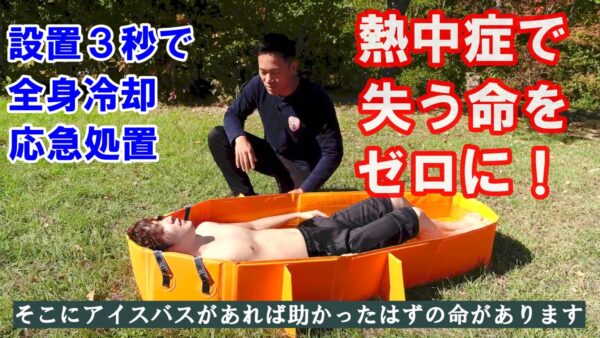
A patented product that can be installed in 3 seconds; the standard price is60,000 yen (including tax). I hear it’s being adopted by the Ground Self-Defense Force, schools, and companies.
As a general rule, ice packs and water are almost always available on site.
If you just throw some ice packs and water into this, you can immediately cool down the entire body of a victim who has collapsed.
Personally, what made me think, “This is it!” was the fact that the structure was designed with the specific characteristics of a civil engineering site in mind.
While we’re busy inflating an inflatable pool and filling it with water from a hose… the victims’ symptoms are getting worse.
It can be set up in three seconds—that’s a huge advantage for on-site first aid. The key is that, just like an AED, “anyone can use it, anywhere, easily.”
That thing I’ve been saying all along—"a cold-water bath on site"
Actually, I’ve been saying for a long time, “Let’s put a cold-water bath on the set.”
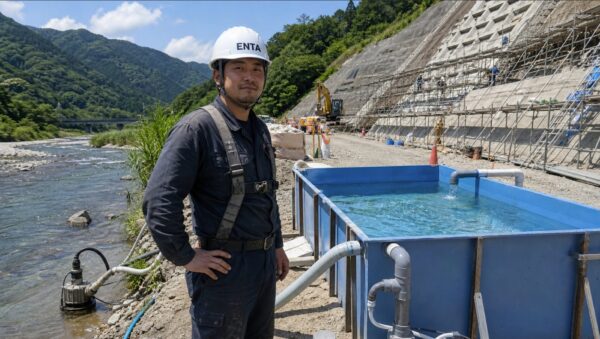
Slope construction sites are often located along rivers or near streams, aren't they?
Just use an injection hose (air hose) and a small pump to circulate river water, keeping it in a constant state of being a water bath.
After finishing work on site, I always take a cold shower to quickly release the heat that has built up in my body before getting in the car to drive home.
Just doing this makes a big difference in how heavy your body feels the next day.
If even one craftsman goes down, the entire production process comes to a standstill.
So, in the summer, a cold bath isn't a "luxury"—it's "process management," right!? lol
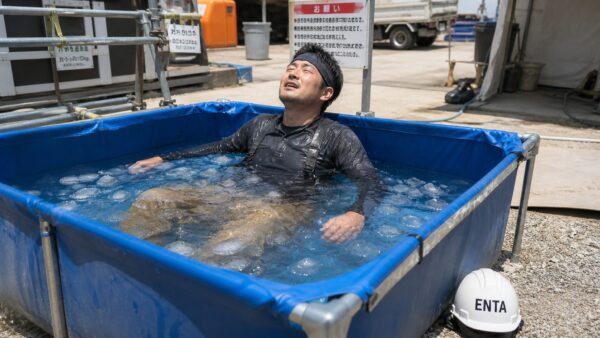
"Dash Pool" for large construction sites, "electric portable" units for break areas
Furthermore, at large-scale job sites or those near rivers,Dash PoolLarge products like this are also an option.
Since the size is large, securing a water supply is a challenge, but at a river site, a permanent recirculation system can be set up.
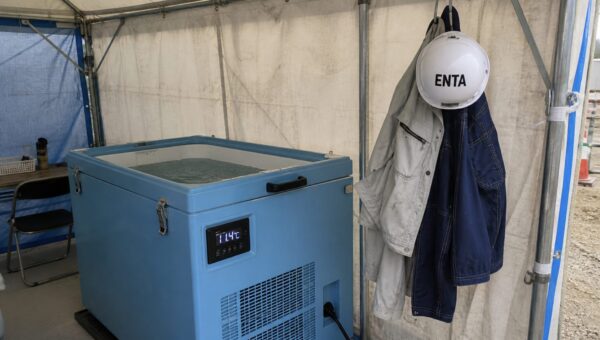
Electric Portable Ice BathYou can use it, too. (For indoor use?)
I’ve heard there are models that can cool the water down to about 11.4°C, so if you place one in the rest area, it could quickly cool down workers who are “on the verge of heatstroke.”
Here's a general idea of how to choose the right option based on the size of the site, the availability of a water source, and the availability of a power source.
| Site Size | Water Source | Power Supply | Appropriate Equipment |
|---|---|---|---|
| Elementary to Middle School | Yes/No | None | P-PEC (3-Second Installation Type) |
| Large-scale | There is a river | None/Yes | Dash Pool (Recirculating System) |
| Medium to Large | None | Yes | Electric Portable Ice Bath |
By combining them in this way, we can handle virtually any slope or civil engineering site.
Since heatstroke prevention measures have been included in the cost estimate,
I think what people are really wondering is, “So, what about the money?”
Starting this year, funding for heatstroke prevention measures is expected to be increased in the budget.
This is just a rough estimate, but for a construction site with site management costs of about 5 million yen,Around 30,000 yenIt is believed that this amount has been recorded.
It’s hard to say exactly what the numbers are, since they can vary greatly depending on the contracting agency, type of construction project, and region, but it’s actually less than I expected lol.
There are currently three main systems in operation.
① Long-standing"Amendment to Site Management Expenses to Help Prevent Heat Stroke"(FY 2019–, adjusted based on the rate of days with high temperatures)
② Starting in Reiwa 7 (FY 2025)A system that allows heatstroke prevention expenses to be recorded as design change costs, up to a maximum of 50% of the “On-Site Environment Improvement Expenses” rate.
③ Starting this year—Reiwa 8 (FY 2026)—that cap will beRaise it to 100 percentis being done
(Ministry of Land, Infrastructure, Transport and Tourism, Minister’s Secretariat, Technical Research Division, Revision of Cost Estimation Standards / Construction Prices, May 2025 issue).
It's not much, but it's better than nothing. However, I personally think that ice baths (pools) will become essential on-site in the future.
Since this has been made mandatory with penalties in place, if a case of severe heatstroke occurs and there is no effective cooling system in place,The possibility of being held accountable for safety management...comes up, right?
We’ve entered an era where even a single case of heatstroke can bring a worksite to a halt, cost a life, and result in penalties for the company.
Cold water baths and ice baths are no longer just “nice-to-have items”—they’re “essential equipment on site.”
Before the peak of summer arrives this year, please take a moment to review the cooling system at your worksite.
The idea of taking a break from the job site during the summer... isn't really realistic at the moment, lol (I mean, isn't that actually impossible?)
If they'd include one or two months' worth of company expenses for the summer in the 10-month period, I might still consider it, but that's not going to happen, is it?
That's the gist of it.
See you later.
Simply setting up a cold water bath at the site may help reduce the severity of heatstroke