Hello, everyone.
This is Enta.
I received an email regarding the conversation we had the other day about mixing mortar with hot water.
"What about the grout?"
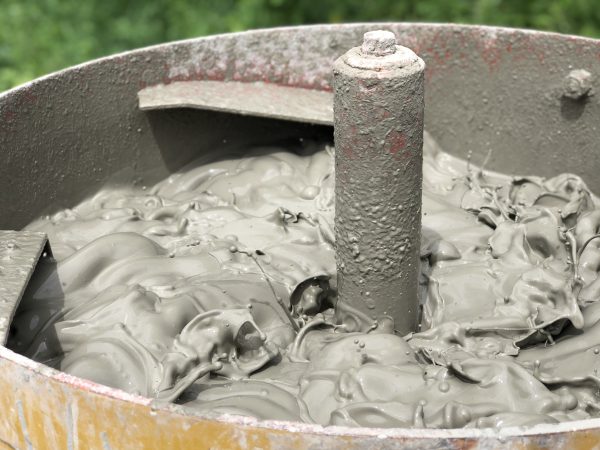
Based on my experience, I think cement slurry is a viable option.
Especially when working in extremely cold conditions.
Simulation at 50°C mixing water temperature
Simulation Conditions
Cement: 1,230 kg (specific heat: 0.20 kcal/kg·°C)
Mixing water: 615 kg (specific heat: 1.00 kcal/kg·°C,Temperature: 50°C)
Admixture: 24.6 kg (specific heat: 1.00 kcal/kg·°C; temperature: same as outside temperature)
Formula:

| Outside Temperature (°C) | Cement Temperature (°C) | Water Temperature (°C) | Temperature After Mixing (°C) |
| -5.0 | -5.0 | 50.0 | 33.2 |
| -2.5 | -2.5 | 50.0 | 34.0 |
| 0.0 | 0.0 | 50.0 | 34.7 |
| 2.5 | 2.5 | 50.0 | 35.5 |
| 5.0 | 5.0 | 50.0 | 36.3 |
This is just a rough estimate, but it looks something like this.
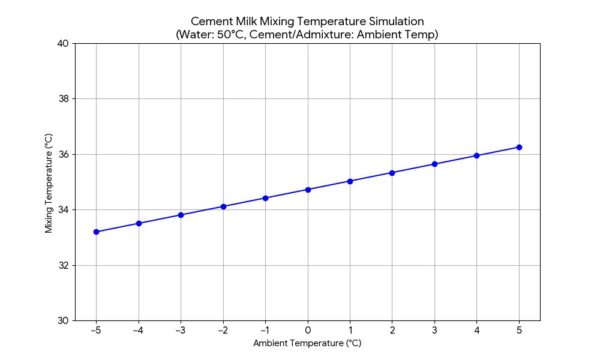
*Vertical axis: Mixing temperature; Horizontal axis: Outside temperature
In conclusion, the mixing temperature is too high!
As expected, since there's a lot of mixing water, the temperature tends to rise.
It does drop quite a bit when you add aggregate, though.
Standards for Mixing Temperature
Ministry of Land, Infrastructure, Transport and Tourism (General Specifications) · Standard Specifications for Concrete (Construction)
Concrete temperature during placement: 5°C or higher, 35°C or lower
The Japanese Geotechnical Society and other organizations do not specify standards for the mixing temperature in ground anchor work or rebar insertion work.
Therefore, if we were to apply the Japan Society of Civil Engineers’ Standard Specifications for Concrete and the guidelines for concrete placement in cold weather,
Ensure that the temperature during mixing and application is 5°C or higher.
I think that's a good standard to go by.
However, since concrete becomes "hot-weather concrete" when the temperature exceeds 35°C, it should be kept below that level.
Simulation at 30°C mixing water temperature
Simulation Conditions
Cement: 1,230 kg (specific heat: 0.20 kcal/kg·°C)
Mixing water: 615 kg (specific heat: 1.00 kcal/kg·°C,Temperature: 30°C)
Admixture: 24.6 kg (specific heat: 1.00 kcal/kg·°C; temperature: same as outside temperature)
| Outside Temperature (°C) | Cement Temperature (°C) | Water Temperature (°C) | Temperature After Mixing (°C) |
| -5.0 | -5.0 | 30.0 | 19.3 |
| -2.5 | -2.5 | 30.0 | 20.1 |
| 0.0 | 0.0 | 30.0 | 20.8 |
| 2.5 | 2.5 | 30.0 | 21.6 |
| 5.0 | 5.0 | 30.0 | 22.4 |
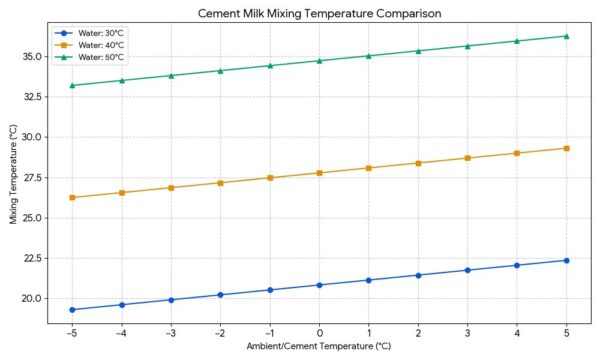
*Vertical axis: Mixing temperature; Horizontal axis: Outside temperature
This is a comparison graph of mixing water at 30°C, 40°C, and 50°C.
What is the best temperature range?
In terms of workability and quality, when it comes to cement slurry, it is generally considered best to use mixing water at 30°C during application.
I don't think 40°C is a problem, but in reality, if the temperature gets too high, it starts to solidify inside the blender lol.
It's not good because the concrete will end up in a "summer heat" state.
Furthermore, since there is a significant risk that this could affect submersible pumps and other rubber gaskets,
As for cement slurry, a temperature of around 30°C is considered ideal.
Also, even if the injection distance is around 100 meters, would 30 degrees be the optimal temperature, taking into account heat loss?
| Ambient and Cement Temperature | When the water temperature is 30°C | When the water temperature is 40°C | When the water temperature is 50°C |
| -5 °C | 19.3 °C | 26.3 °C | 33.2 °C |
| -4 °C | 19.6 °C | 26.6 °C | 33.5 °C |
| -3 °C | 19.9 °C | 26.9 °C | 33.8 °C |
| -2 °C | 20.2 °C | 27.2 °C | 34.1 °C |
| -1 °C | 20.5 °C | 27.5 °C | 34.4 °C |
| 0 °C | 20.8 °C | 27.8 °C | 34.7 °C |
| 1 °C | 21.1 °C | 28.1 °C | 35.0 °C |
| 2 °C | 21.4 °C | 28.4 °C | 35.3 °C |
| 3 °C | 21.8 °C | 28.7 °C | 35.6 °C |
| 4 °C | 22.1 °C | 29.0 °C | 35.9 °C |
| 5 °C | 22.4 °C | 29.3 °C | 36.3 °C |
As long as the temperature doesn't drop below 5°C when the concrete is poured, there's no problem, so it's fine.
By the way, if the mixing temperature is too high, it can lead to a decrease in strength, so you should definitely keep it below 30 degrees!
Since it’s harder to get a strong buzz, especially in the winter, will drinking it with hot water become a must from now on?
That's what I think.
See you later.
If you're having any issues with your spray-applied boiler, please feel free to contact us.