

Hello, everyone.
This is Enta.
I think it's really kicking off today.
The other day,ArticleI’ve been receiving phone calls and emails from various people regarding this matter.
Thank you.

The company is not planning to merge or consolidate.
Basically, they are all separate companies.
It simply means that we’ve established a system that allows us to cooperate very effectively.
For example, it’s like a construction company that used to only handle legal compliance is now able to set up scaffolding and install rebar,
Design and other elements are added as extra value.
There are both good and bad aspects, but I hope we can continue our relationship as we have been.
But that's beside the point.
It's definitely getting cold—just like winter, isn't it?
I feel like it’s not quite cold enough for winter, but it’s still definitely cold.
When it gets cold, it's time for hot water mixed with sake!
That's right!
I've brought this up over and over again, haven't I? lol
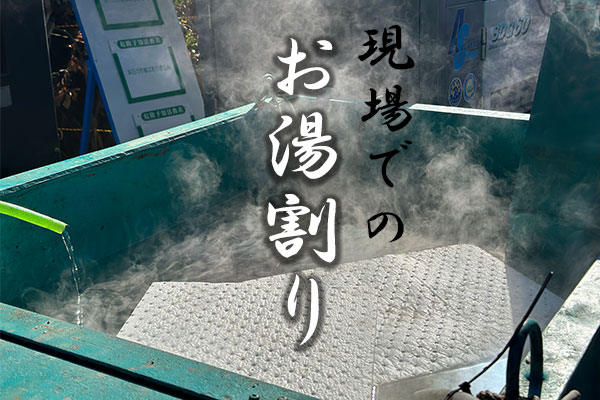
This is definitely the one, isn't it?
When applying the spray coating, mixing it with hot water helps ensure surface strength and prevent freezing.
This makes construction in cold climates entirely feasible.
It's also important to let the material cure properly after spraying.
It is more effective than using antifreeze.
Or rather, if you use antifreeze, there’s a very high chance it will freeze.
The initial hydration reaction is inhibited, and the temperature drops.
And then it freezes!
Also, please be careful, as much of the data (our own data) has not been verified.

This is just a rough estimate, but I calculated the final kneading temperature and plotted it on a graph.
Conditions
The outside temperature is the same as the temperature of the sand and cement.
The water temperature is 50 degrees.
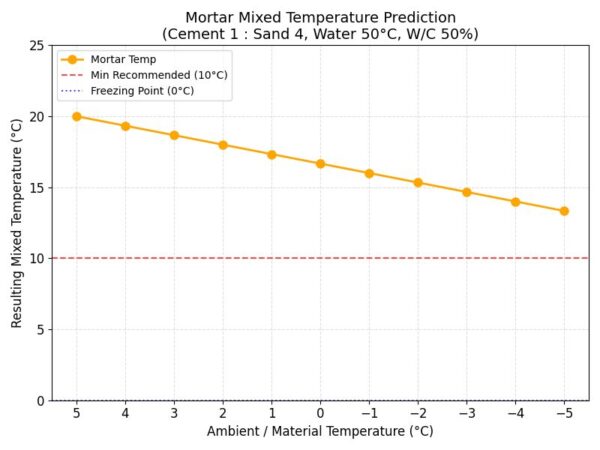
Mortar Mixing Temperature (1 part cement to 4 parts sand, water-cement ratio of 50%)
Vertical axis: Resulting Mixed Temperature (°C) Final mixing temperature (°C)
Horizontal axis: Ambient / Material Temperature (°C) — Ambient temperature and the temperature of the materials (sand and cement)
Red dotted line: Recommended minimum temperature
| Outdoor Temperature (Material Temperature) | Mixing Temperature |
| 5°C | 20.0°C |
| 4°C | 19.3°C |
| 3°C | 18.7°C |
| 2°C | 18.0°C |
| 1°C | 17.3°C |
| 0°C | 16.7°C |
| -1°C | 16.0°C |
| -2°C | 15.3°C |
| -3°C | 14.7°C |
| -4°C | 14.0°C |
| -5°C | 13.3°C |
The higher the mixing temperature after spraying, the less likely it is to suffer freeze damage.
However, proper care is becoming quite important.
Application method: Apply with hot water (50 degrees or higher recommended)
Completed the work by 4:00 p.m. and covered the area for protection.
For protection, cover the entire area with a blue tarp and burn briquettes underneath!
This is the best way to prevent freeze damage!
See you later.