Hello, everyone.
This is Enta.
After installing ground anchors, it is common to find that the grout has settled when you check the opening.
As usual at the job site, the top of the grout was about 1 meter below the edge of the opening.
I guess there might be some grout that’s seeped downward, so it gives the impression that it’s sunk quite a bit.
This raises the question of whether to fill this in or if it’s okay to leave it as is if it’s a temporary anchor.
Since it would normally be safer to fill this in for a permanent installation, this is a follow-up injection.
In the field, opinions often differ among anchor installers and construction managers on this point, but strictly speaking, the need for refilling cannot be determined based on the amount of settlement alone.
The first thing to check is: What type of anchor caused this?
What is the corrosion-resistant structure, and what are its service life and corrosion environment?
In this article, we will consider the selection of Corrosion Protection Structures I, II, and III, as well as the decision regarding mouth filling, based on *Ground Anchor Design and Construction Standards and Explanatory Notes* (JGS 4101-2012), published by the Japanese Geotechnical Society.
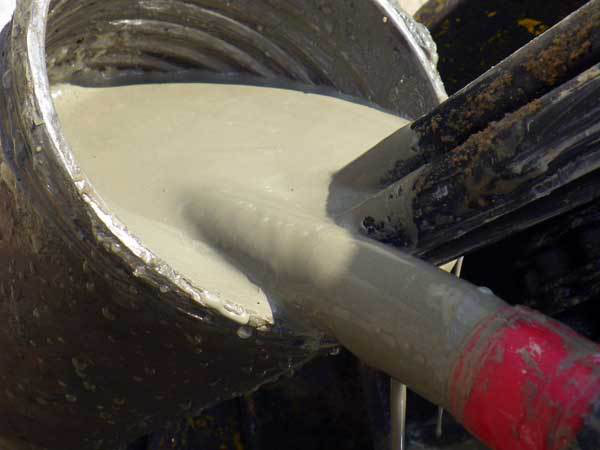
The conclusion is that since it dropped by 1 meter, it’s not a replenishment.
First, the conclusion.
The settlement of approximately 1 meter is an important fact that was confirmed on site.
However, the book does not specify a uniform tolerance value—such as how many millimeters below the mouth the level must be before refilling is required.
Therefore, we cannot use approximately 1 meter as the threshold for passing or failing.
The need for replenishment is determined in the following order.
- Did it fall in the area around the free end, or on the back of the support plate or anchorage device?
- The design specification must be one of Corrosion Protection Structures I, II, or III.
- Is the service life less than 2 years or 2 years or more?
- Normal environment or highly corrosive environment?
- Are there any filling specifications in the design documents or construction specifications?
- Can you explain the causes of subsidence, water seepage, leakage, and bleeding?
If you skip this part and just decide that it’s unnecessary for a temporary structure but necessary for a permanent one, you’ll end up confusing the grouting of the free end with the treatment of the back of the head, lol.
Why Corrosion-Resistant Structures Are Necessary
Ground anchors are used while applying a large tensile force to the tendon.
Furthermore, since they are often installed outdoors or in locations affected by groundwater, corrosion-induced loss of cross-sectional area and damage to the anchorage points can lead to a decline in performance.
The Design and Construction Guidelines stipulate that corrosion protection measures must be implemented to ensure the structure’s functionality is maintained throughout its service life, taking into account the corrosion environment surrounding the structure, its service life, and the structure’s importance.
Corrosion protection isn't just about tensile materials.
- Anchor font
- Tension Section
- Anchor Head
- Back of the Head
- Boundaries Between Sections
These must be considered as a continuous corrosion-resistant structure.
In particular, the boundary between the anchor head and the tension member is an area where corrosion protection is prone to discontinuities. It is important to ensure that the installation leaves no pathways for water or corrosive substances to enter.
Corrosion Protection Categories I, II, and III are determined by the service life and the environment.
The explanatory table categorizes the guidelines for corrosion protection levels as follows:
| Corrosive environment | In service for less than 2 years | In service for at least 2 years |
|---|---|---|
| Normal Environment | Corrosion Protection Structures I | Corrosion Protection Structures II |
| Highly Corrosive Environment | Corrosion Protection Structures II | Corrosion Protection Structure III |
Just because they are called "temporary anchors" on site does not necessarily mean they are classified as Corrosion Protection Class I.
Even if the service life is short, Corrosion Protection Class II or higher is required when the structure is exposed to a highly corrosive environment or is used for critical structures.
Corrosion Protection Structures I
Corrosion Protection Structure I is a simplified corrosion protection system primarily intended for anchors with a service life of less than two years in normal environments.
According to the explanation, corrosion protection should focus on areas prone to corrosion, such as the anchor head and the back of the head.
In cases where the service life is very short and the material is hardly exposed to a corrosive environment, corrosion protection may be omitted.
However, this does not mean that field staff are free to omit this step.
We will make a decision after reviewing the purpose, importance, corrosion environment, and design documents.
Corrosion Protection Structures II
Corrosion Protection Structure II is primarily intended for anchors with a service life of two years or more under normal conditions.
We apply corrosion protection to tension members, restraints, anchors, and pressure plates to ensure they remain functional along the entire length of the anchor.
In the free-length section, the void between the casing and the ground is filled with grout.
At the head of the pipe, a corrosion-resistant cap and rust-preventive oil are used to prevent the ingress of rainwater and corrosive substances.
Standard anchors fall into this category.
Corrosion Protection Structure III
Corrosion Protection Structure III applies to anchors intended for service for two years or more in highly corrosive environments.
Corrosion-resistant tensile members and sheaths, corrosion-resistant materials, and multi-layered corrosion protection—performance exceeding that of Corrosion Protection Structure II is required.
A highly corrosive environment is one in which corrosion may still occur even when adequate corrosion protection measures are in place.
If there are concerns that cement-based grout may deteriorate due to soil conditions or groundwater, changing the grout material should also be considered.
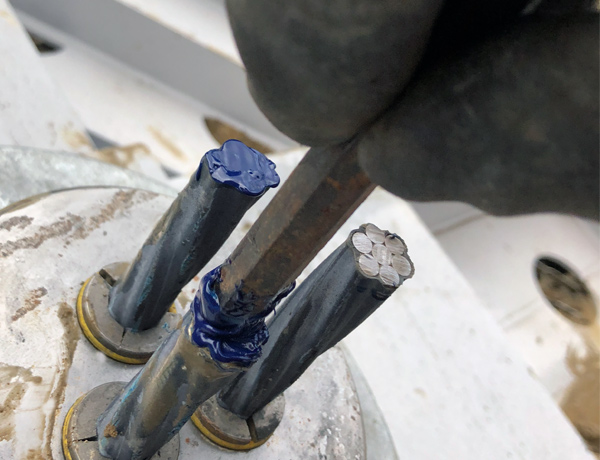
Consider Filling and Injection Separately from the Back of the Head Treatment
This is the most important factor to consider when deciding on lip fillers.
The grouting of the free-length section and the treatment of the backside of the support plates and anchors differ in both purpose and timing of installation.
Filling and Injection of the Free-Length Section
Grout injection is the process of injecting grout into the void between the outer surface of the sheath on the free end and the surrounding soil after the anchor body has been installed.
In general, the fixed section and the free-span section are constructed simultaneously, but in the textbook, they are treated as separate.
There are two main objectives:
- Enhancing the Corrosion Protection Performance of Free-Length Sections
- To prevent soil loosening and weathering around the borehole wall
The construction guidelines in the Design and Construction Manual state that grouting must be performed for Corrosion Protection Class II or higher, and may be performed for Corrosion Protection Class I when necessary.
In other words, grouting for Corrosion Protection Structure I is not uniformly required.
But it doesn't say anywhere that you don't have to fill it in if it's Corrosion Protection Structure I, lol.
We determine the necessity based on factors such as soil instability, spring water, design specifications, and construction methods.
That said, in theory, with Corrosion Protection Structure I, there’s no need to inject grout even if the structure is 1 meter lower.
The first layer of corrosion protection is made of polyethylene pipe.
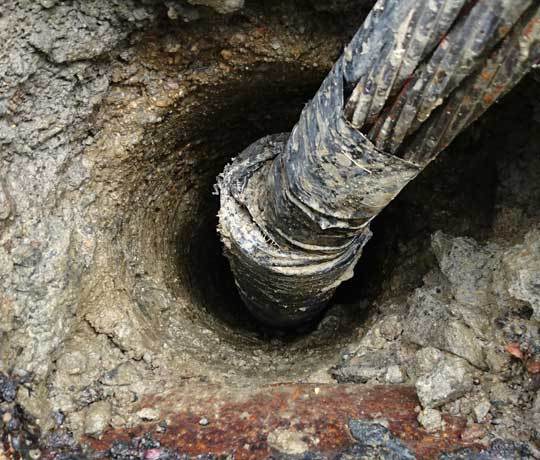
Finishing the Back of Support Plates and Fasteners
The rear surface of the anchor head is located at the boundary between the free length and the head, making it an area where corrosion protection is prone to discontinuities.
The standard specifies that the back of the head must be treated according to the method indicated in the design documents before tensioning and setting.
The guidelines state that the space behind the support plate must not be left hollow but must be filled with anti-corrosion materials or grout.
The concept is to completely fill the back of the anchor with grout or rust-preventive oil, ensuring that the filling material does not leak, evaporate, or settle.
What to Check at a Site Where Grout Has Sagged
I understand the urge to fill in the gap when the grout has sunk significantly at the job site.
However, if you don't identify the cause before refilling, the additional grout may sink again.
The following are some possible items to check.
- Leakage into cracks or voids in the ground
- Backflow and dilution caused by confined groundwater or spring water
- Separation of Grout Components and Bleeding
- Insufficient injection to the specified position
- Leakage into other man-made structures
- Post-Construction Settlement
- Position of the Injection Tube and Injection Procedure
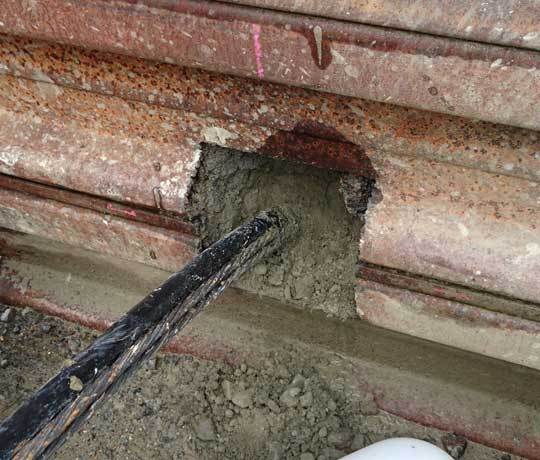
Since we don’t know the cause of the subsidence, simply adding grout from above and calling it a day isn’t enough—but to be honest, we don’t know what’s going on inside.
It would be fine if it were leaking from somewhere else, but it’s not exactly something you can easily tell...
If the top surface drops again after the refill, the same decision will have to be made again.
However, to fill it in, you'll likely need to inject the material multiple times, imagining that you're slowly filling in the hole.
However, this applies only to cases where the corrosion protection level is II or higher.
This applies strictly to permanent anchors.
If this were a temporary anchor, you’d probably think, “We don’t need that!”
However, what is the condition of the area above where the temporary anchor was drilled?
If vehicles are going to be driving at full speed on a major road, it will be necessary to ensure the ground is properly grouted, keeping in mind the possibility of sinkholes forming.
However, you could also say that it's not necessary if there's nothing there.
It really comes down to where to draw the line between cost and quality, doesn't it? lol
I suppose it might be nonsense to cram everything in.
I guess it’s okay to think, “Well, as long as I inject it, there shouldn’t be a problem, right?!”—but I want to make sure I don’t just stop thinking.
Let's always ask ourselves, "Why?" as we go along!
See you later.