Hello, everyone.
This is Enta.
This muggy, hot season...
It's still bearable with the air-conditioned suit, but is it only a matter of time before it stops working as well as it used to!?
I guess it's going to be damn hot again this summer, but at the Ministry of Land, Infrastructure, Transport and Tourism, summer vacation is...
I suppose public holidays will remain the same regardless of whether it's a prefecture, city, or town...
But that's beside the point.
In this post, we’ll discuss the “cost breakdown of ground anchor construction.”
People sometimes ask me, “Are anchors expensive?”
Well, I don't think the average person really understands whether that amount is high or low, but public works projects are generally expensive.
After all, it guarantees a certain level of performance and quality.
Quotes for long-span anchors—especially ones with a drilling depth of over 50 meters—are pretty pricey, lol.
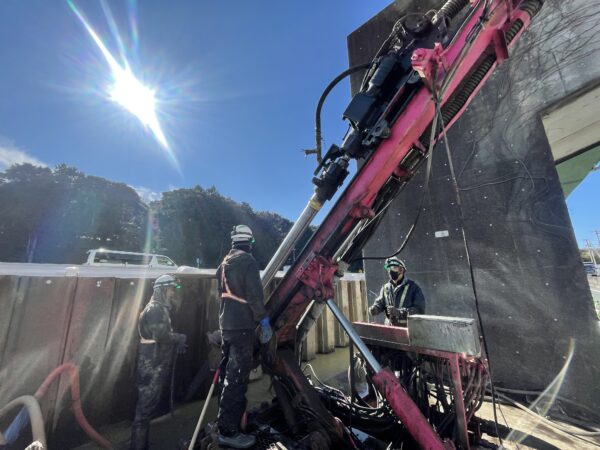
As someone actually working on a 60-meter-class drilling site, I’ll break down the unit cost from three perspectives: machinery, consumables, and risk costs.
Cost of ground anchor work for a three-story building
To put it simply, the cost of the anchor isA three-tiered structure consisting of “initial investment (machinery) + variable costs (supplies, materials, and labor) + risk costs”。
Even under the Ministry of Land, Infrastructure, Transport and Tourism’s construction package-based cost estimation standards, the cost of drilling holes for ground anchors is calculated by adding up the costs for each soil type, right? (See the previous article.)
In other words, even in government cost estimates, the basic premise is that “the cost of drilling can vary drastically depending on site conditions.”
According to the design breakdown (for slope work on the Onomichi-Matsue Expressway) published by the Regional Development Bureau of the Ministry of Land, Infrastructure, Transport and Tourism, the details of the actual public works project are as follows:
Even with anchors of the same specifications (5 φ12.7 anchors, with a maximum load of 550 kN),For boreholes longer than 10 meters but no longer than 20 meters, the cost is 641,300 yen per borehole; for those longer than 20 meters, the cost is 703,400 yen per borehole.。
Well, since this includes load-bearing structures and anchor materials, it looks pretty expensive at first glance.
If it's just drilling, it would be around 200,000, I suppose.
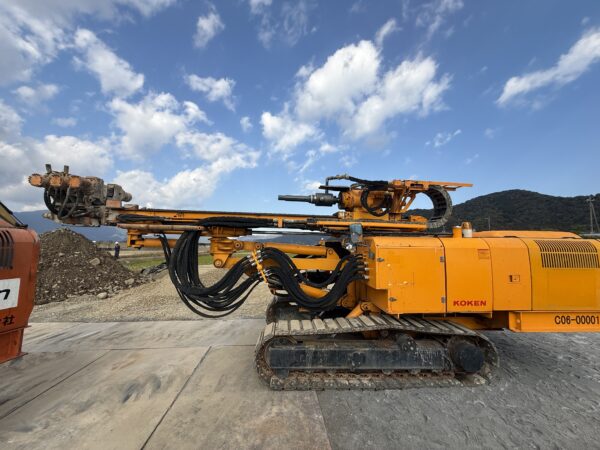
Where will we recoup the cost of the machinery, which is just over 35 million yen?
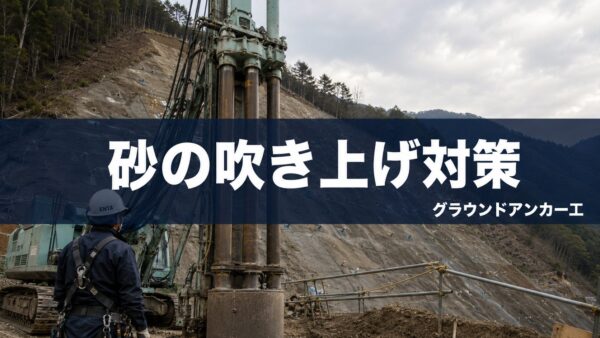
The 55-kW-class rotary percussion drill, capable of drilling holes for long ground anchors, features the following on the main unit:35 million and upI will.
The 88-kW class starts at 55 million! (Manufacturer's suggested retail price, lol)
If we include rods, casing, grout pumps, and plant-related equipment here, the initial investment will increase even further.
As for how to recoup the cost of this machine, the only way to do so is through the "m" of drilled holes.
Let's try a rough calculation.These figures are purely hypothetical and are provided for illustrative purposes only.
・Machine: 35 million yen
・Assuming a 7-year depreciation period: approximately 5 million yen per year
・Assuming 40 days of actual operation per year: approximately 125,000 yen per day
In other words, a drilling rig is a machine that, even on days when it’s set up on site but doesn’t drill even a single meter, still costs about 130,000 yen a day on the books, lol.
Setup changes, repackaging, downtime, rain. Even on days when production isn’t running, depreciation doesn’t stop.
Since long-hole drilling inevitably takes more days per hole, it is more efficient than 10-meter-class drilling, which helps keep costs down.
On a 10-meter-class job site, there are a lot of small details to handle, so the unit price tends to go up.
It’s one thing if it’s our own equipment, but you can see how the costs would go up even more if we had to rent it, right?
Casing and Bit Consumable Costs | “Assets in the Hole” That Increase with Depth
In dual-pipe drilling, casing (the outer pipe) is pushed down into the hole while being extended in sections to support the borehole wall.
The price of this casing has been going up and up lately, too...
I based this on the average prices in my neighborhood and the surrounding area.
| Item | Specifications | Reference Unit Prices |
|---|---|---|
| Casing | 1.5 m per piece (φ90 class) | 45,000 yen or more |
| Casing | 1.5 m per piece (φ115) | 60,000 yen |
*These figures are for reference only. They may vary depending on the time of year, manufacturer, and purchase lot, so please check with the respective manufacturers or trading companies for exact amounts.
For a 70-meter borehole, that’s 70 m ÷ 1.5 m, soThe calculation indicates that approximately 47 casings will fit inside the hole.(The actual drilling configuration depends on site conditions.)
If we use the reference price of 60,000 yen for a φ115 pipe and do a simple calculation, that means there are 47 pipes worth approximately 2.8 million yen embedded in the ground.
While a shallow hole might be treated as just a “tool,” a long one becomes an “asset.”
This is where the cost of long anchors begins. You simply can’t do the work without having this much inventory (tools) on hand.
Of course, drill bits are consumables. If they hit a hard layer, they wear down much faster, and if you have to replace a bit midway through, you’ll have to pull it out completely and reinsert it, which will significantly increase drilling time.
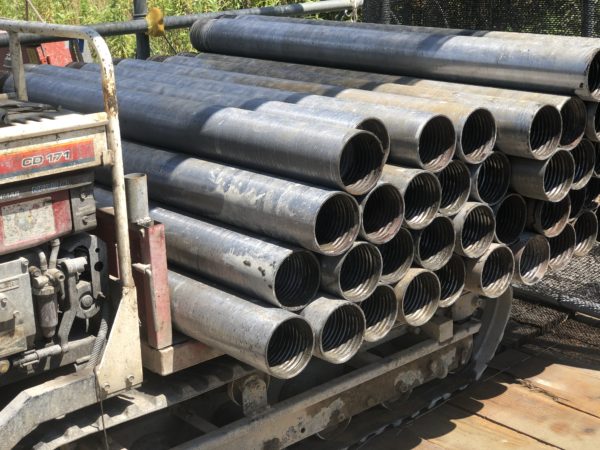
Understanding Risk Costs | A Real-Life Example of Losing 10 Casing Sections at the 60-meter Mark
Here's an example from my own experience.
At a 70-meter drilling site, jamming (a condition where the pipe becomes stuck inside the borehole and cannot move) occurred at the 60-meter mark, andI lost 10 casings.
The amount of the loss was equivalent to 450,000 yenThat's how it was. It's not so bad that it ended there, right...?
That 450,000 yen includes all labor and machine hours required to dig down to 60 meters, so the profit from that single site alone would be wiped out in an instant.
It really makes me cry, lol.
There are various possible causes, such as the part breaking off inside or the threaded section becoming stripped.
This means that this is not an “accident caused by poor drilling technique,” but rather “a matter of probability inherent in the nature of long-hole drilling.”
The deeper it gets,
・The value of the materials inside the hole increases (but when you lose them, you lose them all at once)
・Less information about the underlying soil (since they are digging between the points of the borehole survey)
・Recovery becomes more difficult (a pipe stuck 60 meters away won’t come out easily)
・Drilling techniques and experience are required
Therefore, for long-term estimates, it is necessary to include a risk premium as part of the "insurance premium." The concept can be summarized in the table below.
| Nature of Expenses | Examples of Contents | How to Include It in a Quote |
|---|---|---|
| Predictable Wear and Tear | Bit wear, normal wear and tear on the casing | Stack in quantities appropriate for the depth and soil type |
| Unpredictable Emergencies | Jamming, steel component failure, hydraulic hose rupture | Accumulate through rates and insurance surcharges (risk premiums) |
| Holding Costs | Machine Downtime Due to Reloading, Idling, or Weather Conditions | Allocate machine costs and process costs by number of days |
We'll also consider simulations of expected values.
"Once every 10 sites" is merely a hypothetical example for illustrative purposes.That said, the actual frequency varies greatly depending on the ground conditions, construction methods, and the skill of the operators.
Suppose we’re in a world where a loss of 450,000 yen occurs once per 10 job sites; in that case, 450,000 yen ÷ 10 job sites = 45,000 yen per job site.
In other words, any estimate that doesn’t include a risk allowance of 45,000 yen is bound to run at a loss in the long run in that industry. It’s just simple math.
From the general contractor’s perspective, it might seem like “money down the drain if nothing happens,” but behind the scenes at sites where nothing happens, another site is siphoning off 450,000 yen.
That's the reality of drilling, lol (I don't know about other sites, though!—but the contractor is the same, after all).
It's really tough being a construction company, lol.
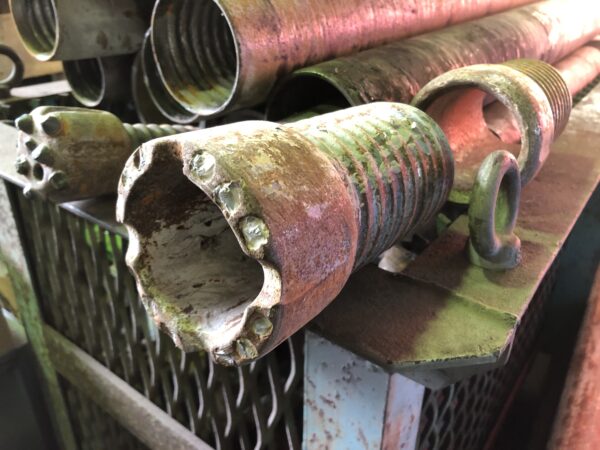
Comparison of Profitability Between the 10-Meter and 70-Meter Classes | Why Are Long-Length Models “Something Else Entirely”?
Let’s consider just how different the world is between a 10-meter-class and a 70-meter-class system, even though both use a single “ground anchor.”
This is just my personal opinion, but I don't think I'm saying anything too outlandish, lol.
Let me just say up front—you can see that, if you look solely at drilling “efficiency,” longer drill bits have the advantage, right?
Unlike the 70-meter-class machines, which can continue digging for extended periods once they’re set up, the 10-meter-class machines require a lot of minor adjustments, such as repositioning and realignment, so
When viewed on a per-meter basis, the unit price tends to increase.
So why is the unit price per roll higher for the longer ones? (In comparison)
The answer isn't efficiency, but rather,Because the risk is highThat's it.
| Item | 10-meter class | 70-meter class |
|---|---|---|
| Drilling Efficiency and Setup | There are many small steps involved, so the unit price per meter is likely to increase. | It's efficient because you can dig in large areas at once |
| Number of casings (calculated as 1.5 m per casing) | About 7 bottles | About 47 bottles |
| Value of materials inside the borehole (based on a simple calculation using a reference value of 60,000 yen per unit for φ90) | Approximately 315,000 yen | Approximately 2,115,000 yen |
| Illustration of Potential Damage in the Event of Loss | in the range of several hundred thousand yen | Up to several million yen |
| Standard Estimation Consumption Table | Within the scope (reportedly with a total borehole length of 30 meters or less) | Not applicable |
| Accuracy of Ground Conditions Data | Relatively high | The deeper you go, the higher the estimated percentage becomes |
In other words, the 10-meter class is all about “efficiency.” The cost is determined by how smoothly you can manage the small details.
The 70-meter class is a “high-risk gamble.” While efficient drilling helps keep costs down, the value of the assets inside the borehole increases as the depth increases, and
Information on the underlying ground becomes scarcer, and the amount lost due to a single incident skyrockets. This insurance premium is reflected in the unit price.
The high unit price of long anchors is not due to “a large amount of work” or “low efficiency,” but rather,Because the nature of the risk changes, unit prices tend to rise.That's right.
Well, if you're familiar with the surrounding natural terrain, your perception of the risks in this area changes dramatically.
If a contractor accepts a job based on the unit price for 10-meter-class extension lines, assuming that longer lengths are more efficient, any jamming that makes the line unrecoverable will wipe out their profit in one fell swoop.
If a quote that includes risk costs is deemed “too high” and ends up being cut, having the courage to turn down the job is also part of cost management.
I may sound like I know what I'm talking about, but we mess up a lot too, lol (Give me a break, lol).
Anchor shots that long are just that difficult. It’s best to have a veteran handle them whenever possible, but there are situations where that’s not always feasible...
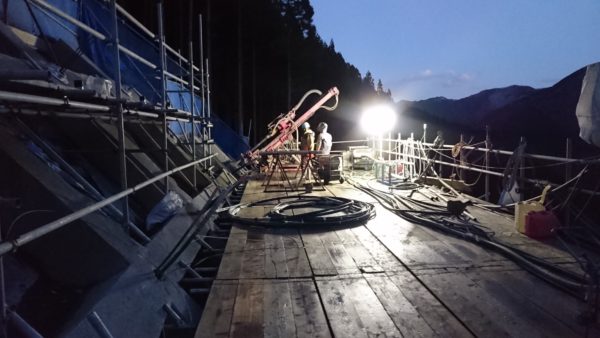
If you think about it, there’s no construction method this high-end, right? lol
Well, civil engineering is a specialized field, so machinery and supplies are often designed specifically for certain construction methods, which is why this kind of thing happens frequently—but I do think this is the best method for slope stabilization work.
Now that I've written this far, I'm sure you're thinking, "So, how much should I factor that risk into the unit price?!" I'll write about that another time.
I've been able to put together a pretty good summary of unit prices using AI, so I'm thinking of laying bare the unit prices of major companies and contractors too, lol.
Strictly speaking, this is something that’s meant to help us contractors stay in business, but,
See you later.
Rotary Percussion Consumables (Part 3) | Detailed Explanation