Hello, everyone.
This is Enta.
I wrote an article a while back called “For Those of You Who Can’t Sleep Because Your Anchor Is Missing” (what a terrible title, lol)
Even now, I still occasionally get messages like, “It came out… what should I do…?” lol
I understand exactly how you feel.
I’ve had anchors come loose many times myself, and it’s even happened at our construction site, lol.
But it's okay.
If it comes out, just start over.
I’m happy to do rework on our own projects, and I’ve also done rework for other companies.

But that's beside the point.
This time, we’ll tackle the first hurdle in that “do-over”
How to Pull Out a Loose AnchorI’ll cover everything in one go—from step-by-step instructions for each tool and safety precautions to determining when to redo the work.
The design and construction standards for ground anchors are basically written with the premise that “they must not pull out,” so they don’t include any instructions on what to do if they do pull out lol.
In other words, this area is entirely based on oral traditions passed down on-site.
That’s exactly why I think it’s worth writing down.
First of all, everything depends on “where the leak is.”
Before thinking about how to pull it out, there’s one thing you need to check.
Where is the gap?
1. Is it on a slope at a high elevation?
2. Is this even a place where a backhoe (BH) can operate on unpaved ground?
3. Can a crane be used?
This determines which tools to use and the procedure to follow.
For slopes: A jack is the only option.
If you need to remove it from a slope, you have no choice but to use a jack to lift it out.
Although the free length of a permanent anchor is covered, if the grout has come loose, only the PC steel strands inside will be exposed.
Repeat the process: “Use the jack to pull out the steel wire → shift the jack’s head and reinsert the wedge → use the jack to pull it out again.” It’s a tedious process, but it’s reliable.
However, this is based on the fundamental premise that the PC strands are no longer adhering to the cement slurry.
If this attachment is still intact, do not pull it until it reaches its breaking load! It is extremely dangerous!
If you absolutely can't get it out, you'll have to cut it off.
If you can't pull them all out at once, try pulling them out one by one if that works.
If BH is involved, it's relatively easy. Grab each PC wire one by one with a wire clip, attach it to the BH, and pull hard—it’ll come out easily.
If a crane is available, you can use the same method as for BH.
As a general guideline for the required force, whether using a jack, a BH, or a crane, it is usuallyIt can be pulled out with a force of several hundred kilograms.。
And once it starts moving, it slides right out.
Even when using a jack to remove it little by little, I’ve often found that it slides right out with a load of about 1 metric ton.
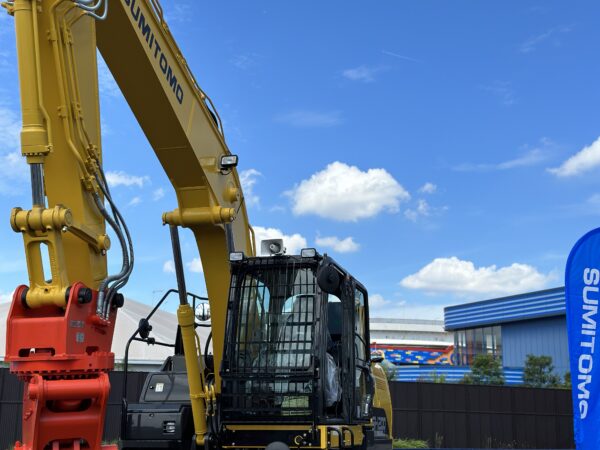
By the way, tools that can be used to pull out temporary anchors include:Fujiwara Industries Co., Ltd.A product called “Unbond Lock” is available from [Name], which securely locks onto PC steel strands and allows them to be pulled out.
It's convenient because it can be used with either a BH or a crane.
Please check the latest information regarding current sales status and model numbers.
What to Do When You Can't Pull It Out | The World of 7t and the "Anchor That Won't Come Out"
This is where the real action begins.
If it came out easily, there wouldn't be any trouble, but—Most of the time, they get stuck halfway through and can't get out.w (I'll skip the temporary part)
A common issue with temporary anchors is when, for some reason, the sheath surrounding the prestressed steel strands tears, allowing cement slurry to seep in.
Once it gets to this point, it's really hard to get out of it.
It depends on how long it's been stuck there, but based on my experience,It will come out if you apply about 7 metric tons of force.。
However, this 7-metric-ton area is dangerous for cranes and backhoes.
It's not that you can't remove it with a crane, but I don't recommend it because there's a risk of falling due to the recoil when it comes loose.
This is exactly when you need a jack.
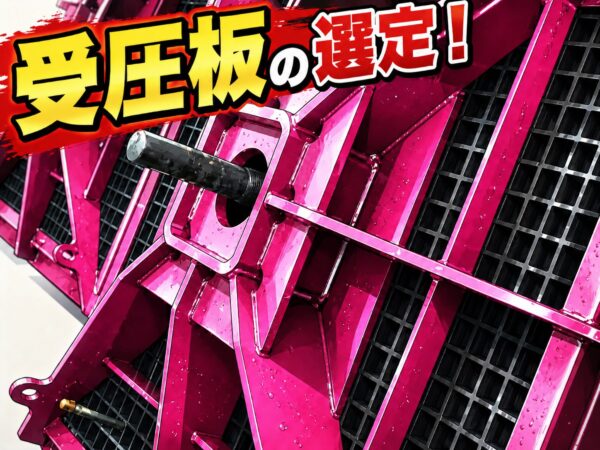
If the formwork has already been removed and there is neither a steel base nor any counterforce, then,Install a pressure plate to absorb the reaction force while pulling it out....and can be done safely.
The job site we actually worked on had an installation angle of about 40 degrees, which made it difficult, but if we pulled straight, it came out easily, and once it started moving, it was fine to remove it with a crane.
And,There are some anchors that should be deemed "unremovable" from the start.。
With tie-back anchors such as SEEE, since a nut is attached to the “mansion” section at the tip, there is a limit to the length of the mansion.
So, it's impossible to remove them all at once. Just cut them off—that's fine!
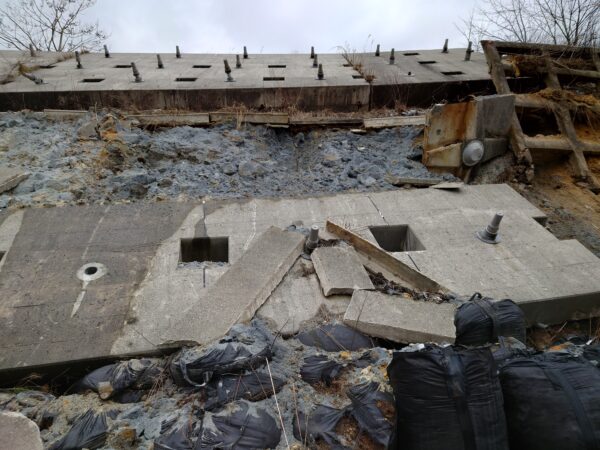
In addition, since the surrounding poly-based components and other materials remain in place, drilling holes later on becomes quite difficult.
Depending on the type of anchor, it’s probably best to state outright that “it won’t come out,” so don’t try to pull it out by force, and
It's safest to switch to hitting from a different angle right from the start.That's it.
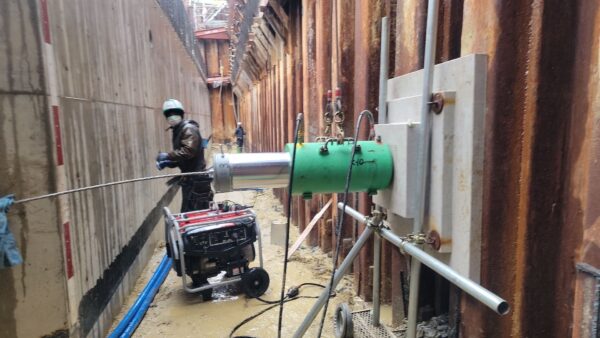
If I absolutely had no choice but to drill in the same spot, I’ve also had experience drilling a hole while cutting the PC steel strand with a metal-cutting drill bit at different angles into the same hole.
The Moment It Comes Off Is the Most Dangerous | 3-Piece Set for Preventing Bounce-Back
The task in the pulling-out process that is most likely to result in an accident is,The Moment It Slips OutThat's it. The steel wire snaps with a plunk.
The following applies only when using a crane or a backhoe to remove the object. It does not apply to jacks.
There are three measures we take on-site to prevent splashing.
1,Hold the steel wire with a rag. If you hold the steel wire with a rag just before it comes out, it won’t bounce around violently. “Isn’t holding it dangerous in the first place?”
People sometimes say that, but it’s really no big deal. (You’ll see once you try it; if people say it’s dangerous, just add one more piece of equipment at the end.)
2,Operating Direction. At the moment it comes loose, if the crane or BH operator swings the steel wire in the "return direction," it is less likely to bounce.
And the positioning of the crane and BH at the moment of release is also important.
Do not place people or machinery in positions where they could be struck by a bouncing steel wire. This means you should not pull the wire straight from the front.
3,Anchoring of Pressure-Bearing Structures. In the case of secondary products such as pressure plates, there is a risk of them falling if the anchors come loose. Be sure to secure them before beginning work.
In the case of a jack, it will fall the moment it comes loose, so be sure to secure it.
Just a little tip: toward the end, you can actually pull it by hand (though you'll get covered in grease, lol).
Also, the machine that removes the unbonded material while spinning around with a motor isn't available for rent or anything like that.
I can say this for sure because I've looked for it before lol (Apparently, it used to exist.)
Reinstallation After Removal | Criteria for Determining Angle, Anchorage Length, and Preparation of the Original Hole
Once the extraction is complete (or if it is determined that the object cannot be removed), it is time to design and plan the reinstallation.
There are four key points to consider.
① Adjust the angle. Since it’s difficult to pour concrete in exactly the same spot, we vary the position slightly—up, down, left, and right—by about 1 or 2 degrees within the construction tolerance limits.
In my experience, it’s usually a matter of raising or lowering it about three times, or moving it back and forth.
In the troubleshooting article I wrote in 2017, I also mentioned, “If possible, adjust it downward by 1 to 2 degrees.”
However, there is a limit. If you set the angle too high, the angle during head processing will exceed 5 degrees, so that won't work.
It's okay as long as it's within 5 degreesThat's what the book says, lol
If you use a pressure plate designed to adjust the angle of components such as tapered plates, you can achieve a larger angle.
Furthermore, if the angle is increased further, the calculations must be redone (including the structures under compression and the total load).
Please also take into account the effects of the groups above, below, to the left, and to the right.
② Increase the fixation length. If possible, it would be safer to reorder the material with a length that’s about 1 to 2 meters longer. (Longer than that is also fine.)
The cost of materials is negligible. Once a section has been removed, there’s a chance the surrounding soil has been disturbed, and anchors aren’t a one-size-fits-all solution when it comes to changes in soil conditions.
The idea is to anchor it deeper than the original deepest point of the anchor.
③ Grout is injected into the original hole. Since this could cause loosening, be sure to inject grout into the original hole after removing the bolt.
Even if drilling the free end involves partial overlap, I want to ensure that the anchorage section is located in a spot that is clearly different from the first hole.
④ If the base layer is unstable, consider using a packer as well. If you're on a mountain where cement slurry runoff is severe, be sure to consider this option.
And one thing we mustn't forget is the paperwork.
It’s only proper to officially notify the local government before redoing the work.
It’s not impossible to keep it within the company or the prime contractor, but it’s just kind of easier to just say it, lol.
For public works projects, changes to angles or anchorage lengths require a basis for stability calculations (from an administrative standpoint as well).
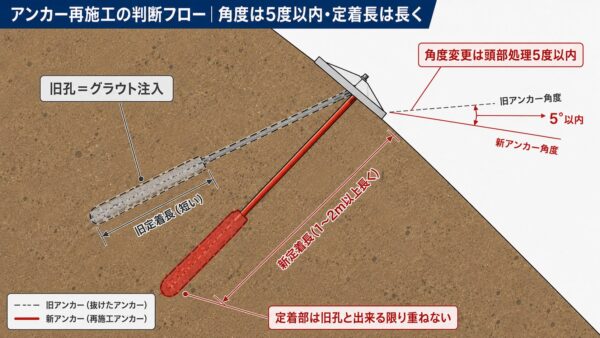
Although the fixing length is the same in the illustration, if you are setting up a new one, please move the fixing length further back.
So far, I have covered everything from the removal procedure to determining whether to redo the work.
As I mentioned at the beginning, this kind of information isn’t included in the ground anchor standards manual. This is purely based on Ent’s experience.
After all, this is a world where staying in place is the bottom line.
But in reality, even if we were to drive 100 piles, there would only be about two test sections, and the soil conditions change the farther we go horizontally.
Even if you thoroughly clean the borehole and inject high-strength grout, it will still leak out when it’s meant to (though of course, it’s better if it doesn’t!).
That’s why I think the true skill of an anchor operator—and the people who manage them—lies in having a plan B so they don’t panic when things go wrong.
Dealing with emergencies is truly a world of oral tradition.
I wish there was something like a “Civil Engineering Failure Manual” lol
To everyone across the country whose anchor came loose today! Let’s steel ourselves and do our best!
See you later.