Hello, everyone.
This is Enta.
The other day, after I wrote an article about set loss, I got a question asking, “So, what is relaxation, then?” lol. That’s a good question, lol.
It's in the Design and Construction Guidelines for Ground Anchors! When I say that, you're probably like, "Whaaaat?!" lol
As I was thinking, “How would I explain this so even my own kids could understand?” I realized that if I could explain this well, it would be easy for the interns to understand, too.
But that's beside the point.
I’ll explain “relaxation” using rubber bands as an example.
This is an introductory guide for those who are just getting started with ground anchors or who have come across this term for the first time in stress management documentation.
It’s in the Design and Construction Guidelines for Ground Anchors, but it’s a bit mind-boggling, lol.
Relaxation Through Rubber Bands
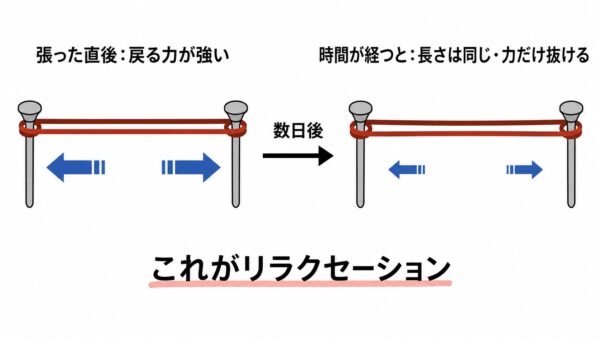
Let's say you stretch a rubber band out really far and then hook it onto a nail to secure it at that length.
The moment you pull on it, it’s straining with all its might, as if to say, “I want to go back!”
But what happens if you leave it like that for several days? The rubber band gradually loses its elasticity, and the force with which it tries to snap back becomes weaker than it was at first.
Even though the length hasn't changed at all, the force pulling it back is gradually weakening.
This is relaxation.
Can you picture that?
The same applies to PC steel strands.
Pull it firmly with a jack (apply tension), then secure it with a wedge.
Now that it's secured, the length of the steel wire won't change anymore.
But the steel cable itself isn’t very good at holding out at full strength for long, and as time goes by, its holding power—that is, the force with which the anchor holds the mountain in place—gradually fades away.
Of course, steel is much more durable than rubber bands, so very few of them come loose.
The Difference from Set Loss | “Sudden Loss” vs. “Gradual Loss”
This is often confused with “set loss,” which I wrote about the other day. The difference lies in the timing and speed.
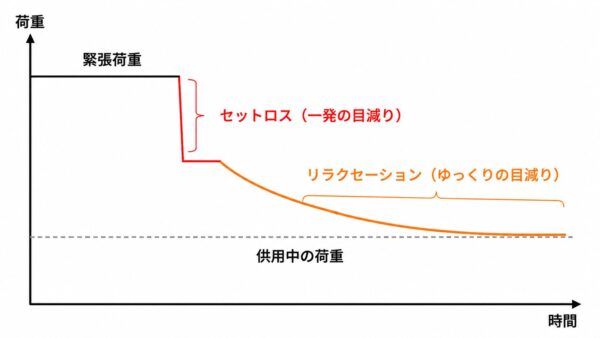
Set lossIt’s that “one-shot loss”—the moment it settles into place, the wedge sinks in with a thud, and the tension is released.
Relaxation is a phenomenon in which, after set loss occurs, the load gradually decreases over time due to the inherent properties of the prestressed steel strand itself.
To put it simply, set loss is a “one-time drop in load,” while relaxation is a “gradual, ongoing drop in load” that continues afterward.
In other words, the difference is that set loss is a phenomenon in which the load drops suddenly the moment the material sets, whereas relaxation is a phenomenon in which the load gradually decreases over the course of days, months, or years during service.
Since both ultimately serve to reduce the load on the anchor, it is important to consider set loss and relaxation together when managing tension.
For more details on how set loss works, its causes, and ways to minimize load loss, please see our separate article.
How Much Leakage Occurs? | JIS Figures and On-Site Countermeasures
So, just how much does the tension actually decrease? If we look at the standards for prestressed concrete (PC) steel strands and PC steel wires (JIS G 3536),
The relaxation value is8.01 TP3T or less for standard products; 2.51 TP3T or less for low-relaxation productsIt is stipulated as follows.
This value represents the rate of decline in initial force after 1,000 hours have elapsed.
In other words, the materials are categorized into “Standard (N)” and “Low Relaxation (L)” at the material stage, and can be distinguished by the “N” and “L” at the end of their designations.
It is believed that the materials used in ground anchor construction are almost exclusively low-relaxation materials.
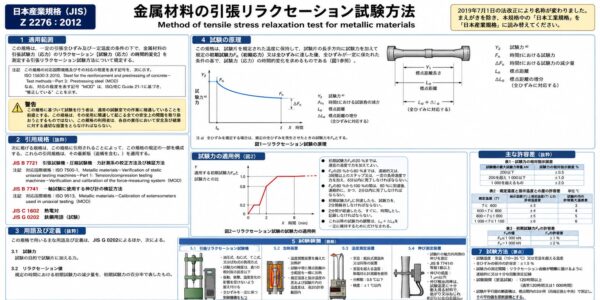
Incidentally, the relaxation test method itself is specified in the JIS Z 2276 standard, but,
That test is conducted in a laboratory using short test specimens.
Maybe because that test is conducted with 1/100 precision, we’re also implementing 1/100 control measures outside...
To be honest, you know full well that I'm trying to manage things in a way that's just not feasible, lol
The measures to be taken on-site are simple.
From the very beginning, I tense up, taking into account the relaxation of the steel wire and set loss.
The idea is to add enough in advance to account for any that might fall out.
The amount to apply depends on the design and specifications, but it’s not just a matter of “pulling it tight and calling it a day”—
It’s easier to understand if you keep in mind that “even after it’s been secured, the load gradually eases off,” right?
I started by talking about rubber bands, but ultimately, anchor tension management comes down to “how well you can imagine the loss of that invisible force.”
The load decreases immediately when the wedge sinks in, gradually decreases due to wire fatigue, and decreases further if the ground is poor due to the settlement of the load-bearing plate.
Taking all of that into account, we ensure that there is sufficient load-bearing capacity to properly support the mountain even during operation.
I’d be happy if the meaning of the terms in the design and construction guidelines just clicked into place with the help of a single rubber band.
Technical terms aren't really a big deal once you get the hang of them, lol.
I wonder if the next one will be Creep? lol
See you later.