



Hello, everyone.
This is Enta.
The other day, a hydraulic hose burst, and it took me three and a half hours round trip to Sapporo...
My butt split open lol
But that's beside the point.
Reasons Why Stress Management Fails
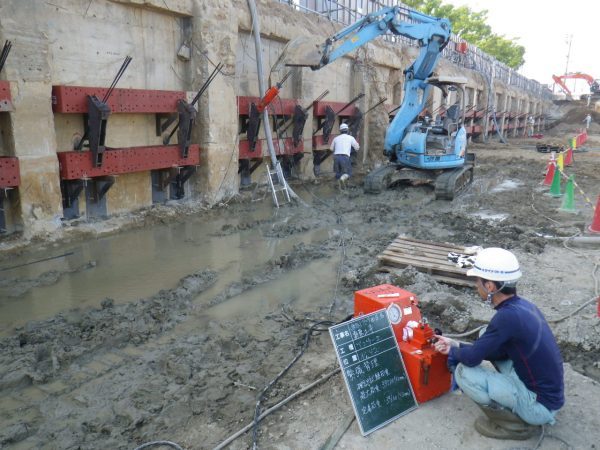
Don't you all think this is pretty difficult to manage?
You’d think it would be a problem if the government took photos or made notes of your numbers and results, right?
Don't worry. It's fine.
However, this is only true if the anchor structure has been properly constructed,The fundamental premise is that nothing is missing.I'll write it here.
The primary factor contributing to failure in stress management is
There are cases where the values do not fall within the upper and lower limits on the elastic-plastic displacement curve.
Do you know why this is? Have you ever thought about it?
Why won't it go in?
I used to struggle with this, too. Sometimes, even when I do everything perfectly, it just doesn't work out.
That "What the heck?!" phase, lol

The answer is simple.
It's just that the dial gauge isn't set up properly.
That's all there is to it.
We use precision instruments, such as dial gauges, outdoors during stress tests.
Even when the wind blows, the gauge reading fluctuates. Is there a fixed point on the scaffolding?
First of all, there are no fixed points when you're working on scaffolding.
A frame catcher in the legal framework? Is that really a fixed point?
There's practically no such thing as a fixed point, lol.
Strange things happen because the discussion proceeds as if there were a fixed point.
Well, let's say there was a fixed point. (Let's say we were able to create one.)
Can you position the dial gauge on the jack so that it is exactly aligned in the same vertical and horizontal directions?
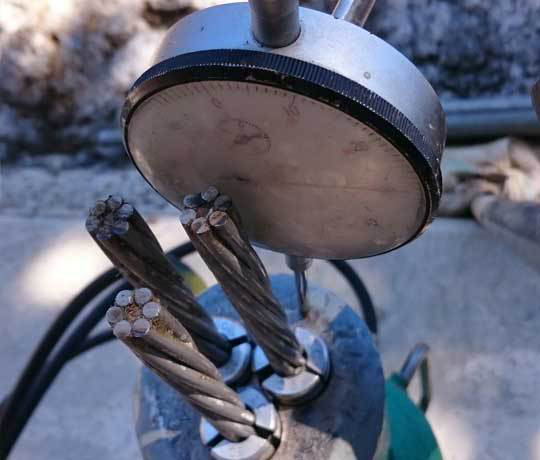
You're thinking, "I've got it all set up perfectly!" aren't you?
Dial gauges are calibrated in 1/100 increments. The human eye can generally distinguish differences down to 1/10 (provided there are markings).
Even if the misalignment is less than 1 mm, the hydraulic cylinder stroke will increase, and
When it shrinks, the tip of the dial gauge is in a different position than when it was set.
(It's much better with wire-type digital meters.)
It's impossible to set the dial gauge with even the slightest deviation.
Also, it's hard to find a stable footing right from the start (though it's a bit better on a dirt surface).
That's why we can't collect good data.
That's why you fail.
"Alright! I thought I'd set it up just right!"—and then the anchor head starts spinning around lol
This is the phenomenon where the twist in prestressed steel strands unwinds due to tension.
With this twisting motion, the dial gauge is definitely going to point in that direction, isn't it?
The same applies to digital gauges (wire-type) as well as dial gauges.
Do you understand why stress management fails?
We're actually doing things on-site that are practically impossible, lol.
Well, there are ways to make it work, though.
For the reasons mentioned above, even if the government office makes a note of it, you can simply say, “I made a mistake, so I’ll try again,” and that’s perfectly fine.
You might as well just say why you failed. It’s when you try to hide it that things get weird.
In my case, I tell them absolutely everything, without holding anything back. Most government officials agree that that’s the way it should be.
So, when someone asks, “What are you going to do?” I say, “I’ll use a caliper.”
The dial gauge is just a prop for the photo, but I’ll even go so far as to say that you can get accurate measurements with a caliper lol
If you know you’re going to fail, you won’t be afraid or hesitate even when others are watching.
The key is how to cover that.
Even if you're told to use a dial gauge, the data from a vernier caliper is ultimately the most reliable.
I've been saying this for several years, but only those who have experienced it themselves will understand.
Those of us who've gone through stress management training with me are all fans of calipers now.
Though, the dial gauge is just a fake, lol.
You're free to choose whichever method you prefer. I think you should just pick the one that works best for you.
See you later.
How to Conduct Suitability Tests for Ground Anchor Construction



I always read your posts and look forward to them ^ – ^.
Please tell me how to take measurements using a vernier caliper.
I'd like to give it a try. Do I mark the stroke at the initial load and then measure from there with a caliper?
I'm looking forward to it. Like Enta, I handle both management and day-to-day tasks. I've been learning a lot from you.
Thank you as always.
It's easy to use a caliper.
All you have to do is measure the jack's cylinder.
If you make sure to measure at only one spot—any spot will do—you’ll minimize the margin of error.
So, if a structure under pressure sinks, you just need to subtract the amount it has sunk, and that's all.
I'll write about this in more detail next time.
It must be tough to handle both the hands-on work and the management! The hands-on work gets easier once you get used to it, but construction management is really tough, isn't it?
Let's work without pushing ourselves too hard!!
If you know any work hacks, please let me know!
I'm going to go ahead and share this, lol. Good stuff deserves to be shared! And here's something even better!!
We look forward to your continued support.
Thank you for your hard work. I always enjoy reading your posts. I’m also a fan of using digital calipers for measurements.
Thank you for your hard work.
Thank you as always.
There aren't many people who prefer digital calipers, so that's pretty rare! lol
No one's going to believe this until you actually do it and show us the data, right? lol
It's really such a simple thing, but...
Even when I ask the Anchor Association, they say it's fine as long as you subtract the settlement of the load-bearing structure, lol.
Minorities really don't get much recognition, do they? lol