Hello, everyone.
This is Enta.
The Ministry of Land, Infrastructure, Transport and Tourism has announced the labor unit rates for public works design for the Reiwa 8 fiscal year.
Press Release(PDF format)
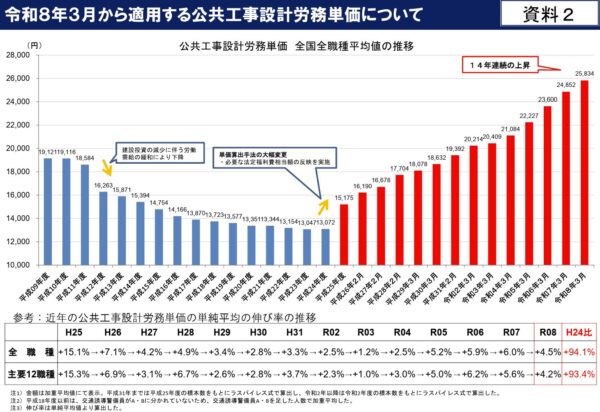
Average Across All Job CategoriesUp 4.5%... This is the first time the daily rate has been set at25,834 yen...was surpassed.
This marks the 14th consecutive year of increases.
When I saw this, to be honest, I thought, “4.5%, huh…” lol
It's kind of a fine line between whether to be happy or sad, isn't it?
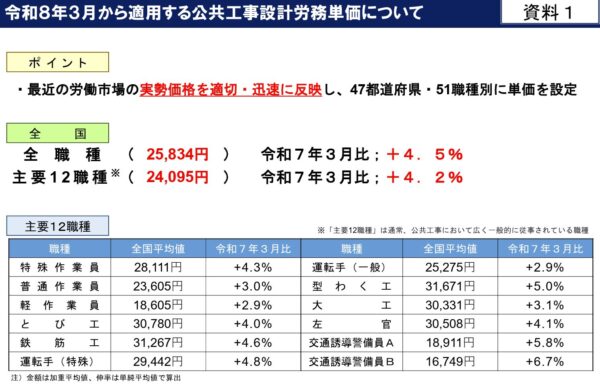
As a country, we’d really like to highlight the fact that we’ve been growing for 14 consecutive years, wouldn’t we?
The slope construction project (Aichi) is 34,000 → 34,600 yen.
A tiny increase of 1.8%... (What's this...?)
4.51 TP3T increase—what do you really think about that?
First, let's go over the numbers.
In the previous fiscal year, Reiwa 7,6.01 TP3T IncreaseThat was it.
This year, however, that figure fell to an increase of 4.51 TP3T.
To be honest,The growth rate is slowing down, isn't it?。
Speaking of prices, the Consumer Price Index for 2024 has been hovering around 3% year-over-year, but
Construction materials have been used in the civil engineering sector since 2021An increase of approximately 411 TP3T or moreThis situation continues.
According to data from the Japan Construction Industry Federation, the construction materials price index for the civil engineering sector rose by approximately 411 TP3T compared to January 2021 (as of December 2025).
Fuel and equipment costs remain high, and on-site costs continue to rise across the board.
With food prices and utility bills continuing to rise, the cost of living for skilled workers on the job site is naturally increasing as well.
Given that, to what extent will the 4.51 TP3T increase in labor rates have an impact?
To be honest, the reality is that we haven't caught up yet.I think so.
So, will bankruptcies increase?
It's going to increase. (There's no doubt this year will be a tough one too, right!?)
The reason is simple:Although the cost structure has changed, the unit price per order has not kept pace.From.
Construction materials have risen by 411 TP3T or more, fuel costs remain high (though they did drop quite a bit under the Takashi administration), and machinery costs have skyrocketed.
Given all of that, how many companies will actually be saved by the increase in the labor rate to 4.51 TP3T?
Even if the Ministry of Land, Infrastructure, Transport and Tourism were to approve design changes due to rising material costs, would prefectures, cities, and municipalities readily approve them?
In industries like the slope stabilization sector, where small and micro-enterprises make up the vast majority, it is almostLabor Costs!
In a situation where there’s nothing left to cut back on, if the unit price per order doesn’t go up,Only companies with the resilience to survive will make it.It's as simple as that.
Large companies have the advantage of economies of scale. But what about slope-construction firms with 5 to 20 employees? What will happen to small and medium-sized contractor firms?
The difference in stamina is just insane.
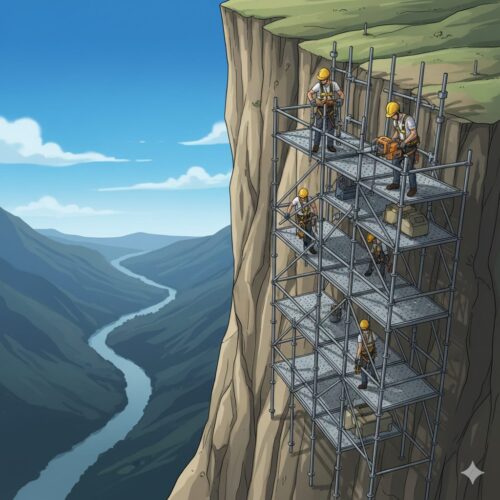
So what should we do?
It's easy to just vent and call it a day.
"Unit prices aren't going up," "Prices are rising too much," "It's the government's fault," "The big companies' unit prices are too low."
They're all right lol
But it's also true that complaining won't change anything.
If there's one thing I can say, it's that,Don't Give Up on Negotiating the Unit Price for OrdersThat's the point.
Are you just accepting the price quoted by the general contractor without question?
Are you able to say, “We can’t do it at this price”?
Companies that can't say this will be the first to struggle.
Rather than the fear of saying no,The fear that accepting work at low prices will bring the company to a standstillThat one is way bigger...
We must put an end to the era of cutting employees' salaries just to keep operations running.
Unit prices are meant to be negotiated. You shouldn't just accept them without saying anything.
Construction companies that rely heavily on major contractors and simply carry out the projects assigned to them don’t even negotiate unit prices, do they?
(Violation of the Construction Industry Act)
It’s also risky for major companies to simply send contractors documents—such as order acknowledgments—that are just there to get them to sign off on quotes prepared by the major companies themselves.
Well, it’s true that there are some contractors who can’t even do that, though...
This is a really difficult issue, but,
As mentioned in the recent article, it seems the only way forward is for major companies to acquire these firms and bring their operations in-house.

Rather than debating whether the figure of a 4.51 TP3T increase is “good or bad,”
Accurately understanding what lies behind these numbersThat's more important.
If you just celebrate every time the numbers go up, you’ll find yourself left behind before you know it.
Numbers are just a form of information.
How we interpret that and how we respond will shape the company's future.
We live in an era where those who use information as a weapon and keep moving forward are the ones who survive.
Our only way to survive is to raise our unit prices, but conversely, these are tough times for general contractors, too!
I think it’s time to consider how we can survive alongside our prime contractor.
Is it a major company? Or a local business? ...
I really feel like we've reached a difficult juncture.
All that's left is to hope they'll really ramp up our orders (I'm seriously counting on it!)
See you later.