

Hello, everyone.
This is Enta.
The other day, an article like this was trending on X.
Sekisui House to Hire a Large Number of Carpenters as Full-Time EmployeesThat's the story.
They have named it the “Crafters System” and aim to have a workforce of 1,000 people by 2033.
Full-board training, comprehensive social insurance, two days off per week, and the potential to earn over 8 million yen annually.
When I heard this, to be honest, I thought, “Whoa! So the housing industry has finally made a move!” lol
Well, Ichijo Komuten did something similar a while back when it took over a similar construction company.
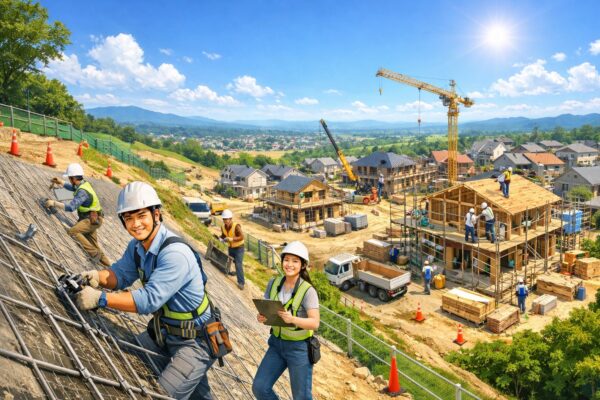
What's happening in the housing industry?
Simply put,Major companies have begun to recruit artisans directlyThat's the point.
The number of carpenters has fallen to one-third of what it was 40 years ago, and the majority are in their 50s and 60s.
Daiwa House acquires partner companies, while Sumitomo Forestry trains employees at its own training school.
The multi-tiered subcontracting structure is beginning to break downThat's right.
It’s not that they aren’t selling—it’s because the situation has shifted to the point where they can’t be built.
So what will happen to the public works and slope stabilization industries?
What's happening in the housing industry is,This will undoubtedly have an impact on the slope stabilization industry as wellI think so.
The slope construction industry consists of small and medium-sized enterprises ranging in size from 5 to 30 employees, and the aging of its skilled workers is on par with or exceeds that of the housing industry.
There's a really high chance that major slope stabilization companies will take over small and medium-sized ones.
You get quite a few solicitations from major construction associations, don't you?
After all, even the big companies don't want to use shady contractors, do they? (I totally get that.)
No people → Can't get work → Can't maintain the machinery.
Companies that have fallen into this downward spiralIt's either a takeover or going out of businesswill be quite high.
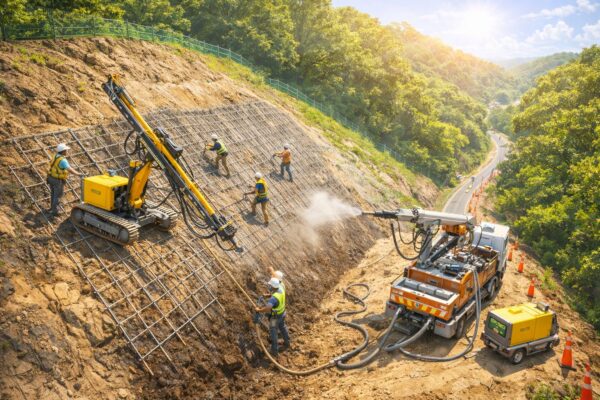
How should we, as slope contractors, proceed?
Personally, I think there are three possible approaches.
① Proactive Measures: Develop talent in-house and thoroughly strengthen our team of skilled craftsmen
Improve compensation and establish a training system.
Companies that can do that are strong.
But the risk of rising fixed costs is huge.
ButIf we don't do it, the future will be tough。
② Passive Strategy: Play it safe and stick with the status quo
When business owners are getting on in years, they tend to think, “If I can just hold on for another 10 years, that’ll be fine,” lol.
ButWhere is the 10-year warranty?That's the story, though...
③ The Safe Bet: Survive Through Partnerships and Collaboration
This might be the most realistic option...
Small and medium-sized enterprises collaborate to share personnel and machinery and jointly secure orders.
An Era of Joining Forces as Partners, Not RivalsThat's it.
Alternatively, through M&A—mergers and acquisitions—we can combine our strengths to achieve a balance.
That's exactly what we have here.
While Sekisui House's moves pertain to the housing industry,At their core, they are just like us。
"We can't get the work done without people." Especially since slope stabilization work is done by hand...
The value of skilled trades—which even AI cannot replace—is sure to rise in the future.
There’s a good chance we’ll be entering a truly crazy era over the next 10 years!
If you just wait, you’ll be swallowed up. This is an era where only those who take action survive.
I feel like the time has come for the slope stabilization industry to change as well.
I believe the era of setting up legal frameworks is coming to an end, and
I feel like there’s a growing demand for more fundamental construction work.
What do you all think about this blue-collar/white-collar issue?
See you later.