Hello, everyone.
This is Enta.
We’re now in the latter half of the rainy season, and there’s been a steady stream of news reports about heavy rain in various areas lately.
Every year around this time, I start to worry about old retaining walls. This is also the season when we start getting the occasional inquiry along the lines of, “Our retaining wall is starting to bulge.”
But that's beside the point.
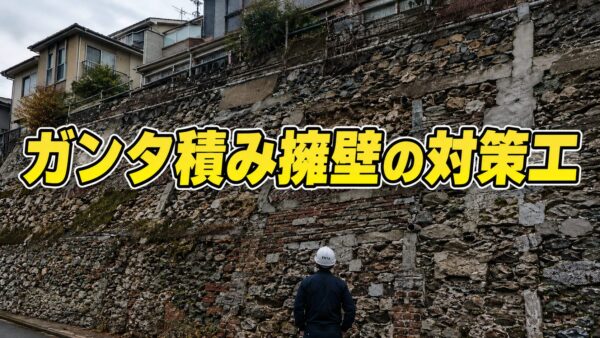
In this post, I’d like to share my thoughts—based on my own experience—on countermeasures for the “Ganta stacking” method, which is commonly seen in the Yokohama area.
Normally, public works contractors like us, who specialize in slope stabilization, don’t usually get involved with retaining walls for residential homes, but,
We also do retaining wall reinforcement work, lol
I’ll list both the appropriate construction methods and the ones you absolutely must not use.
What Exactly Is “Ganta-zumi”? Let’s Start by Assessing the Current Situation
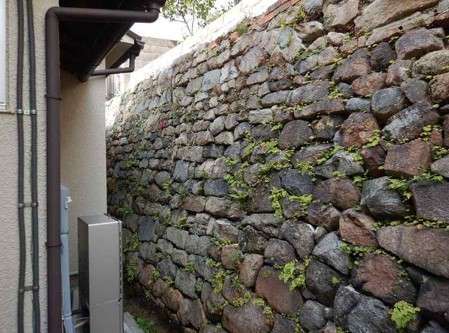
A "ganta" retaining wall is a type of retaining wall built by stacking and interlocking concrete scraps, bricks, roof tiles, and similar materials.
According to the retaining wall checklist provided by the Yokohama City Bureau of Architecture, it is described as “a retaining wall built by reusing old concrete blocks and other materials,” and
It is classified as a “dry-stone retaining wall,” which is considered structurally unstable.
The problem is that the surface is often covered with mortar, so at first glance, it’s hard to tell what materials are inside.
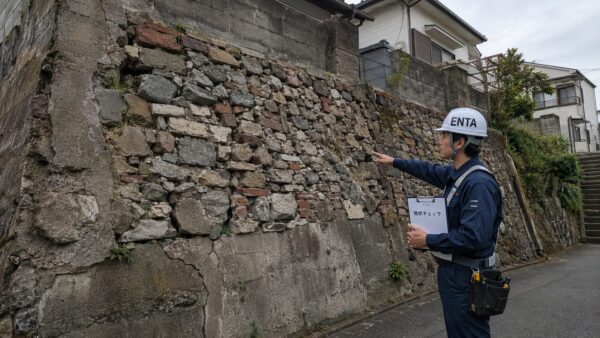
So, before taking any measures, I always assess the current situation. These are the main abnormalities I check for.
・There are large gaps between the stones, and some stones are missing in places.
・The entire body is bulging forward
・Soil from the back is seeping out through the gaps; the back looks hollow.
・There are no drain holes, or they are blocked
・There are cracks running vertically and horizontally (vertical cracks may indicate collapse; horizontal cracks may indicate subsidence)
・The foundation of the house above is cracked, and the soil above it is subsiding.
・A layer of stone or block masonry is placed on top of the gabion wall (two-tier retaining wall)
・There are traces of areas that were previously covered with mortar, and abnormalities are appearing in those areas.
Countermeasure Method 1: Using the Moldam Method to Turn “Individuals” into “Chains”
The Moldam method is effective when there are gaps and you need to join stones together.
This is a construction method in which a special filler is injected into the interior of the stone masonry to bond the stones together.
This is a patented construction method developed by Kyushu Disaster Prevention Maintenance, and it is registered with the Ministry of Land, Infrastructure, Transport and Tourism’s NETIS (New Technology Information System).
The key point is that injecting the material causes the entire stone wall to bond together as if it were a single piece of rock.
It’s like the difference between relying solely on the weight of individual stones to stabilize the slope, as we’ve done until now, and being able to stabilize the entire slope surface.
I find the expression “stringing together scattered stones” to be just right.
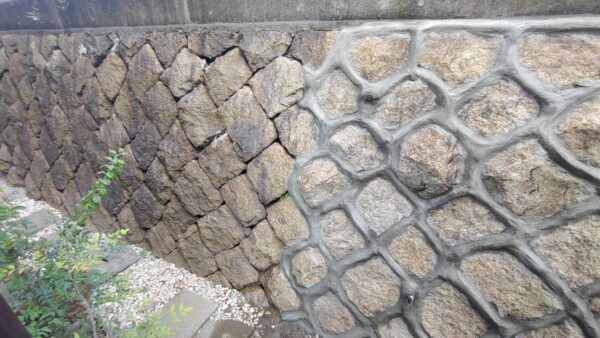
However, the Mouldam method is, strictly speaking, a technique that only hardens the surface of the masonry.
Therefore, it’s best not to expect too much from the ability to counteract the earth pressure and water pressure pushing up from deep within the ground.
In that case, we’ll need to compensate using a different construction method.
Remedial Methods 2 and 3: Reinforcement Insertion Method and Drainage Boring Method
For gunta masonry, which is subject to strong internal forces caused by heavy rain or earthquakes, we combine it with rebar insertion work.
This construction method involves driving reinforcing bars approximately 2 to 5 meters into the ground and bonding them tightly to the natural ground using cement slurry to form a single, integrated structure.
According to the Reinforcing Bar Insertion Manual and materials from the Japanese Geotechnical Society, the concept is to increase the shear resistance of the natural ground and create a “pseudo-retaining wall” equivalent to the length of the driven reinforcing bars.
It's a standard construction method used throughout Japan for public slope stabilization projects.
The key here is water management.
In areas with high groundwater levels or abundant spring water, it is necessary to first lower the groundwater level by draining the site using dewatering boreholes.
In addition, measures are needed to prevent soil pressure from building up during heavy rain. That’s why we always consider rebar and drainage as a package at our company.
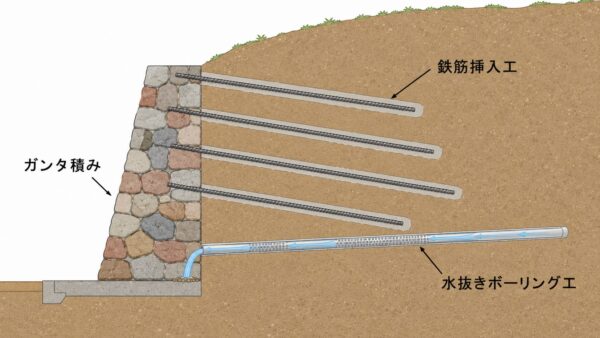
When we say “draining” here, we don’t just drain the surface—we drain water from a depth of at least 4 meters.
Drainage drilling (horizontal drilling) is a method in which a borehole is drilled at a slight upward angle from the horizontal, a perforated pipe is inserted, and groundwater is forcibly drained.
This prevents the interior from becoming saturated with rainwater and helps keep it stable.
To be honest, I think this drainage drilling alone is pretty effective, lol.
It is commonly used as a landslide prevention method in public works projects.
Construction Methods You Must Never Use
Finally, here’s a construction method you should absolutely avoid.
This involves covering the entire surface with mortar without any reinforcement.
The reason is that if you hide everything, you won’t be able to tell what changes occur afterward.
Even if soil and debris are seeping out through the gaps or bulging out, you won’t notice it if the problem is developing beneath the surface mortar.
Generally, this type of construction is finished using lath wire mesh (tortoise-shell wire mesh) and a thin layer of mortar.
Therefore, it lacks strength, and there is a very high likelihood that it will peel off over time and develop cracks at an early stage.
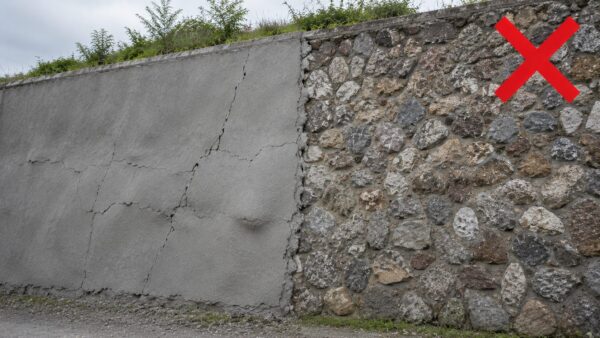
It looks good on the surface, but it’s a repair method you should absolutely avoid.
The contractors who push this say it makes the stone more resistant to weathering, but it takes decades or more for the stone to weather anyway lol.
Even if you've already hidden it, there are plenty of ways to reinforce it.
That said, does that mean all surface-coating methods are ineffective? Not necessarily.
In our case, if we’re covering the surface, we always install rebar.
Use D13 rebar at 20-centimeter intervals.
This is because, if the surface coating is securely connected to the natural ground (gan-ta masonry) with rebar, it functions not merely as “cosmetic” finishing, but as a surface that bears the load.
Even when covering it, I believe it’s important that it’s properly integrated with the natural ground.
Naturally, we’ll make it the same thickness as a national highway (8 to 15 centimeters).
The thickness varies depending on the region—such as cold climates—and other conditions.
As a slope engineering professional, prioritizing strength is absolutely essential!
We will never let it collapse! That is our job.
Ultimately, the key to countering Ganta stacking (stone stacking) isn't about hiding it, but rather...
"It's about understanding the conditions inside, connecting the surfaces, thoroughly draining the water, and integrating it with the natural ground."
Even a retaining wall on a residential property is just another slope (cliff) to us, so it’s business as usual! Of course, we’ll make sure it doesn’t collapse and protect the client’s life!
That’s exactly why I want to choose a construction method that makes sense, rather than one that simply hides things.
See you later.
Results of Applying the Mormudam Method to Ganta Piling in Kanagawa Prefecture