Hello, everyone.
This is Enta.
Every once in a while!
I sometimes get asked, “What does ”1.24 m³ of sand’ mean in the mix design for sprayed mortar?”
Another reason is that lately, the specifications just say “sprayed mortar 1:4,” and the figure of 1.24 m³ has been omitted lol.
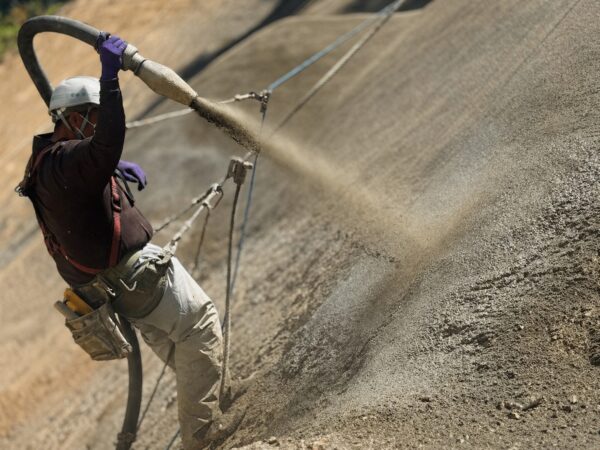
This time,The meaning of “1.24 m³ of sand” in the mix design for sprayed mortar,
The Relationship Between Bulk Volume (Apparent Volume) and Absolute Volume (Volume of the Particles Alone)I'll start writing from there.
Based on the test methods specified in JIS A 1104 and JIS A 1109, we will create a template that can be used for explanations.
That said, I do feel that this way of thinking is a product of its time, so please keep this in mind if the topic ever comes up.
What Does 1.24 m³ of Sand Mean? | Listed by Loose Volume
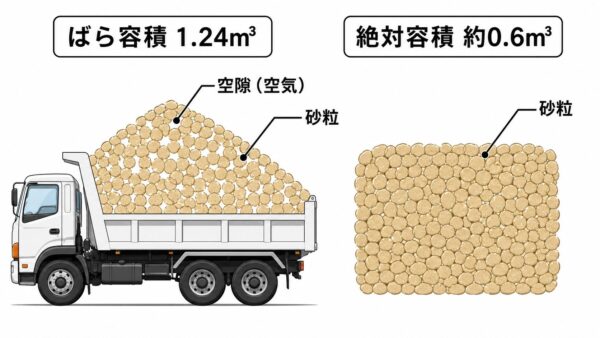
To put it simply,The entry “1.24 m³ of sand” in the mix design table represents the “bulk volume” when the sand is loaded onto a dump truck using a wheel loader (tire shovel).
The apparent volume, which includes not only the "absolute volume" consisting solely of densely packed grains of sand, but also the air gaps between the grainsThat's it.
In the old standard specifications, the mix design for sprayed mortar (volume ratio 1:4) was stated as follows:
| Ingredients | Mass | Volume (bulk volume) |
|---|---|---|
| Cement | 420 kg | — |
| 砂 | 1,680 kg | 1.24 m³ |
*Example mix ratios for on-site formwork and mortar spraying per 1 m³ of mortar.
Traditional cost estimation standards and standard specifications documents from various organizations
The Relationship Between 1.24 m³ and 1,680 kg
These figures are derived from simple proportional calculations. For general-purpose fine aggregate (sand),Mass per unit volume in loose state (uncompacted)is approximately 1.35 t/m³ (measured in accordance with JIS A 1104, “Test Methods for Unit Volume Mass and Bulk Density of Aggregates”).
1.24 m³ × 1.35 t/m³ ≈ 1.67 t (= 1,670 kg) ≈ 1,680 kg
In other words, it’s a simple relationship between volume and mass per unit volume: “1.24 m³ of loose sand contains approximately 1,680 kg of sand.”
These vary slightly depending on the sand's specific gravity, source, and moisture content.Therefore, when calculating the exact mix design, it is standard practice to measure the bulk density of the on-site sand.
Reasons for Distinguishing Between Apparent Volume and Absolute Volume
In the world of formulation calculations,It is very important to distinguish between “apparent volume” and “absolute volume.”That's it.
- Loose Volume (Apparent Volume): The volume, including air (voids), that can be measured on-site. This refers to the state when the material has been loaded onto a dump truck using a loader.
- Absolute Volume: The volume of the sand particles alone (excluding voids). This value is used in theoretical calculations for mix design.
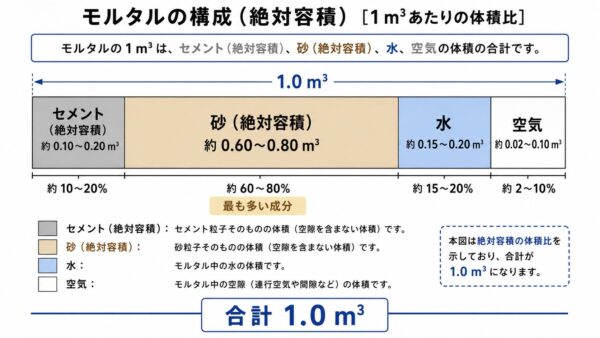
To be honest, the main reason for confusion in mix design calculations is mixing these two up. Even if you say, “I added 1 m³ of sand to 1 m³ of mortar,” the volume of the individual grains in 1 m³ of loose sand is only about 0.5 to 0.6 m³, so the total of cement, sand, and water in the calculation won’t add up.
Calculation to Determine the Absolute Volume of Sand
The apparent dry density of sand (measured in accordance with JIS A 1109, “Test Methods for Density and Water Absorption of Fine Aggregates”) is generally 2.5–2.7 g/cm³. The absolute volume of 1,680 kg of sand is,
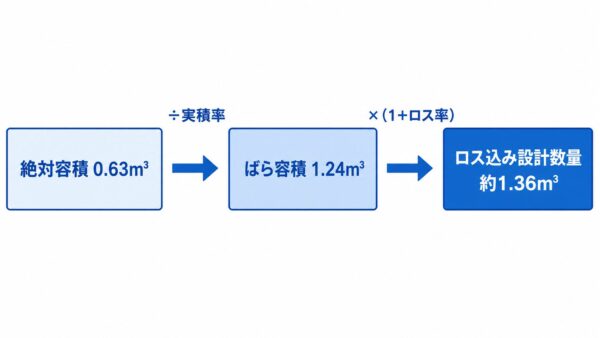
1,680 kg ÷ 2.65 g/cm³ ≒ 634 L ≈ 0.63 m³
In other wordsA 1.24 m³ volume of loose sand contains approximately 0.63 m³ of sand particles (absolute volume)....in other words, the remaining 0.61 m³ is air (the spaces between the particles).
This "ratio of absolute volume to total volume" is Actual Achievement RateThat said, when measured according to JIS A 1104, sand generally registers between 50 and 601 TP3T. (This won’t be on the test, lol.)
1.24 m³, Loss Rate, and Design Quantity
In traditional cost estimation, thisThe figure obtained by multiplying 1.24 m³ by the on-site loss ratehad been recorded as the design quantity. For example, assuming a loss rate of 10%,
Design Volume = 1.24 m³ × 1.10 ≒ 1.36 m³ per 1 m³ of mortar
This represents the “total amount of sand to be ordered” for dump truck transport and inventory management.
Reduced administrative burden resulting from the transition to the market-based pricing system
Recently, the market unit price method has become the norm, and management items such as these receipt and issuance ledgers (forms used to record the daily difference between the quantity of materials received and the quantity used) have virtually disappeared.
Back in the day, inspectors would nitpick over every little detail, saying things like, “The difference between the received quantity in the receipt and disbursement ledger and the actual quantity used is too large—that means there’s too much waste,” and
The site supervisor was really at his wits' end, lol.
Recently, there’s been an increase in the use of ready-mix concrete for mortar spraying on small lots, so to be honest, it’s becoming less of an issue, but,
I think it's good to know that things like this—even basic stuff—have happened in the past, lol.
Standard for the Water-to-Cement Ratio
Standard Values for the Water-Cement Ratio (W/C Ratio)。
With sprayed mortar, generally 45–551 TP3T is considered the standard, and the distinctions in usage in practice are as follows.
| Season/Conditions | Guidelines for the W/C Ratio | Reason |
|---|---|---|
| Summer | 55% | In Conditions of Extreme Dryness and Heat: Improving Workability |
| During the winter | 49% Degree | Prevents Freezing, Reduces Bleeding |
| Standard | 50% | Annual Standard Values |
※This is merely a general guideline for the industry, Be sure to check the Special Specifications and the ordering agency’s instructions on-site.
A Discussion on Antifreeze
I’m sometimes asked whether to use “de-icing agents” during winter construction, but based on my on-site experience, Generally speaking, it's best not to use it. That's the conclusion.
It is said that data from experiments conducted at official testing facilities actually shows that the effectiveness is limited.
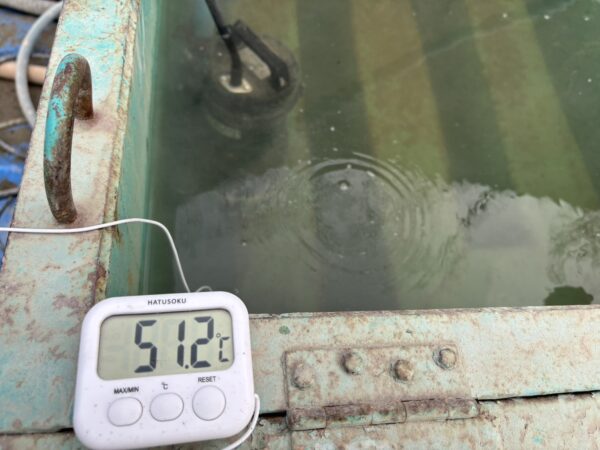
Rather than preventing freezing,Mixing the paste with hot water (using warm water) or curing with briquettesIt's definitely more effective to maintain the temperature that way.
(For more details, see the separate article on winter construction measures.)
Tips for Explaining Things on Site
Finally, here’s a template for explaining what “1.24 m³” is when someone asks, lol.
- "This is the (apparent) volume of the rose." — Numbers recorded when scooping with a peeloader
- "The volume of the sand grains alone, when tightly packed, is approximately 0.63 m³." — Calculated based on the dry bulk density specified in JIS A 1109
- "The old specification called for using 1.24 m³ of this loose sand per 1 m³ of mortar."
- "The old method of estimating quantities involved multiplying by the loss rate to determine the order quantity."
- "Now that we're using market unit prices, all we have to do is place an order based on the quantities listed in the design drawings."
As an engineer, it’s better to know this than not to know it, right?
See you later.
[Related Articles]
- What Is a Chapman Flask? | Surface Moisture Content Test for Fine Aggregates
- Standards for Cement Slurry Compressive Strength Tests | Why Three Tests in the Morning and Three in the Afternoon?
- On-Site Spray-Applied Formwork: Category List
[References and Sources]
- JIS A 1104 "Test Methods for Unit Volume Mass and Bulk Density of Aggregates"
- JIS A 1109 "Test Methods for Density and Water Absorption of Fine Aggregates"
- The Japan Society of Civil Engineers, *Standard Specifications for Concrete*, Construction Volume (Chapter on Mix Design)
- (Previous Edition) Standard Specifications for Public Works: Section on Mortar Spraying Work
- Ministry of Land, Infrastructure, Transport and Tourism, “Civil Engineering Cost Estimation Standards” and Civil Engineering Design Guidelines of Each Regional Development Bureau