Hello, everyone.
This is Enta.
These days, everything is digital, isn't it?
These days, almost every company handles everything—from estimates and schedules to photo management—entirely digitally.
I was thinking, “This is just too convenient—I’ll never go back to paper…” but.
But here's the thing—for some reason, whenever I'm thinking things through, I still end up writing them down by hand in a notebook, lol.
Things like the vision during development and what happens on-site.
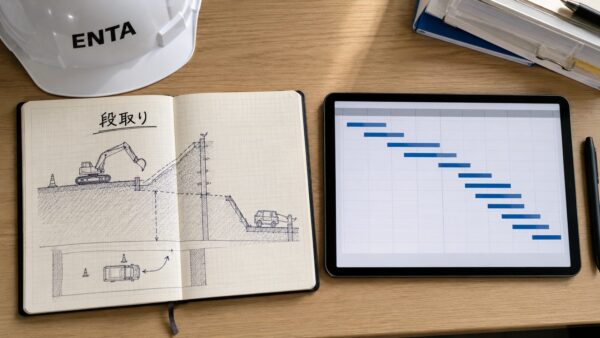
Before I put it into CAD, I quickly sketch it out by hand first.
That really helps me visualize it all at once.
Plus, since I remember exactly how it felt at the time, I can transfer it to CAD quickly later on.
I wondered, "Why is that?" so I looked it up, and I came across a pretty interesting story lol

This time, we'll be talking about "how to choose between digital and analog."
Let’s break it down by role—craftsman and supervisor—to see which is better suited for what on a construction site.
Why Does Handwriting Stick in Your Mind? (I Looked Into It)
When you write up a KY (Hazard Prediction) report on-site, you tend to remember the details pretty well, don't you?
On the other hand, if I just read someone else’s “KY” comments from the sidelines, I tend to forget them pretty quickly.
Isn't that strange?
Upon looking into it, I found that a well-known psychological study apparently showed that people who type on a computer tend to copy text verbatim, resulting in a superficial understanding, whereas those who write by hand summarize the material in their own words, leading to better scores on subsequent tests measuring “conceptual understanding.”
In another study conducted in 2024 by the Norwegian University of Science and Technology (NTNU), in which 36 college students were monitored using an EEG device equipped with 256 electrodes, it appears that only when writing by hand were broad regions of the brain associated with memory and learning connected (linked) to one another.
Apparently, that lively connection wasn't evident while he was typing on the keyboard.
The idea seems to be that when you write by hand, the fine movements of your fingers, the visual information your eyes take in, and the sensations in your hand all come together at once, which is why your brain is working at full capacity.
*Since both of the papers mentioned above state that it’s hard to say definitively which one is better, their credibility is a bit questionable, lol.
Still, the fact that the author of *KY* says they remember it well really lines up perfectly with the actual experience on the ground, doesn't it?
Let's Try to Categorize On-Site Tasks as "Suitable for Analog" or "Suitable for Digital"
To put it simply, I think the distinction would be something like this.
- Organize your thoughts · Expand your ideas → Analog (handwritten)
- Record confirmed information · Share it with everyone · Perform calculations → Digital
I've put this into a table to show the differences between the craftsman's work and the supervisor's work.
| Scope | Best suited for analog (handwritten) methods | Well-suited for digital |
|---|---|---|
| The Work of an Artisan | ・Review of construction visuals and finishing details ・Filling out the KY (Hazard Prediction) form |
・For verifying dimensions and quantities ・For reviewing construction photos and the final result |
| The Director's Job | ・Rough outline of the process and setup ・Notes on Observations Made on Site |
・Sharing and updating the schedule ・Drawings, CAD ・Quantity tracking, cost management |
The reason is simple: analog methods are most effective when it comes to “thinking” and “memorizing.”
As the study mentioned earlier shows, moving your hands makes it easier to retain information.
Conversely, digital tools excel in situations involving “accurate recording,” “distribution,” and “calculation.”
It reduces transcription errors, and everyone can view the same up-to-date data. This is a clear victory for machines.
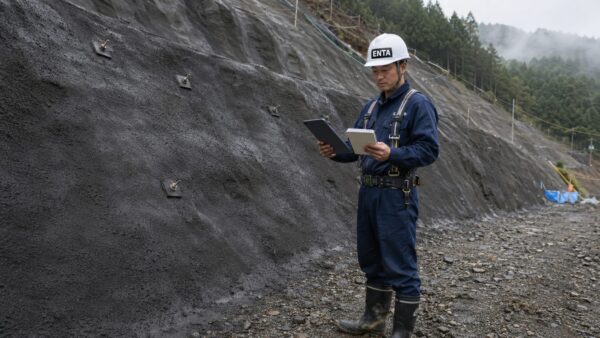
So, how do you decide which one to use?
In my case, I still draw the construction sketches by hand.
I sketch rough drafts in my notebook, and once they're finalized, I transfer them to CAD.
Drawing by hand helps me visualize things better, and since I remember the feel of drawing, it’s actually faster to transfer the design to CAD later on.
To summarize the above, I’ve taken the liberty of suggesting that this might be a good way to draw the line.
- Thinking and Memorization Tasks (visualizing the construction process, planning the workflow, KY, notes during construction) → Start by writing them out by hand
- "Record, Share, and Calculate" Tasks (sharing as-built drawings, photos, quantity takeoffs, costs, and schedules) → Leave it to digital tools
In short, the "input"—thinking and memorizing—is analog, while the "output"—recording, sharing, and calculating—is digital.
I think this method of handoff probably results in the least amount of loss.
Going fully digital is certainly faster, but it feels like we’re moving forward without giving it enough thought.
And so it ends without me ever understanding...
On the other hand, if everything is done manually, errors can occur during data sharing and calculations.
That's why I think it's not about leaning toward one or the other, but rather about “fusion.”
In the old days, craftsmen and foremen memorized everything—from blueprints to work procedures—using only their heads and hands.
Now, digital technology is there to help with that.
It really is a convenient time we live in, isn't it?
But I think that if we hand over the entire process—right down to the starting point of thinking—to machines, we might fail to develop that important “intuition.”
That's why I still write out the initial sketch by hand.
That way, I'll remember it better in the long run, and it's easier to explain, lol.
It's not a question of digital or analog—we use both.
The input is people, and the output is data. I think this might be the most powerful approach.
See you later.
No More Misreadings with the Shift from Analog to Digital | DX