Hello, everyone.
This is Enta.
A question I’ve been hearing a lot lately is, “How do you handle the inspection of empty bags?”
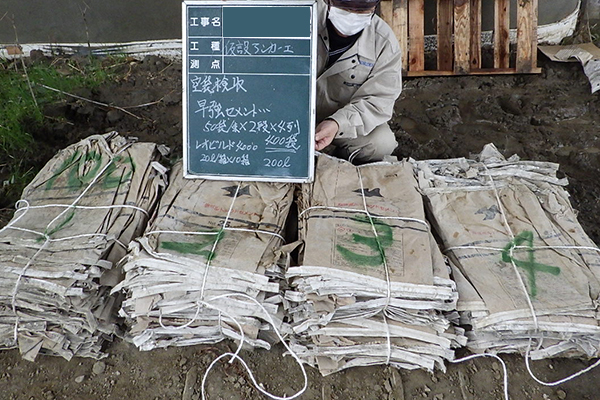
Back in the day, there was something called the "loss rate."
Well, I still have some now, lol.
In our construction projects, the design documents are our top priority.
These are the design documents I often look at.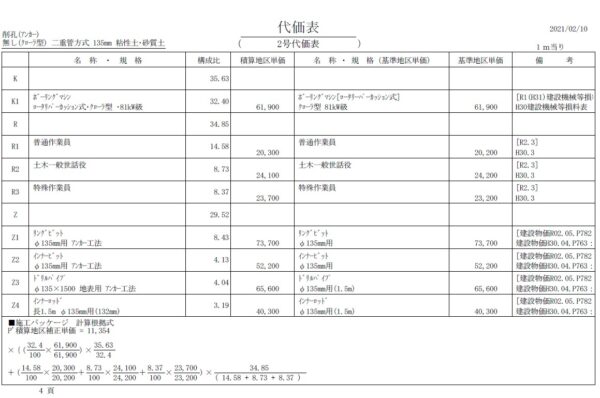
The numbers and ingredients listed here are all there is.
Based on this, recent spray-applied and injection work is calculated using market rates.
The market unit price is listed as a "Construction Package (SP)."
It's a simple story,A unit price that remains unchanged for one year, even when factoring in all construction lossesThat's the point.
If the quantity changes, the total amount will increase or decrease accordingly. Quantity × Market Unit Price = Contract Price
It has nothing to do with whether losses are increasing or decreasing just because the quantity has gone up.
Since this is the market unit price, there is no such thing as a loss rate.
In the past, they used to list the loss rate as "XX percent."
Of course, even now, depending on the type of work, it is still specified.
In the case of a wooden frame, for example, you start by installing the lath, right?
The market price for sheet piling is 1,760 yen/m² under the conditions of “1,000 m² or more (standard), no restrictions, slope cleaning included (no adjustments).” (Aichi Prefecture)
This includes the materials, such as wire mesh and anchor pins.
If the slope being worked on is a clean cut slope and the loss of wire mesh is around 1.2割, it’s perfectly fine to take photos of the quantity received as is.
I think our generation of middle-aged guys, in particular, is pretty sensitive to waste, lol, but back in the day, material waste for fishing nets was 1.4割.
That's why we ordered 1.4 times the usual amount, right?
The same goes for empty bags. You only need as many empty bags as you’ve used for the job.
□ Let's assume that a 1,000-meter retaining wall was constructed using 300 units.
That means we need 4,428 empty cement bags with no waste.
Even if there were no losses, 4,428 bags would be sufficient. (I’d guess the actual loss rate is around 10%?)
(Be careful here—if you go below this, the material cost will be lower than the market price, which would be weird lol)
In my experience, since we switched to market-based pricing, there are almost no inspectors or government officials who bring up issues like losses anymore.
It's the general contractor's supervisor, who's still stuck in the past with those old loss rates, lol.
Now that we're using market unit prices, I think it's fair to say that the concept of a loss rate no longer applies.
This means that as long as you use it within the design specifications, there won't be any problems.
However, the situation is different when the design documents specify a cost estimation based on the sum of individual components.
Please be especially careful when using special construction methods, as the loss rates from the past may still be applied in some cases.
See you later.