Hello, everyone.
This is Enta.
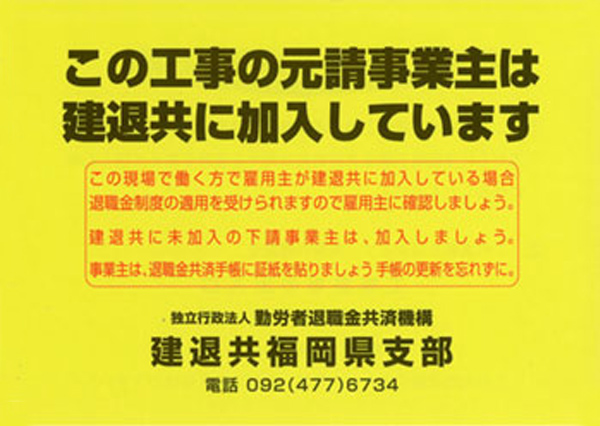
You’re surely familiar with the Construction Industry Retirement Allowance Mutual Aid System (Ken-tai-kyo), right?
It's the severance pay we receive when we leave the construction industry—the one managed through our mutual aid handbook that we can collect when we quit.
Basically, you receive stamps from the general contractor and affix them to your logbook.
Then, after retirement, the individual submits the application themselves.
That's basically how it works, right?
One of our Vietnamese staff members is returning to Vietnam, so we’ve had to file an application with the Construction Workers’ Retirement Fund.
So, since a bunch of things happened that made me go, “What?!”, I’m writing this down.
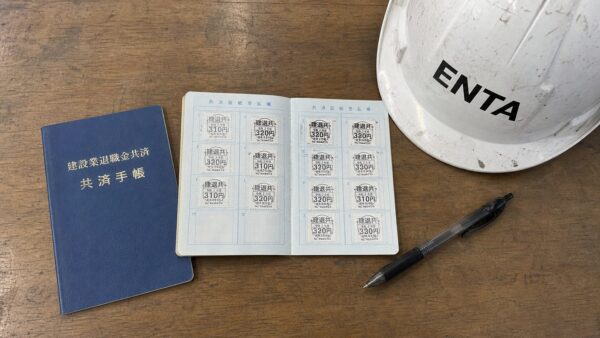
Is it the “obligation” of the general contractor to issue a revenue stamp? I looked into this thoroughly.
"Once work begins at a construction site, the general contractor is required to issue a Ken-Tai-Kyo certificate."
Many people in the field see it this way.
I used to think that too, lol.
But if you look into it properly, it’s actually a little different.
The Small and Medium-Sized Enterprise Retirement Allowance Mutual Aid System is a program established under the Small and Medium-Sized Enterprise Retirement Allowance Mutual Aid Act, and enrollment itself isOptional。
It's not a legal obligation.
(Construction Industry Retirement Allowance Mutual Aid Headquarters, Ministry of Health, Labor and Welfare).
So, as for why there’s a perception that “it’s only natural for the general contractor to pay,”
In the case of public works projects, the amount equivalent to the Construction Workers Retirement Fund contributions—including those for subcontractors—isIncluded in the construction cost estimate from the outsetfrom
(Construction Retirement Fund "Frequently Asked Questions/G3," Ministry of Land, Infrastructure, Transport and Tourism materials).
The general contractor uses that money to buy stamps and retirement bonus points in bulk and distribute them to the subcontractors, apparently.
こThis isn't an "obligation"—it's a "request." Just—and I mean just—a request! lol
However, if the business is enrolled in the Construction Workers' Retirement Fund as part of the Business Management Review,15 bonus points!!
It’s common for the client to ask how many revenue stamps are needed.
As a result, general contractors undertaking public works projects effectively have no choice but to proceed.
"It's not an obligation, but it's kind of like one."
So it's a definite! lol
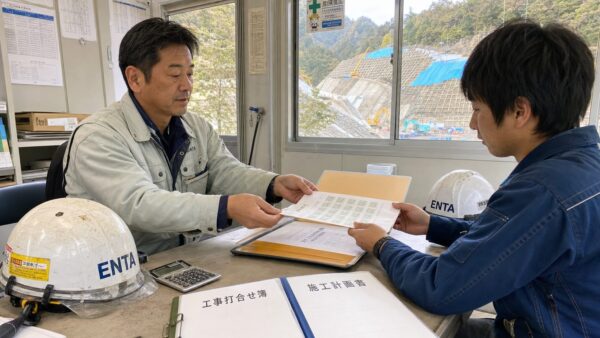
We handle private construction projects in-house—this is something that’s surprisingly easy to overlook.
As for private-sector construction projects, the standard practice is for the company to purchase the tax stamps and have its employees affix them.
We also buy them in bulk a few times a year and put them up.
I actually think there are quite a few companies that aren't doing this.
"For public projects, we get it from the general contractor; for private projects... nothing, lol."
The condition for receiving a retirement benefit is that a mutual aid stamp must be affixed toAt least 24 months' worth (calculated as 1 month for every 21 days)That's true.
If you don't reach this number of days, no matter how long you work on-site,It won't cost a single yen。
When it comes to seeing off a long-time craftsman, whether or not this is there makes a pretty big difference.
That falls under the company's responsibility, doesn't it?
So, public transportation is usually the best option, but in this case, there's just no helping it.
Or joining the Chutakyo program is another option. It depends on your company, though...
As a general rule, foreign nationals must file applications “in person.” But in reality…
So, let’s get to the main topic: the Vietnamese staff.
As a general rule, when applying for retirement benefits from the Construction Industry Retirement Allowance Fund,The person in questionThat's what they're going to do.
This is because if a third party collects the severance pay on the employee’s behalf, there’s a chance the employee won’t actually receive it. In terms of the purpose of the system, this makes perfect sense.
In addition, for foreign applicants, the Ken-Taikyo Headquarters website provides guidance on the procedures for claiming retirement benefits.English, Vietnamese, Tagalog, ChineseIt is officially maintained there.
So far, the general consensus is: “You can apply yourself, they support your native language, and it’s well done.”
But here's the thing.
When my boyfriend contacted the service desk before returning to Japan, this is what they told him.
"For foreign nationals, it's fine for the company to act as an intermediary."
"Whaaaat? lol"
When I asked, “Wasn’t it supposed to be the applicant who filed the application, in principle?”
"If we don't do that, the paperwork will get stuck and we'll never make any progress," he said...
I guess that makes sense, lol (Well, I can see where you're coming from.)
After he returns to Vietnam, he’ll have to gather all the necessary documents—his certificate of residence, ID, and mutual aid handbook—and send them via international mail… That’s way too much of a hassle.
That’s why, when it comes to foreign nationals, the company has a system in place where it gathers the necessary documents on their behalf and submits the applications for them.
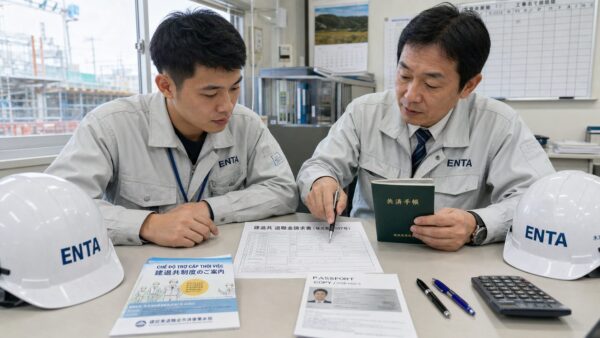
The recipient account is an overseas account in the account holder's name; this is correct under the system.
What concerns me is the flow of money.
You might be thinking, “If the company helps with the paperwork, won’t the payment be made to the company instead?” But that’s not the case.
The bank account for transfers is, strictly speaking,An account in the person's namein the form of specifying [...].
In our case, I’ve been told that we’ll designate his personal bank account in Vietnam, and the funds will be deposited directly into that account.
It won't go through the company's account.
This system is properly designed to protect the individual.
Even if the company acts as an intermediary, the money goes only to the individual.
From a design perspective, it is correct.
Well, that's definitely better.
It's a hassle to have the company come back later and say they took it, after all.
The discomfort I feel when people only say, “Use the company,” when it suits them
So, this is where it gets a little confusing for me.
"As a general rule, applications must be submitted by the applicant." "However, for foreign nationals, please have the company handle the application."
There is a discrepancy between the system’s design and the reality on the ground (on the administrative side of the organization).
It just makes you wonder—do they only treat companies like partners in worker protection when it suits them?
Of course, if we can be sure their retirement benefits will be paid out, we’d be happy to help.
It works, but I'm just like, "Hmm, I don't know..." lol
The employment of foreign workers will continue to increase.
I also think we should give more thought to establishing a “formal channel for applications by foreign nationals” as a matter of policy.
In the past? There were some people who abused the Construction Workers' Retirement Fund, but,
With digitization becoming more widespread these days, I really hope they’ll step up their game in this area as well.

Is your company's Construction Workers' Retirement Fund working properly?
Is it possible that while public works projects are handled entirely by the general contractor, the tax stamps are missing from private-sector projects?
When you’re saying goodbye to a long-time employee’s notebook for the last time and think, “Is this all there is…?”—that’s when the person themselves is the saddest.
Especially with foreign staff, once they return to their home country, there’s no way for us to follow up with them.
As part of our company's responsibility, we want to make sure the labels are applied properly and that the packages are sent out correctly.
Since I’ve worked so hard here in Japan, I’d like to give it my all at least for the finale.
Instead, I’d like the payments to be made only to those who have actually returned to their home countries, so,
I want strict disciplinary action to be taken against those who cut out in the middle of things!
See you later.
I did some in-depth research on the retirement benefit system for the construction industry!