Hello, everyone.
This is Enta.
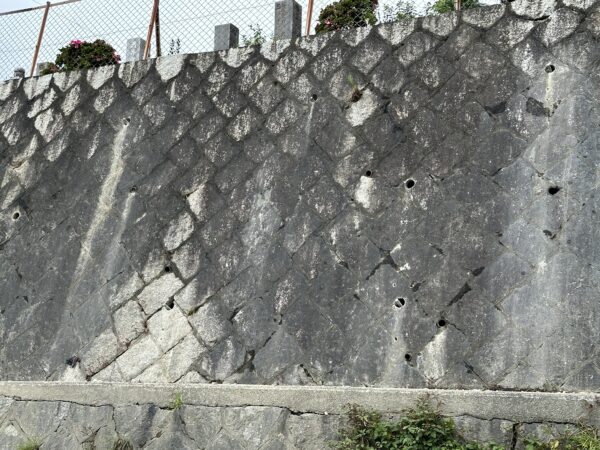
There have been many stone masonry projects recently, and a clear trend in stone masonry has emerged.
This trend is the same even when concrete is poured into the backfill!
Until now, I thought only the dry-stone wall had gaps in the backfill.
(The soil behind the stone wall has been washed away, leaving it hollow.)
However, surprisingly, the soil particles deep within the other stone walls are also being washed away.
As a result, there are horizontal cracks caused by the settlement of the stonework itself, and in some places, the stones have cracked due to soil pressure.
Even in relatively new stone walls, there are quite a few gaps on the back side.
That's because there aren't any anti-leak materials or anything like that in the drain section, you see~
So every time it rains heavily, the soil in the backyard washes away, and in 10 years, things will be in really bad shape, lol.
The reason I figured this out is that,
When you're a rebar installer and you're pouring cement slurry (grout) to bond the rebar to the concrete, it just keeps flowing in!
You can tell right away when air escapes or drilling fluid comes out even while drilling.
Thanks to that, the cement slurry pours in by the bucketful, so it ends up rock-hard, lol.
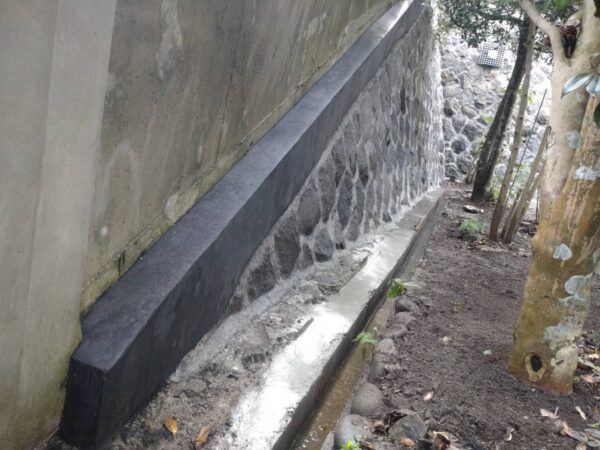
Even if something looks fine at first glance, it might actually be pretty bad.
Even when there's a serious problem with stone walls or masonry, it's hard to spot, and by the time cracks start to appear, it usually feels like it's already too late.
If you're concerned about the stonework at your home, there's an easy way to check it yourself!
Try sticking a stick into the drain pipe.
How much does it hold?
Since the rocks are about 30 to 40 cm in size, it would be a problem if anything larger were to get in.
It's possible that the back is hollow.
For nowA method that's easy for beginners to followThat's it.
If possible, it would be even better to stick a borehole camera in there.
If you're looking for an affordable option, I think a fiberscope is a good choice.
If possible, I'd prefer the swivel type.
The soundness of a stone wall depends on the soil behind it!
If the soil is loose, there’s a high chance it will collapse every time it rains heavily.
It might be a good idea to take a look at the stonework at your home.
On the other hand, if you stick a stick in there and it hits the concrete, that’s a construction defect lol.
This means that it is not functioning as a drain.
If it contains crushed stone, that's fine ^^
See you later.