

Hello, everyone.
This is Enta.
When you're driving down country roads, you often see those old retaining walls made of cobblestones, right? Some of them are even bulging out in an arch shape, and I find myself staring at them every time, wondering, "Is this even safe?" lol
Those stone walls that our ancestors built one stone at a time look great as part of the landscape, but once they start to deteriorate, they can suddenly collapse all at once.
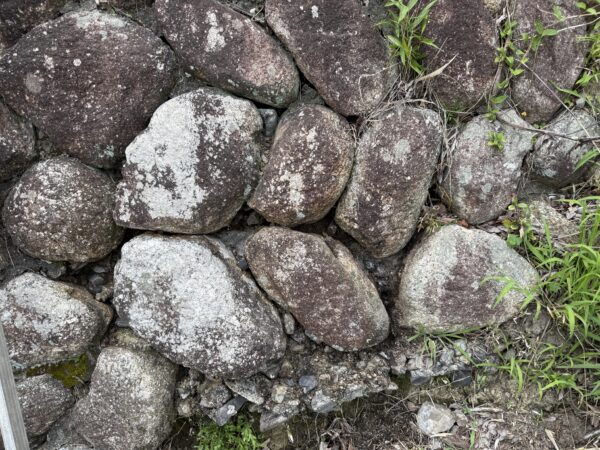
The “Moldam Method” allows us to reinforce such stone walls without destroying them and while preserving the landscape. It’s a method we’re actively using in our projects, and we’ve been receiving quite a few inquiries about it.
In this post, I’ll break it down and explain it from the perspective of someone who actually does the work.
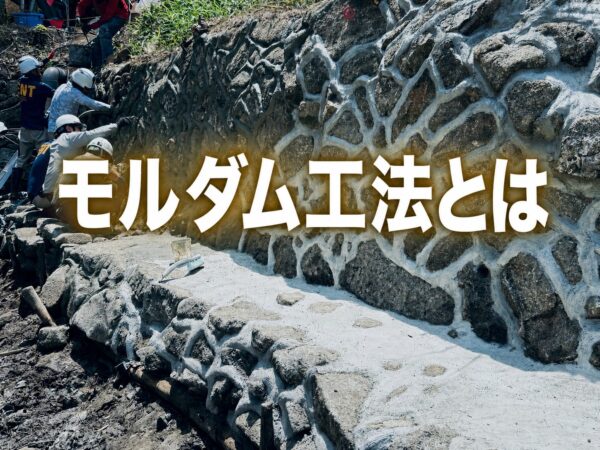
What is the Moldam Method? It is a construction method that reinforces masonry by bonding it “from the inside.”
In a nutshell, the Moldam method is a “masonry bonding and reinforcement method.”
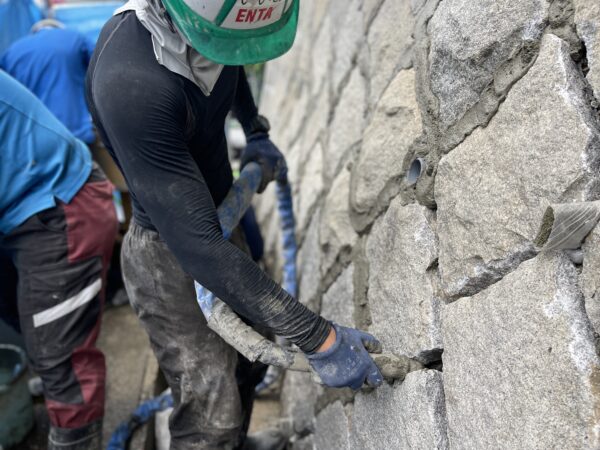
A construction method in which a high-adhesion filler specifically designed for masonry is injected into the interior of existing masonry structures (such as stone walls, rubble walls, and masonry retaining walls) to bond the stones together and reinforce the structure.
It was developed by Kyushu Disaster Prevention Maintenance Co., Ltd., and is a patented construction method (Patent No. 5686466).
Furthermore, our technology is registered with the Ministry of Land, Infrastructure, Transport and Tourism’s New Technology Information System (NETIS), and our company has a proven track record in public works projects, such as reinforcing stone walls alongside JR rail lines.
When people think of reinforcing a stone wall, they often imagine methods like “spraying concrete on the front” or “building a new retaining wall in front of it”—in other words, covering up the front side, right?
Unlike that method, the Moldam method is based on the concept of bonding and solidifying the entire masonry structure “from the inside,” so it does not require large-scale construction work.
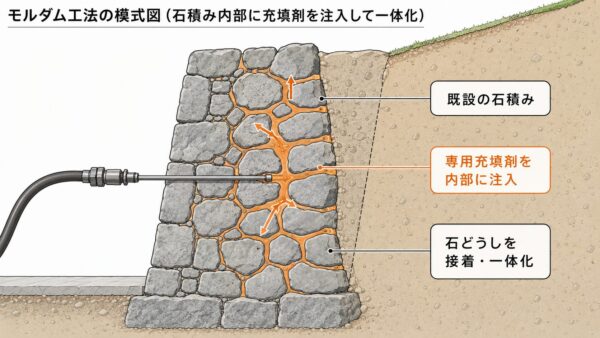
Its greatest strength is that it “reinforces the drainage system without compromising its functionality.”
The aspect that makes me think, “They’ve really thought this through,” more than anything else when I’m actually doing the work is how they handle drainage.
A major advantage of the Moldam method is that it allows for internal reinforcement while maintaining drainage functionality.
Specifically, to reduce water pressure on the stone walls and masonry, a specialized drainage sheet is installed at one location per square meter to create a barrier layer, and the interior is bonded while leaving a path for drainage.
Stone masonry is actually a structure that stays intact because “water drains away.”
It doesn't collapse because it releases the water pressure from the back. So, if you block the drainage and let it all harden completely,
Water with nowhere to go could actually push against the stone wall and end up causing it to collapse. That’s common knowledge among civil engineers.
"Thinking you're reinforcing it, but actually blocking the water flow and making the problem worse"—that's a mistake people really tend to make on construction sites.
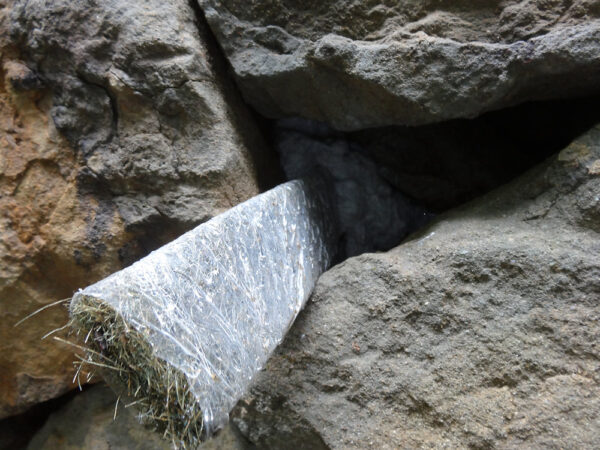
In that regard, the idea of bonding from the inside while ensuring proper drainage makes perfect sense.
The photo ↑↑↑↑ shows a drainage sheet; the area where the mold is placed is protected with plastic wrap, and water drains out through this coconut fiber mat.
Furthermore, since no new structures are built on the surface, it is less expensive than other construction methods and does not detract from the scenery.
Even with stone masonry along the property line, the fact that it can be built entirely within the lot without protruding onto the street—and that it works even in tight spaces—is a real plus once you actually try it.
The Difference Between “Moldam Ace” Filler and Regular Mortar
The name of this construction method comes from the specialized filler material used in it.
The fillers are called “Mordam Ace” and “Mordam G Hyper,” which is why this method is known as the “Mordam Method.”
How is it different from regular cement mortar?
It is characterized by higher strength and adhesion (bonding strength) than conventional cement mortar.
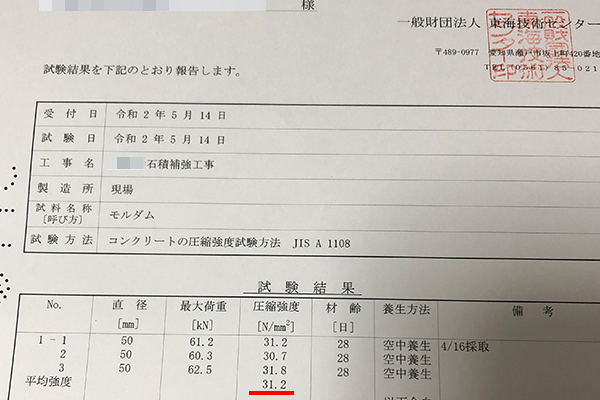
It has the same strength as regular mortar, and its tackiness ensures that the stones bond firmly together!
In terms of the actual construction process, it’s less about simply filling gaps and more like firmly bonding the stones together to create a single, cohesive wall that won’t come apart.
The scary thing about a stone wall is that “if one stone comes loose, the others will fall like dominoes.”
Therefore, if the individual stones can be bonded together with strong adhesive force, the “first one”—which triggers the collapse—will be less likely to shift.
We make our decision based on an on-site inspection, but if the structure is almost 100% stone masonry, we can handle it.
However, if stress is already present, different measures will be necessary.
Where is it used? Applications
Where exactly is it used?
This construction method can be applied to various types of stone masonry reinforcement, ranging from stonework in private residences to road maintenance projects, slope stabilization projects on steep slopes, and riverbank reinforcement projects.
It’s used as a preventive measure against heavy rain and earthquakes, as well as to prevent the collapse of aging stone walls, and most of the stonework we do involves this type of construction.
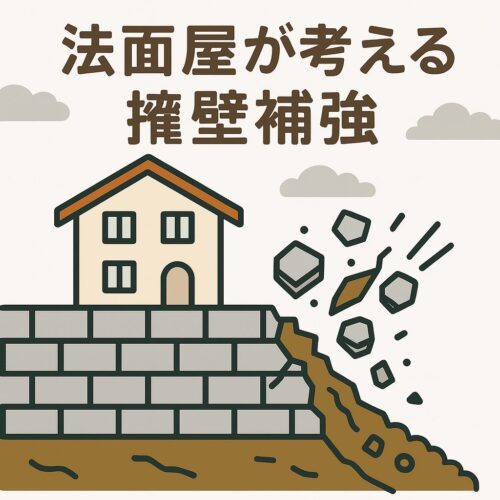
When a stone retaining wall is in danger of collapsing, there are usually signs to warn of it.
1. The stonework curves outward in an arch-like shape. (Protrusion)
2. The gutter at my feet has been crushed by the stone retaining wall, so the water isn't draining properly. (Extrusion)
3. There are cracks running through the mortar in the joints. (Internal soil and sand have leaked out.)
Stone walls like this are often under more pressure from water and soil than they appear to be.
You have to be careful, because sometimes the situation is obscured by overgrown vegetation.
Even the stone masonry—which looks as if water is constantly seeping out from the back after a rain—drains properly, but since the soil was removed at the same time, the interior is hollow.
This isn’t limited to the Moldam method, but when it comes to masonry, “inspecting and taking action before it breaks” is ultimately cheaper, safer, and—well—cheaper than “fixing it after it breaks”!
If you have an old stone wall on your property or a client’s property, I recommend giving it a thorough inspection first.
When it comes to disasters, advance preparation is everything.
See you later.