

Hello, everyone.
This is Enta.
I don't have any work at all, but I'm doing machine maintenance at the company lol
There aren't many times throughout the year when we can take the machine apart like this.
So, I’m taking this opportunity to take everything apart, replace each gasket, check for oil leaks, and carry out the repairs.
Since I’m taking it apart anyway, I’ll apply some rust inhibitor and finish it up, but it’ll definitely take a whole day, so I’ll install it another day.
If that happens, things will get confusing unless they wrap up in order, lol.
I'd like to make sure I don't end up with any extra bolts at the end, lol.
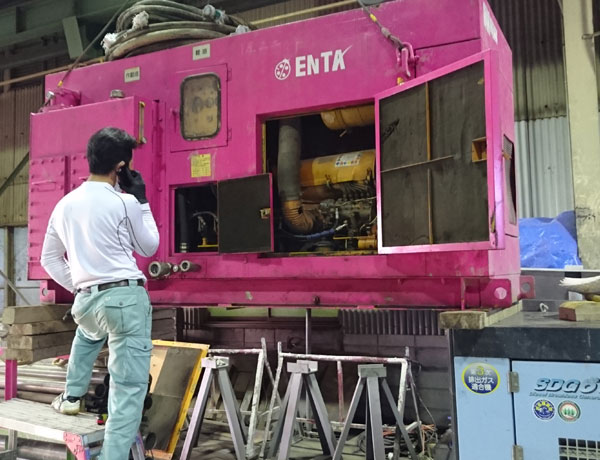
I can't figure out where the oil leak is coming from on my unit, so I'm asking a pro right now lol
But that's beside the point.
This is the aptitude test for Grand Anchor.
I imagine this is something almost everyone has experienced, but,
The elastic displacement measured during the qualification test did not fall within ±10% of the theoretical value.

I've been through a lot. Every time, I end up explaining things to the government office while breaking out in a cold sweat, lol.
This is the result of trying various things, poring over books, trying again, asking for advice, and repeating the process.
To put it simply, it's really not something you need to worry about that much.
| 1: Is it safe in relation to the design anchor force?
The maximum design load is set higher than the design anchor force; if the structure can withstand this load, the design and construction are deemed to be appropriate. |
| 2: Whether the load-displacement relationship is appropriate.
(Ground Anchor Design and Construction Standards, Commentary, p. 192) |
An anchor is generally considered to be functioning properly as long as it stretches to some extent and does not come loose.
Well, I’m definitely not joking (lol), but in my case, I make that clear even when I’m at the city office.
"Since it hasn't come loose, it's functioning as an anchor."
"This exam is designed to make it difficult to determine whether an answer is correct or incorrect."
Most government officials just say, “I suppose so,” lol.
Next, regarding point 2: Ultimately, as long as the price stays within the upper and lower limits of 101 TP 3T, that’s fine, but it’s hard to get it to stay there, isn’t it?
The cause can essentially be boiled down to one thing, but,
Reason 1 (The Main Reason)
Instability during testing and measurement.
It’s difficult enough just to conduct a 1/100-scale test like this outdoors on scaffolding.
I’ve written about this measurement method before, but that old-school approach is the simplest and most accurate way to collect data (according to our company).
Test Methods for Ground Anchor Construction
Test Methods for Ground Anchor Construction, Part 2
*However, this applies only to areas where the ground has sufficient bearing capacity and the load-bearing structures do not sink.
Reason 2
It is possible that grout has seeped between the PC steel strand and the polyethylene coating, causing friction.
In fact, I experienced this myself with a certain anchor.
Since the anchor had no further stretch, the results did not fall within the range shown above.
After that, as a countermeasure against the ○○ anchor, caps were added to the prestressed steel strands, weren't they?
The fact that there are vinyl caps on either end of that anchor's PC wire is a remnant of that, lol.
It's one of those things that people in the know are aware of, lol.
Reason 3
Calculation Error in the Free Dive Event
This actually happens quite often—for example, mistakes like forgetting to specify that it’s a condominium unit, or simply forgetting something by accident.
(I used to mess up quite a bit with this back in the day lol)
As a countermeasure,
This is a contingency plan in case things get completely out of hand during a meeting or similar situation.
Initial load (measured on the cylinder) → Maximum load 1 (measured on the cylinder) → Hold (until displacement is eliminated) →
Measure again → Initial load (measure the cylinder)
(*Note: "Cylinder measurement" refers to the method of measuring a hydraulic cylinder with a vernier caliper.)
(This applies only when the structure under pressure is stable.)
To put it simply, it's as follows ↓.
Initial Load → Maximum Load → Initial Load
Please use this to take measurements and calculate the elastic displacement.
I think it'll probably come in, more or less.
*This means that if you just do a quick, one-time measurement, it will register accurately.
When we perform cycle testing, the measurement accuracy gradually decreases.
If the anchor body itself is sound and functioning (anchored) properly, and yet it is not detected within the range, then the test method is flawed.
As for the rest, while it might be a bit of a stretch to call it “using clever words,” please make your decision based on the instructions of the engineer in charge.
Basically, as long as it doesn't fall out, you're good to go!
(The problem is the testing method, but that’s what skill, experience, and all that talk make up for, lol)
To get right to the heart of the matter,
JIS Z 2241
Test Method for Tensile Testing of Metallic Materials
JIS Z 2276
Test Method for Tensile Relaxation of Metallic Materials
I hear that tests are conducted in the lab using test specimens ranging from about 100 mm to 600 mm in size.
"Doing that on-site... lol"
(I'd better stop before I get in trouble.)
See you later.