Hello, everyone.
This is Enta.
When applying tension in ground anchor work, you attach a dial gauge or digital meter to the jack side, right?
That's to measure the elongation of the PC strand.
Don't just look at the tensile stress and stop there; check both the stress and the strain.
If you're a beginner, just remember this for now.
In ground anchor testing, the approach involves measuring the load, displacement, and elongation of the anchor to verify parameters such as elastic elongation and creep.
A basic dial gauge is a device used to measure the amount of movement of an anchor, isn't it?
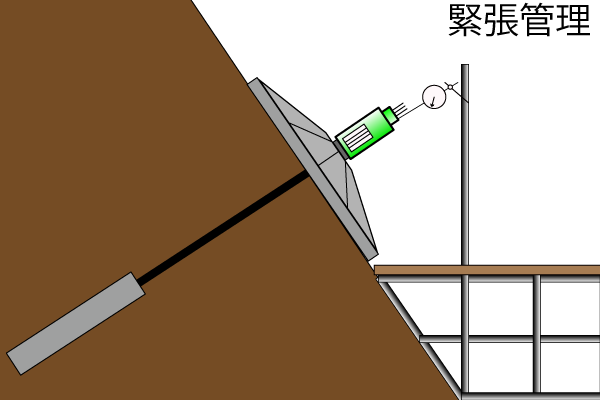
The key factor to monitor in stress control is the elongation of the prestressing steel strands.
When it comes to tension control in ground anchor construction, the most important factor is the jack side.
Apply a load using a hydraulic jack and measure how much the PC strands stretch.
By checking this amount of elongation, we can verify whether the anchor is functioning as intended and whether there is any abnormal elongation.
This is the basis of stress management.
It would be fine to just look at the load cell and say, “Okay, we’ve reached the design load,” but it’s only meaningful for quality control when you look at the load and elongation together lol.
Well, I guess as long as the veterans don't leave, everything's fine, lol.
What does the dial gauge attached to the pressure plate measure?
Occasionally, there are job sites where a dial gauge is also attached to the pressure plate.
Have you ever seen this?
"Huh? Are you going to put one there, too?"
I guess some people might think that, lol
From my seniors and supervisors,
"Make sure to install gauges on the pressure-receiving plate, too."
I suppose there are people who wear them even though they don’t really know why.
What is he looking at?
Simply put, we're looking at how much the load-bearing plate sinks.
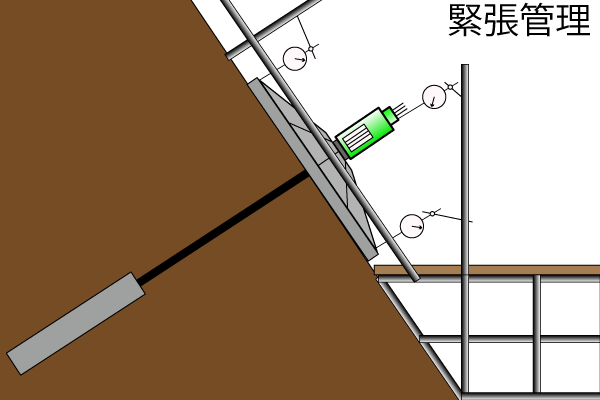
Measuring the settlement of the bearing plate does not officially determine the bearing capacity of the soil.
However, please note the following.
The dial gauge attached to the load-bearing plate does not accurately measure the bearing capacity itself.
What we are seeing here is simply the displacement—that is, how much the load-bearing plate and the surrounding rock mass moved when under stress.
In other words,
"A gauge I installed because I wanted to monitor the ground bearing capacity"
That said,
"A gauge that officially measures soil bearing capacity"
That's not the case.
So, should we measure it and put it in writing?
Probably not at most job sites.
This differs from the established management criteria for PC strand elongation and load control.
Of course, this doesn’t apply if there are clear instructions from the client, general contractor, or designer. (Which will never happen, lol.)
In that case, please follow the construction plan and the details of the discussions. (It should not be included in the plan; it’s just pointless, self-serving management.)
Once the ship has sunk, it’s quite difficult to replace the pressure-bearing plates.
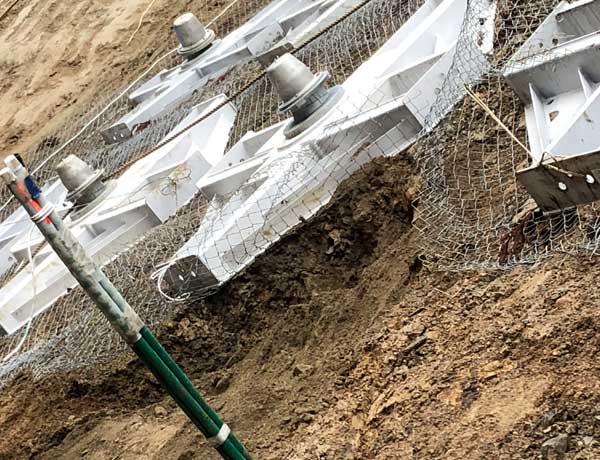
Suppose the pressure plate sinks deeply while under tension.
"Oh no, I might not have enough ground bearing capacity!"
That's how it is, isn't it?
But by that point, it's already quite late.
That's because this is generally how things work on-site.
1. Cut through the earth.
2. Drill a hole for the anchor.
3. Insert the PC steel strands.
4. Apply the grout.
5. Install the pressure plate.
6. And then I get nervous.
At the tension stage, the load-bearing plate is already on site.
The anchors have also been installed.
The excess length of the PC strands is also specified.
In other words, there—
"Let's switch to a larger pressure plate!"
That said, it’s not that easy.
It affects everything—from material procurement and design verification to the fit of the anchor heads and the finish of the slope.
Realistically speaking, it's already pretty much too late, lol.
You’re probably wondering, “What am I supposed to do with these leftover ingredients??”
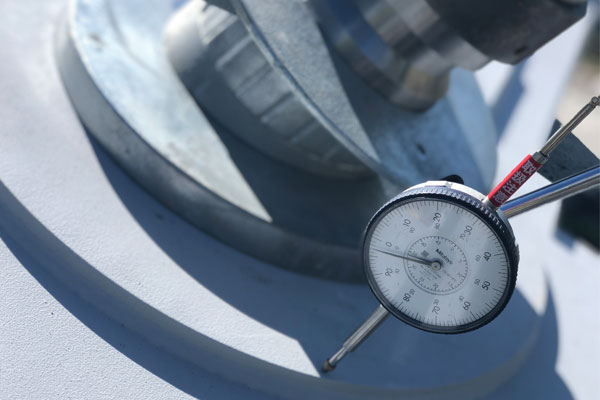
Situations Where the Gauge on the Pressure Plate Side Is Still Useful
So does that mean the dial gauge on the pressure plate is completely useless?
Basically, I think it’s “pretty much meaningless as a standard management practice.”
However, that doesn't mean I don't understand anything at all.
For example, the pressure plate moves significantly the moment tension is applied.
It sinks gradually even while supporting a load.
Its behavior is clearly different from that of the anchor next to it.
It does help you notice abnormalities like this.
However, that is not an official soil bearing capacity test.
This is merely a supplementary observation to help you notice when “something seems off.”
That's all, though...
Key Concepts for Stress Management That Beginners Should Keep in Mind
This is what I want to tell beginners.
The dial gauge on the jack side is used for tension control.
The dial gauge on the load-bearing plate is used to monitor the plate's deflection and movement.
Although these two are both dial gauges, they have different meanings.
Furthermore, simply measuring the load-bearing plate side does not resolve the issue of insufficient ground bearing capacity.
The problem lies at an earlier stage.
How should we assess the condition of the natural ground?
Do the on-site conditions match the design assumptions?
Is the pressure-receiving area sufficient?
Is the back of the pressure plate making firm contact?
Is the leveling appropriate?
Before you start getting nervous, it’s much more important to take a look at this section.
However, if there is excavation into natural ground, it will be difficult, and you should assume that design changes to the ground bearing capacity are virtually impossible.
It's not possible to measure soil bearing capacity with physical accuracy.
A plate load test is used to measure soil bearing capacity.
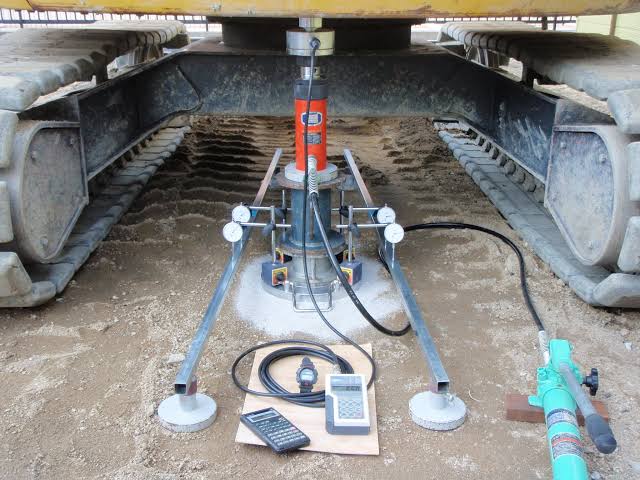
Look at the contact surface before looking at the pressure plate
On site, there may be voids behind the load-bearing plate, the natural ground may be loose and crumbly, or the sprayed surface may be rough.
If you tense up in that position, of course you'll sink. (Uneven weight distribution)
It's not so much that the anchor is at fault, but rather that the recipient is at a disadvantage.
So, before attaching the gauge to the pressure-receiving plate,
"Is this pressure-receiving plate properly supporting the load across its entire surface?" Is the surface properly formed?
You should take a look at it.
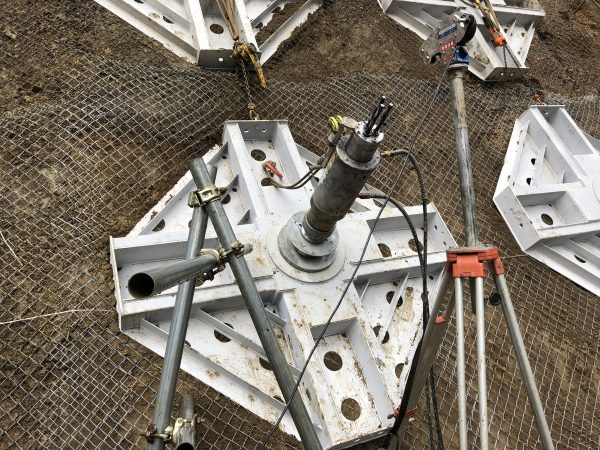
The dial gauge on the pressure plate is not essential but should be considered supplementary.
Is it necessary to attach a dial gauge to the pressure plate when the system is under tension?
My answer is,
It is not essential for routine stress management.
However, it does serve as an aid in detecting abnormal movements in the load-bearing slab or the underlying soil.
I guess so, lol
If you're just putting it on as some kind of ritual, it doesn't really mean much lol
There are ways to deal with situations where the bearing capacity of the soil is questionable, but I’ll save that for next time.
See you later.