Hello, everyone.
This is Enta.
The other day, we launched “CAI,” a platform that offers free civil engineering site software.
Next is software that enables end-to-end management of ground anchor tension control, from planning through the creation of control charts.
Actually, I've already finished the control chart part, so I'll post it once the experiment is done lol
I've turned my desire to take it easy into this software^^

But that's beside the point.
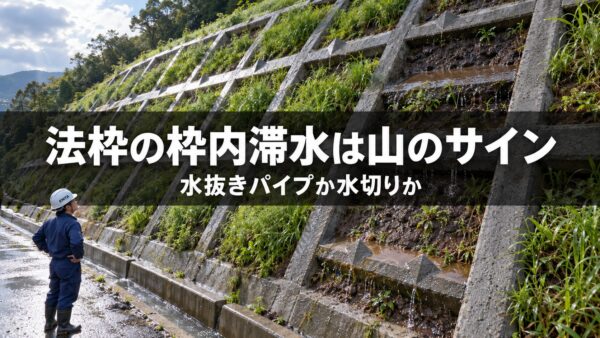
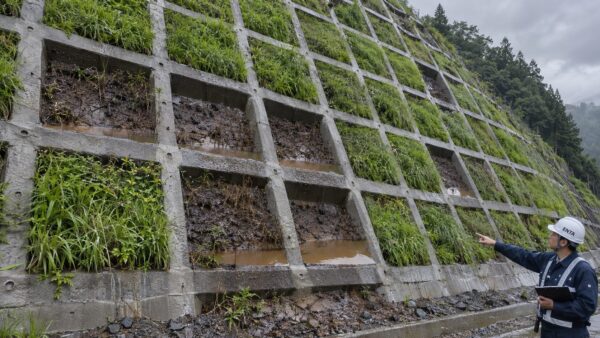
When you go to check out a formwork site the day after it rains, you sometimes see frames where water is still pooled on top of the side forms, right?
The growing medium is black and damp only in that spot, and no grass is growing there.
In severe cases, moss might even grow on them.
In this post, we’ll discuss the causes of water buildup inside the window frame and how to address the issue.
Let me state my opinion first.
Water pooling within the boundary is a sign from the mountain telling us, “This slope doesn’t have enough outlets for the water.”
And the reason you can see that sign is because this construction method doesn't completely cover the earthen embankment with the retaining wall.
Water pooling within the retaining wall is a sign from the slope.
Previously,Future Sprayed Mortar WorkersIn that article, I wrote about how spray-on coatings make hazards invisible the moment they’re applied.
The legal framework is different.
Since you can see the natural ground and vegetation through the gaps in the frame, you can tell at a glance where water is pooling after it rains.
I think this is a very important point.
So, what happens if you leave the accumulated water alone?
The Board of Audit's fiscal year Heisei 24 audit report states that the reason the contracting authority designed the drainage system within the frames is that if rainwater and other fluids remain inside the frames, there is a risk that the vegetation will wither or the cross-frames will deteriorate.
When I first started this job in Kyushu, the only drainage option within the frame was a drain pipe.
Water collects in the frame, causing the vegetation there to rot; the pipe gets clogged, leaving the water with nowhere to go;
What's really scary is what's behind the frame.
What's even scarier than the water on the surface is what's behind the frame.
A long time ago, I saw a "percolation-type" retaining wall that had neither drainage pipes nor drainage channels.
This framework is based on the concept of allowing rainwater to seep into the natural ground and containing it with retaining walls.
Apparently, the existing frame was installed about 20 years ago; the vertical frames were partially lifted in some places, so they had been secured from the side with sandbags filled with soil.
I suppose the rain-saturated ground must have partially collapsed.
If water cannot drain away and the undisturbed soil becomes saturated, the retaining wall will be pushed from the inside (toward the undisturbed soil).
Generally speaking, if water seeps behind a hard surface and freezes or exerts pressure, it can cause cracks or delamination.
Ultimately, it's better for the slope to be dry.
It's better if the natural ground is light.
It's a sign that the water inside the frame is starting to shift into the opposite state, isn't it?
Causes of Water Accumulation in the Frame | Water Comes from Below, Not from Above
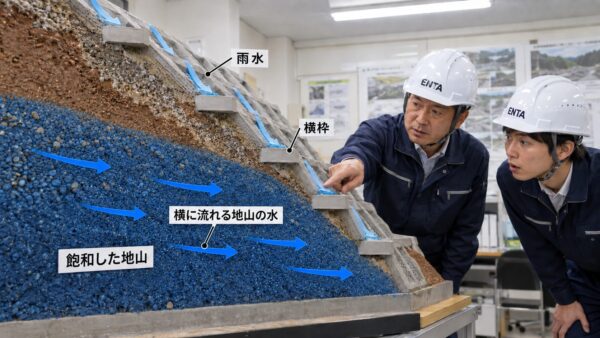
When people hear that water collects inside the frame, I think many assume that rainwater flowing down from above is being held back by the side rails.
Of course, that's part of it.
Since the horizontal frame cuts across the slope, it’s kind of like having a small dam every square, lol.
However, even though it’s been several days since the rain stopped, the frame still won’t dry.
That isn't water coming from above, is it? It's sunny out, lol.
A Driller’s Misunderstanding About Water During De-watering DrillingAs I mentioned earlier, mountain water doesn't simply seep down from above and flow straight into the pipes.
Water that seeps all the way down and cannot escape gradually accumulates in the mountains until the ground becomes saturated.
And the water rising from below emerges from places where it can easily flow from deep within the mountain toward the surface.
It makes more sense to assume that any spots within the area that never seem to dry out are places where groundwater from the underlying bedrock is seeping to the surface.
At this point, it’s not enough to just figure out how to drain the water from the top of the side frame, is it?
This is how I see the field after it rains.
| Status within the box | Cause |
|---|---|
| Water pools there only right after it rains, but it dries up when the sun comes out. | Rainwater flowing down from above is pooling on the horizontal rail. It's flowing out of the drain outlet. OK |
| Even when it stays sunny, the top of the side rail is damp and covered with moss. | Water from the underlying soil is seeping up from deep below. Surface drainage alone isn't enough to stop it. |
Pipe clogs are caused by "wear and tear over time."
This is pretty much the reason why drain pipes fail.
Over time, the PVC opening gets clogged with fallen leaves and dirt.
When it gets filled up, water collects.
When water pools, the vegetation rots.
This trend is the same everywhere in the country, isn't it?
Also, since there’s sometimes mortar left on them, it’s important to clean the PVC pipes once the installation is complete!
Drain Pipe or Drainage?
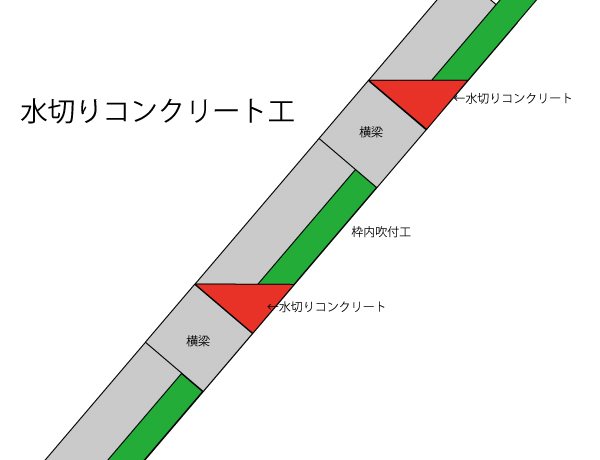
There are two main ways to dispense water from the container.
- Pipe System: Thread a PVC drain pipe with a diameter of about 50 mm through the horizontal frame.
- Drainage Method: Spray mortar onto the top of the horizontal frame so that it forms a triangular cross-section, and let water flow over it.
The Board of Audit said, “It all comes down to the pipes.”
This is the main point of this post.
In cost estimates, the cost of the pipe system is included in the construction cost of the frame itself and is not added separately.
On the other hand, if you opt for the drainage method, you’ll have to factor in the cost of the drainage work.
Furthermore, he pointed out that the 110 construction project—which used a drainage method even though the infill material was mortar or similar—could have been designed using a piping method.
The total amount reportedly reduced was approximately 5.9 million yen for directly administered projects and approximately 17.2 million yen for subsidized projects.
In response to this, the Ministry of Land, Infrastructure, Transport and Tourism, in October Heisei 25,When the backfill consists of mortar or similar materials, the pipe method is generally used.Accordingly, we have notified regional public works bureaus and other relevant agencies to select drainage methods with due consideration for cost-effectiveness and the reliability of maintenance throughout the structure’s service life.
For plant borders, proper drainage is essential.
If the filler is mortar, I think a pipe would work fine.
Even if water collects, it'll dry up, after all.
That is precisely the reason behind the Board of Audit’s decision.
However, if the area inside the frame is covered with vegetation, I recommend using a drainage system.
I’d like to say there are three reasons… but really, there are two major ones.
The first one is the clog I mentioned earlier.
Even if the water has drained away in the year it was built, it will eventually fill up with fallen leaves as time goes by.
And there are virtually no maintenance workers who go around cleaning each pipe one by one on slopes at high elevations.
Once it gets clogged, that's it—the water will just keep building up from there.
The second point is whether it's obvious at a glance.
You can tell from the outside whether the drainage is working.
Even if a pipe is clogged deep inside the mouth, it’s almost impossible to tell from the outside. (It’s hard to tell even when looking from below.)
Let's talk a little bit about money, too.
If we cut off the water supply, the area of vegetation within the frame will decrease and the amount of water cut off will increase, so overall, there won't be much of a difference.
Therefore, the government agency is more likely to accept it during negotiations.
How to Calculate AreaChanges in Area Due to Drainage Pipes and Drainage ConcreteThe finishing angle of the drip edge isSlope of Permeable ConcreteIt's written there, so please take a look.
Before filling all the gaps with mortar,
Recently, due to the labor involved in weed control and damage caused by wildlife, there has been an increase in the use of sealed retaining walls, where the interior of the wall is filled with mortar.
If you use mortar as the filler, the pipe will be less likely to clog.
But in exchange, the "visible signs" I mentioned earlier will disappear.
Even if the underlying soil behind the frame is saturated, you can’t tell from the outside.
It means it will be a slope that is invisible, just like with sprayed concrete.
If you're going to make it airtight, decide in advance where to drain the water from behind the frame.
I don't recommend filling the gap all the way to the center without doing this.
For example, draining about 4 meters of water.
Treatment of Frames Where Spring Water Emerges | Determining Outlets Based on Points, Surfaces, and Water Pressure
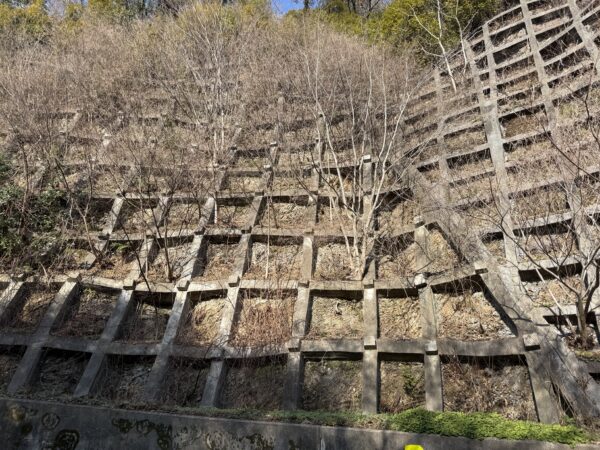
Finally, there are cases where water seeps out of the natural ground during the formwork assembly stage.
The concept of spring water is,Considerations When Spring Water Is Present During Mortar SprayingIt's basically the same as what I wrote there.
I categorize spring water into three types: water that emerges from a single point, water that seeps out over a wide area, and water where you can feel the water pressure.
Here's how it applies to a slope.
Water coming out in droplets
It's the kind that trickles out from cracks in rocks and crevices in the soil.
To do this, add a drain pipe at the location of the spring.
Rather than arranging them neatly according to the drawing, it’s more effective and easier to understand to place them where water is coming out.
We're applying a generous amount in areas where the slope toward the mountain is gentler or where soil erosion is more severe.
It does look better when the drain pipes and stuff are lined up, though, lol.
Water Blurring the Surface
This is the type where the entire area inside the frame is always damp.
Just fixing the top part of the horizontal frame won't stop it.
You need to create a drainage layer behind the frame and direct the water to the outlet.
The Guidelines for Road Earthworks also state that when constructing a frame structure with loose-laid gravel backfill on a slope with seepage, it is advisable to either install branch-like underground drainage ditches along the slope or lay a drainage mat to prevent soil erosion before installing the frame.
However, laying down a mat isn't the end of the story.
A mat that isn't connected to an outlet simply creates a path for water to flow behind the frame.
Before deciding on the area to cover, please think about where to let the water in and where to let it out.
Water with a noticeable water pressure
When you poke a hole in it, it gushes out; it increases suddenly after it rains; it's murky.
It's not a good idea to just let this kind of water flow through the pipes.
This involves first draining the water from the mountains using methods such as dewatering drilling.
At our company, we sometimes install a 4-meter-long drain pipe as a precautionary measure at sites where the water quality is questionable.
Even during the heavy rain at the Noto site, water was flowing properly from those pipes.
Mountain water will flow out on its own as long as there's a way for it to escape.
In cold places, the exit freezes over.
In cold regions, there is a high probability that the outlet itself will freeze.
Even in winter, it’s important to consider whether the exit will remain accessible and whether it might get buried in snow.
What You See After the Rain
In the end, it really comes down to watching it.
On a sunny day, it's hard to tell if the drainage is working properly.
Personally, I think it's best to inspect the slopes the day after it rains.
Whether a pipe is clogged or a frame won’t dry, you can tell right away if you check it that same day.
If you keep the photos, you'll be able to explain things later if anything happens.
The retaining wall is one of the few construction methods that allows the natural ground to be visible.
When water pools inside the frame, it’s the mountain’s way of telling us, “Hey, there aren’t enough outlets for the water here!”
If we take action while the problem is still visible, we can stabilize the slope for a longer period of time.
It's best for the slope to be dry. (I'm saying this twice because it's important lol)
See you later.