Hello, everyone.
This is Enta.
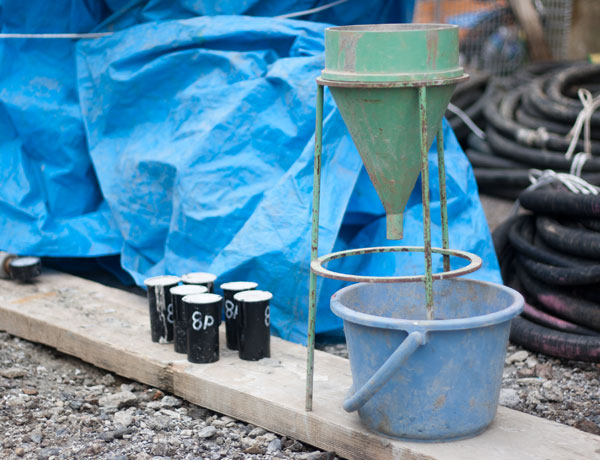
Do you measure flow rates?
I think it often happens that results from this flow test don't fall within the specified limits.
Especially on hot summer days, lol
First, let’s start by answering the question, “What exactly is this flow rate measurement (flow test)?”
This product, called P-Rote, is used for injection mortar and paste...Flow Test EquipmentThat's it.
P-Loop = P-Funnel.
This is used to measure the flow properties of low-viscosity pastes.
Liquidity is sometimes referred to as "workability," right?
Workability refers to ease of workrepresents.
Another aspect we measure is consistency.
Consistency is a property of materialsThat's it.
A flow test reveals these two things.
For example, we conduct a test run and set a midpoint value.
If it's 13 seconds, then within ±4 seconds of that value, it would be somewhere between 9 and 17 seconds, right? (At that location)
If the result falls within this range, we can conclude that the target consistency has generally been achieved (and the strength is also adequate).
In numerical terms, if the value is low, it may indicate that “low concentration = low intensity.”
Therefore, the darker the color, the higher the strength tends to be (due to a higher cement content).
That said, it’s only a matter of a few seconds, so it’s not a big deal.
Normally, concentration is measured using mud balance, but it can also be determined to some extent by measuring flow rates.
If the number is too high, it means that workability has decreased.
However, personally, as long as the grout pump can handle it, I'm fine with it being thick.
This means that even if the value exceeds the limit, the strength will still increase, so there's no problem.
However, for those who are really particular about meeting the specified values, I recommend preparing a cement slurry using local water and cement and performing on-site calibration.
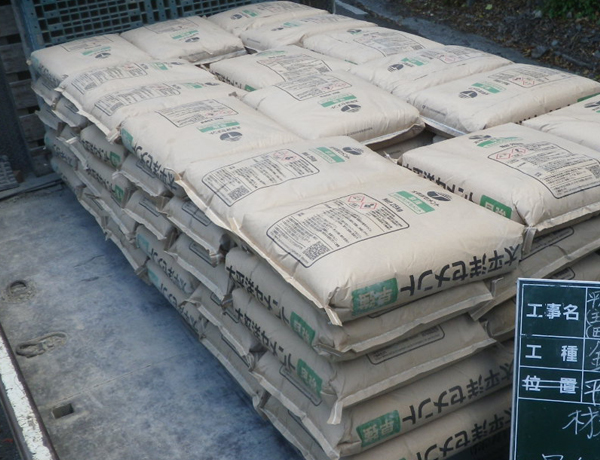
Also, in standard cement slurry designs, ordinary cement is used.
As a result, the concentration of the cement slurry prepared using ordinary cement will differ.
Fast-setting cement is more concentrated because its particles are smaller.
The standard value is 10 to 18 seconds; for ordinary cement, it will likely be closer to 10 seconds, while for high-early-strength cement, it may be closer to 14 seconds.
It's hard to say for sure, but that's a possibility. (Depending on the formulation.)
It also depends on the use of water-reducing agents.
Depending on the water-reducing agent, the setting time may be significantly faster or slower, so be sure to thoroughly understand the characteristics of the water-reducing agent you are using.
Personally, I don't pay much attention to the quality measurements taken at P-Roto. (I do carry out the work, though.)
Especially when it's strong. Since the pump delivers it.
If the current is fast, all you have to do is try again.
Some people get flustered during the observation period, but don't worry—just try again.
That's fine. (Since it hasn't been used yet.)
To put it simply, as long as the concrete achieves the required strength, there is no problem, so please take great care to maintain the proper water-to-cement ratio (W/C) during construction.
See you later.
Optimal Flow Test Values | Enhancing Security with Camera and SECOM Systems
Survey for Reinforcing Bar Installers (Required for Contractors)
If the above...Survey on Reinforcing Bar Installation WorkersIf you haven't responded yet, please be sure to participate.
I'm going to leave this up for a while, so I'd like to hear your thoughts.
It's completely anonymous.
Thank you in advance.