Hello, everyone.
This is Enta.
When installing rebar or ground anchors, you’ll need to inject grout, right?
In such cases, you may need to use a flow meter to monitor the flow.
You use NEXCO quite a bit, don't you?
So, what exactly is that? As the name suggests, it measures flow rate.
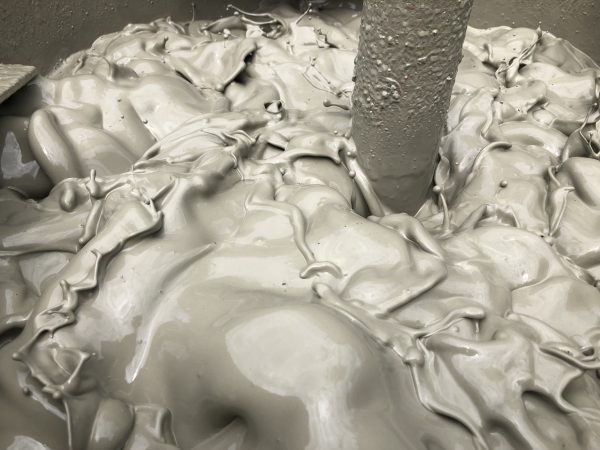
We generally keep track of the amount of grout using empty cement bags and the like.
To manage that more effectively, we keep track of things like the amount per bottle.
For cement, let's assume that 8 bags are used per batch.
Water-to-cement ratio: 50% (W/C)
Admixture: 2% (C × 2%)
Specific gravity of cement: 3.15
Specific gravity of the admixture: 1.15
For example, when managing cement bags, the amount injected per unit is about 80% when mixing eight bags, but with a flow meter, it comes out to ○○ L.
First, calculate the number of liters per 8 bags based on the conditions above. (Convert back using the specific gravity.)
8 bags of cement × 25 kg = 200 kg
200 kg ÷ 3.15 = 63.9 L
Admixture: 200 kg × 2% = 4 kg
4 kg ÷ 1.15 = 3.5 L
Water: 100 L - 3.5 L = 96.5 L
------------
63.9 + 3.5 + 96.5 =163.9 L (finished dough yield per batch of 8 bags)
That's how it works.
As a rough guide, it’s easy to remember that 8 bags of cement slurry is about 165 liters.
For example, for a 20-meter ground anchor with a borehole diameter of φ90,
0.045 × 0.045 × π × 10 m = 0.127 m³ = 127 L
If there were absolutely no loss, it should definitely hold 127 liters.
However, since the loss rate varies depending on the soil type, I think it’s a good idea to consider both the maximum and minimum values when managing this factor.

The photo above shows a rather meticulous method where, due to certain special circumstances, the casing is removed one section at a time as the concrete is poured, so the measurements are listed by meter (cumulative). lol
This is merely a guideline, but based on past results, we inject the fluid allowing for a 1.2-fold loss. (Packer specifications)
By the way, in the photo, we’ve taken the length of the injection hose into account when filling the tank, but this is a special case.
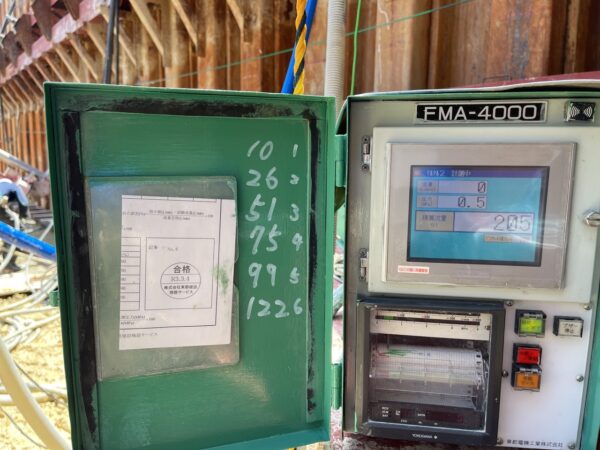
Managing the flow this way using a flow meter allows for more precise control.
On the other hand, if the contractor isn't familiar with flow meters, things could go wrong, or the flow meter might end up covered in cement slurry, so you really need to be careful lol.
In reality, there’s no need to keep records in such detail, but some municipalities may require it, or a specific government official may request it.
We use it on a case-by-case basis.
Of course, the lease payments are pretty steep, lol
You'll need to talk to the general contractor.
Finally, inspect the empty cement bags and compare the amount poured; if it exceeds the specified amount, there is no problem.
I think you'll be able to clearly see the loss.
See you later.
Survey for Reinforcing Bar Installers (Required for Contractors)
If the above...Survey on Reinforcing Bar Installation WorkersIf you haven't responded yet, please be sure to participate.
I'm going to leave this up for a while, so I'd like to hear your thoughts.
It's completely anonymous.
Thank you in advance.