Hello, everyone.
This is Enta.
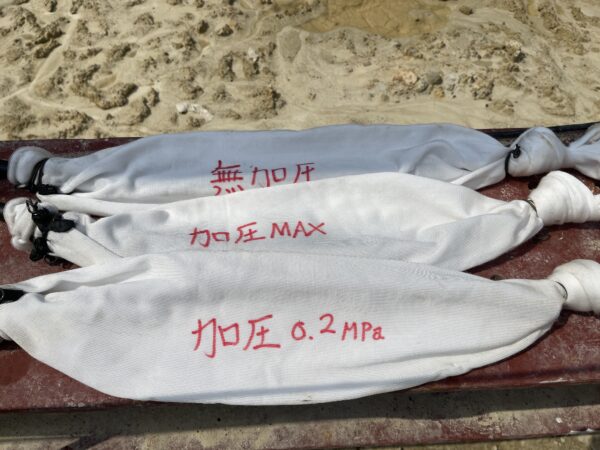
We conducted an experiment on the packer the other day.
The packer used this time was designed for a borehole diameter of φ135, and the manufacturer stated that its expanded diameter was φ149 or greater.
This time, we’ve prepared three types of packers, as described above.
Since the standard operating pressure for the packer is approximately 0.2 MPa, we have prepared models rated for 0.2 MPa and higher (MAX).
Well, we've also prepared a non-pressurized version.
So, I learned quite a few things this time.
I don't think many people have actually tried this experiment.
Well, we did conduct field tests at the Ministry of Land, Infrastructure, Transport and Tourism some time ago, but we realized that wasn't enough.
The reason for that is,PressureThat's it.
I was reminded once again that the way pressure is applied in a packer is extremely important.
Depending on how you apply it, changes occur in the packer.
It's dehydration.
When the surface is dewatered by the packer, the cement slurry inside becomes concentrated, producing the same effect as high-pressure concrete.
There are some tips you need to know to get the most out of it.
First of all, while that method is important, I’d like you to take a look at the expansion rate for now.
In the case of no pressure
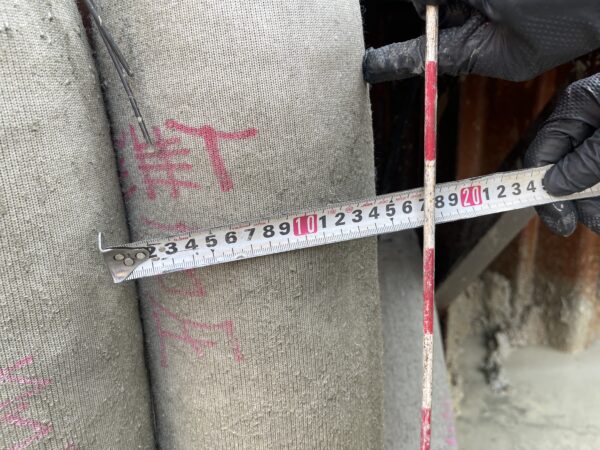
It looks like the pin pole is loose, but since it’s cylindrical, this is the only way I can take a photo of it, so please bear with me (actually, a large caliper is the correct way to measure it).
Without vacuum pressure, it was 170 mm.
Fold width: 180 mm
First, let's calculate the circumference.
0.18 × 2 = 0.36 m
Diameter of a Circle
0.36 ÷ 3.14 = 0.115 m
Since they are 115 mm and 170 mm,
The expansion ratio is approximately 1.5 times.
Next up is the packer maintained at 0.2 MPa
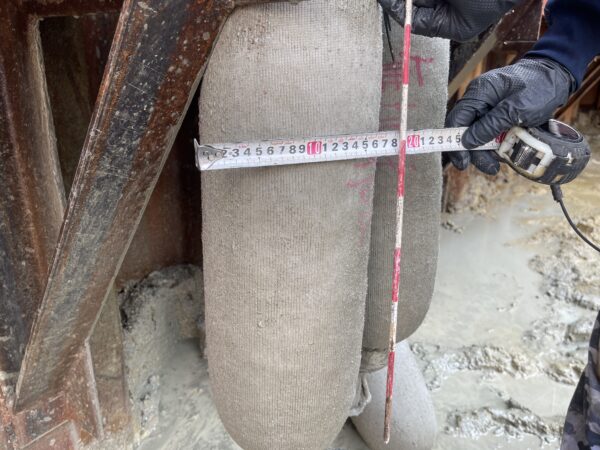
It was 180 mm.
It's 1 cm larger than the one mentioned above.
Since they are 115 mm and 180 mm,
The expansion ratio is approximately 1.6 times.
It’s only a slight difference, but when it comes to the inside of a drilled hole, this seems to be quite important.
That said,It will never be larger than the drill hole diameter.However, since the material tends to fill in any joints, I think that’s an important point.
I think you now understand that it’s best to keep the packer under as much pressure as possible.
However, considering gravity, since the packer on the anchoring side is always at the bottom, it can be said that it will inevitably be subjected to pressure; so, as long as we can confirm that sufficient pressure is being applied, it seems this might not be such a big problem after all.
Pressurization was successful = There are no leaks in the packer
So I think that's fine.
Other than that, it depends on what the director thinks, so I can't really say anything, lol.
I'll edit and post the video tomorrow lol
See you later.