



Hello, everyone.
This is Enta.
As for our company's security measures, we're installing cameras and signing up for Secom!
I often confuse Secom and Acom, and end up saying, “I’m going to Acom!”

We welcome intrusions after installation, so please feel free to try breaking in after you've installed it!

Please make sure to do this after installation!!!
(Please don't force your way in! Please don't break the door or anything...)
But that's beside the point.
Selecting the Right Cement and Flow Tests
Regarding the discussion we had the other day about what constitutes an appropriate flow rate, the basic principle is that it should fall within the specified range.
It is possible to configure this at each site.
Optimal Flow Rate
First, we will conduct a test mix of the cement slurry.
This test mix measures the mix design, flow value, specific gravity, temperature, and strength.
Temperature and specific gravity (mud balance) are optional. (This is standard practice at Nexco.)
Set the mix design to W/C = 50% and admixture = 2%. (This is an example.)
Accurately add water, add the admixture, add the cement, and mix.
Measure the flow rate.
That data isStandard values for this site. (Appropriate values for this site.)
The same can be said for Mad Balan.
For example, if that figure is 15 seconds, we’ll arbitrarily set ±3 seconds or ±2 seconds from that number as the target value, standard value, and optimal value for on-site construction.
While the maximum construction management value is 10 to 18 seconds (typically), the figures above are merely target values.
We will ensure that we do not exceed the construction management limits.
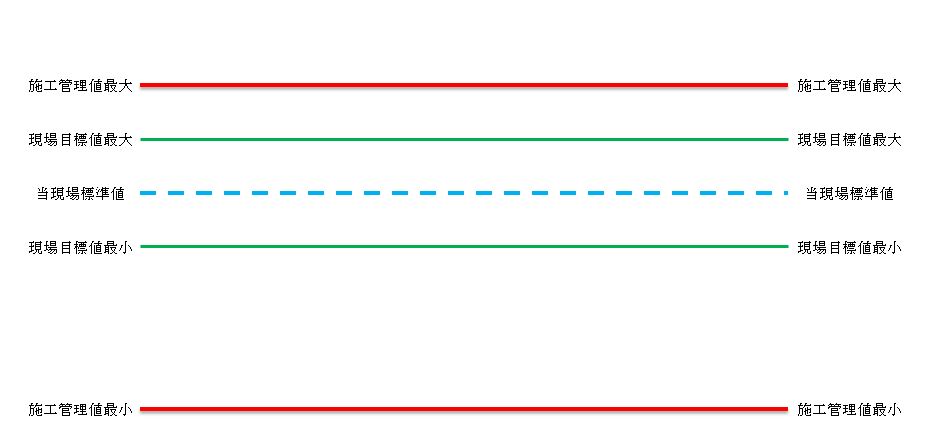
This is to highlight that we’re carrying out construction while minimizing quality control variations on-site.
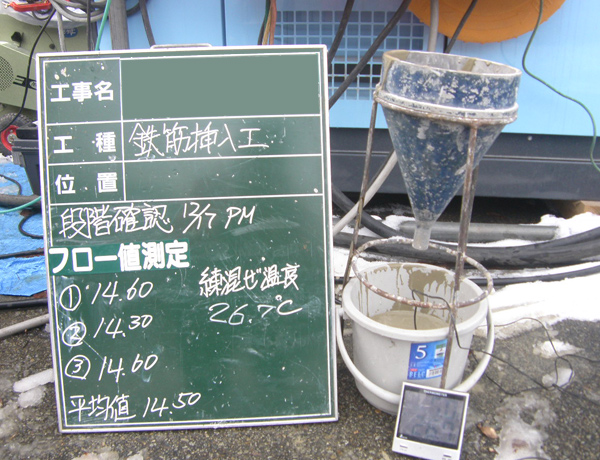
There’s basically no “correct” number of seconds, but
If I had to say,
"The 'correct' flow rate is whatever the site arbitrarily decides as the standard value."
I think this is the correct answer.
Even if the government agency calls us out on it, as long as we explain that we’re doing this to minimize inconsistencies, no one will complain, and
Not that anyone would ever bring it up, though.
However, if possible, you should calibrate the standard values at least once a month.
The reason is that the environmental conditions—such as temperature—are completely different between summer and winter.
Since we sometimes need to conduct precise test runs on a monthly basis, it does take a bit of effort.
I generally complete the work within the construction management budget.
I do handle the details when necessary (if asked).
So, next time, I’ll talk about the photo above. When you look at it, don’t you find yourself thinking, “Huh???”
(It's not that the photo is crooked. lol)
Something's off here, isn't it?? lol
See you later.



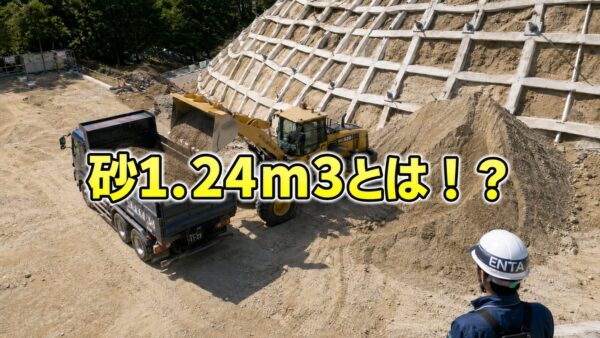
Is the bucket too big and the flow meter is warped? I mess up like that sometimes, too (lol).
Thank you for your hard work.
Unfortunately, that's not true! lol
Are you saying the blackboard is warped or something? lol
Thank you for your hard work.
Unfortunately, that's not true!!! LOL
I'm a first-year manager.
I read your blog often.
It's December, but the mixing temperature is high. I wonder why?
Thank you as always.
Awesome!!
That's right!! lol
Not that anything will come out, though. lol
Stay tuned for tomorrow's blog post!
Is this where I'm supposed to write the correct answer?
I thought it was a place to mess around, lol.
If my jokes aren't funny enough, people point out that they're wrong! LOL
Please make your jokes even more hilarious! lol