



Hello, everyone.
This is Enta.
I’ve created the survey I mentioned in my previous post.
We would like to hear your opinions, so please be sure to participate.
The survey is completely anonymous, so no one will know who answered it. (Not even I.)
Please note that once you’ve made your selection and cast your vote, you cannot change it.
If I'm wrong, please write "You're wrong" in the comments section and let me know which side you support.
First, let's look at the sheath pipes used in rebar insertion work.
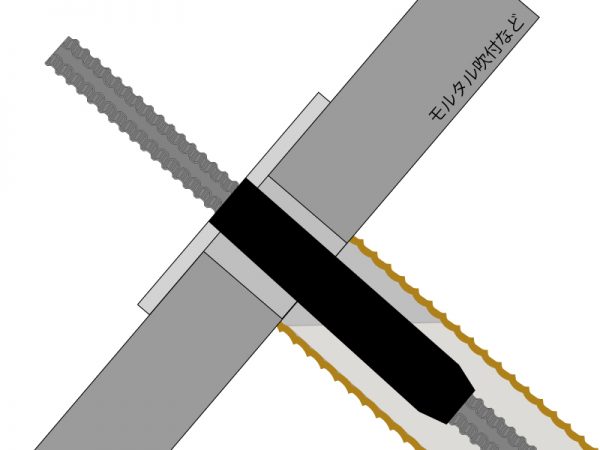
It is the black area in the figure.
Next up is the rust-preventive oil cap.
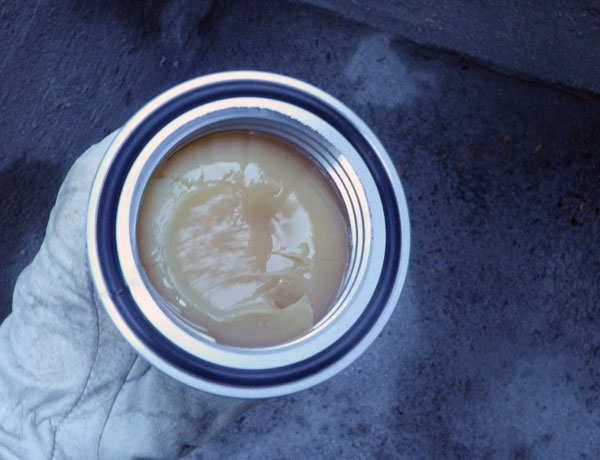
The question is whether rust-preventive oil is necessary.
Next, please tell me your occupation.
Thank you for taking the survey.
Based on these results, I would like to share my thoughts at a later date.
Also, if you have any comments or feedback, please feel free to leave them in the comments section.
See you later.
*Please note that this survey is conducted purely out of personal interest.
Please be aware that we may delete this post if any issues arise.



I always enjoy reading your posts.
Since there were some abstract questions, I’ll provide a general response.
Q1 Basically, since we apply cement slurry up to the mouth of the hole and then completely seal the area behind the plate with mortar, I don’t think a Bell Sleeve is necessary for waterproofing. However, if an eccentric official at the local government office—thinking of it like a ground anchor—interprets the portion of the Bell Sleeve outside the natural ground as “free length” and views it as a means of controlling elongation, then we’ll have no choice but to install it (I know this is a silly, nitpicky argument.) That said, I personally haven’t had to deal with anyone like that.
Q2: If the rebar isn't galvanized, it will rust right away, so I think it's necessary.
Q3: If the rebar has been galvanized or treated with an anti-corrosion coating such as epoxy, I don't think a cap is necessary.
Q4: If we view the treatment of the top surface as a measure to prevent water erosion of the mortar and rebar, I believe it is necessary. Slope restoration projects have been on the rise recently, and based on my experience assisting with them, I’ve generally observed lath and rebar that have rusted due to water erosion. However, since the rebar had already rusted significantly contributed to the slope collapse.
Q5: We are an anchor installation company.
I have a question myself, and several employees are also wondering about this. If you know the answer, I’d appreciate it if you could let me know. When we use the water-reducing agent “LeoBuild 4000,” which is used by our general contractor, Company A, the flow value often exceeds the specified range (especially with batches that have been sitting for a while—they almost always exceed the standard). Since this is strictly a workability test, we adjust by adding more water-reducing agent, but it becomes a hassle to explain this to government officials during inspections. On the other hand, Flowric, used by Company B, consistently falls within the specification range. However, approval is sometimes denied simply because it does not meet JIS standards (you can assume that both the water temperature and pH value are virtually the same).
Although the LeoBuild 4000—whose performance and durability raise some questions—is used as a matter of course simply because it complies with JIS standards, there are certain aspects that just don’t sit right with us as installers.
If you have any feedback, please let me know.
Thank you for your continued support.
Thank you for your response.
In my next article, I will address the topic of flow testing for admixtures.
We look forward to your continued support.
At our company,
A lightweight, single-type model developed in-house
I'm using a mixer, but
(I simply attached three flat bars
(It's a blender.)
On days when it's not raining, it takes about 13 seconds
You're going to fall.
Thank you for your continued support.
I'm curious about that mixer you developed in-house, lol.
Well, I suppose mixing plays a role too, but fundamentally, the flow values of ordinary cement and fast-setting cement are completely different, so there’s not much we can do about it.
I'll write more about this at a later date.
We look forward to your continued support.