Hello, everyone.
This is Enta.
Enta Goes to Mongolia! Part 2.
My 4-night, 5-day trip to Mongolia is about to begin.
Of course, since it’s me, I’m not just going to be sightseeing.
I also took a good look around at how the rocks are exposed in this area, the shape of the mountains, the soil composition, the rock types, and the degree of weathering lol
Since you don't often see slopes like the ones in Japan, the terrain you'll see consists mainly of soil and rock.
The next question is: Which parts have been eroded by the rain and wind, and which parts remain?
In the end, that's what you end up looking at, isn't it?
Even when I go on a trip, I feel like the places I look at are a little different from what most people see, lol.
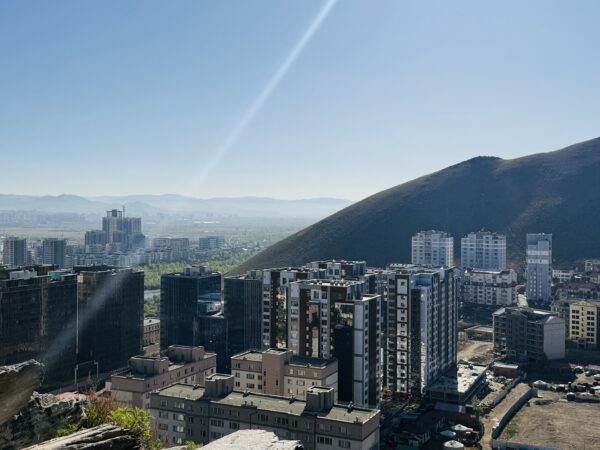
On the first day, we visited the ruins of the Naraiha Coal Mine facilities.
On the first day, we headed to a site that was described as the ruins of a facility associated with the Naraiha Coal Mine.
I hear regular tourists don't usually go to places like this lol (Of course, I'm the one who picked it lol)
It seems most people tend to go to more flashy tourist spots or places with stunning natural scenery.
Well, I guess that makes sense.
I don't think many people come all the way to Mongolia just to see old coal mines and ruins right off the bat, lol.
Based on my research, the Naraikh Coal Mine is considered one of Mongolia’s earliest major coal mines, located near Ulaanbaatar. It appears to have begun full-scale operations in the 1920s and played a key role in supporting Ulaanbaatar’s energy supply during the socialist era.
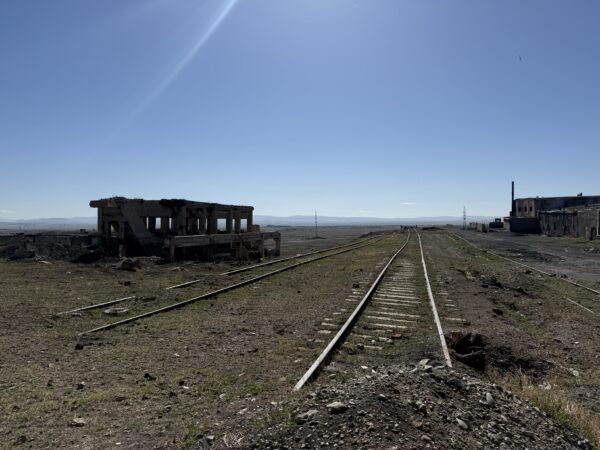
It is no longer in operation as a large-scale coal mine, and remnants of its industrial past can still be seen in the surrounding area.
However, I was unable to confirm whether the building I saw this time is officially open to the public and managed as the “Former Coal Sorting Plant.”
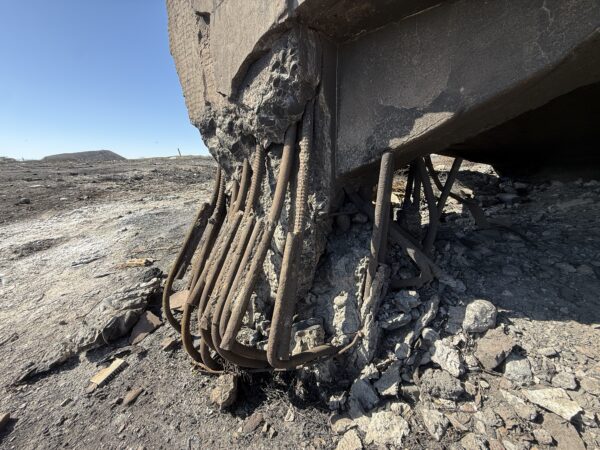
So, this is part of the “Naraicha Coal Mine-Related Facilities Ruins” that we were shown during our visit.
I’ve heard that Japanese prisoners of war once worked here.
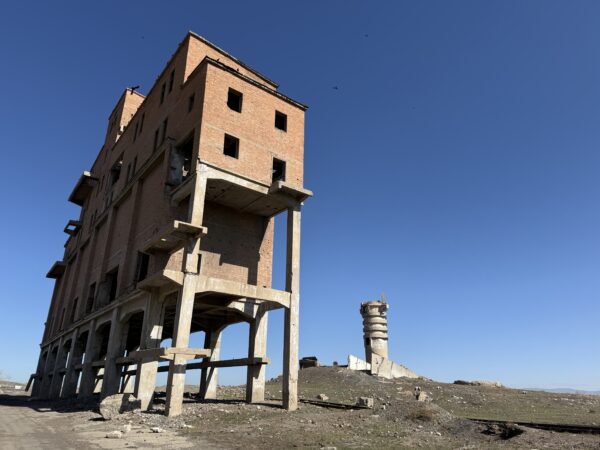
The concrete that exploded in the fire is incredible.
What really caught my eye here was the reinforced concrete from several decades ago.
Perhaps due to the fire, there was some concrete whose surface appeared to have cracked and spalled.
It looks like it buckled after the explosion.
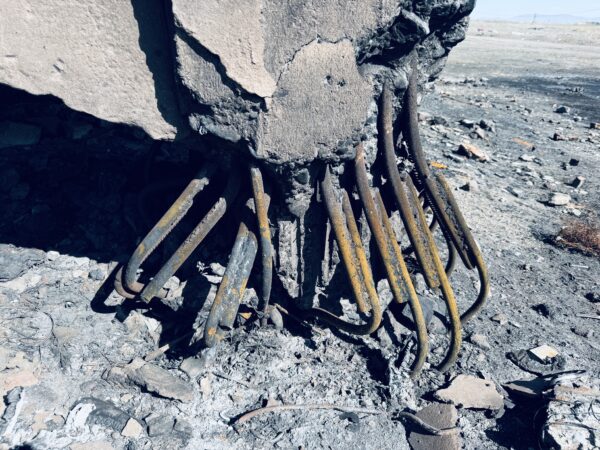
Isn't this awesome? lol
When concrete is exposed to high temperatures, its surface may flake off or the rebar may become exposed due to internal moisture or thermal expansion.
If you've ever done repairs or inspected deterioration on a job site, this is probably the kind of thing that makes you stop in your tracks.
It has a great atmosphere even as a ruin, and since it's surrounded by open space, the building's silhouette looks incredibly cool.
It’s actually much larger and has plenty of other highlights, but personally, I found myself really captivated by this old reinforced concrete structure.
It's less of a tourist spot and more of a tour to see dilapidated structures, lol.
Next, on to the equestrian statue of Genghis Khan
Next, we headed to the equestrian statue of Genghis Khan.
Roughly speaking, the distance to each place I plan to visit is about an hour and a half by car.
The driver's dad said,
"Well, that's pretty close, lol."
That's the kind of thing you'd say.
Nah, my sense of distance is totally off lol
But when you think about it, maybe we're the same.
There are people who, if it takes an hour and a half to get from the office to the job site, think, “Well, I guess that’s pretty close,” right? lol (Limited to slope contractors)
We’ll go anywhere for slope stabilization projects—whether in the mountains, over mountain passes, along the coast, or at prefectural borders.
Since people in Mongolia are used to traveling by car across their vast country, I think they probably consider an hour or an hour and a half to be a short distance.
What's more, as soon as you step outside the city, there are hardly any traffic lights.
Just keep running.
This is Mongolia.
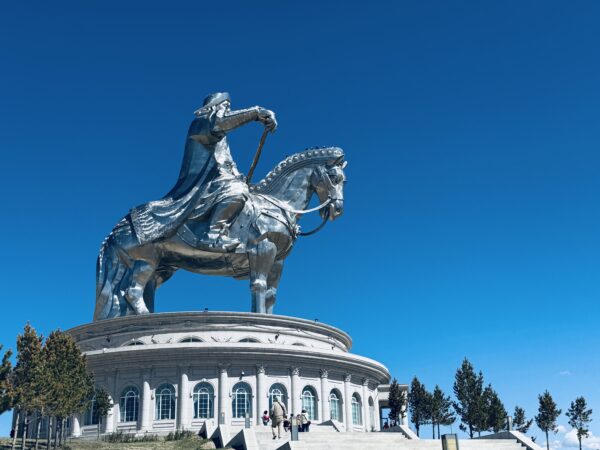
The equestrian statue of Genghis Khan is just huge.
So, I saw the equestrian statue of Genghis Khan.
According to publicly available information, this statue is described as a massive, stainless-steel equestrian statue approximately 40 meters tall.
According to the Guinness World Records, it is listed as one of the world’s largest equestrian statues, with a total height of 50 meters, including the pedestal. (That’s about 450 million yen!)
When you actually see it up close, it's much bigger than it looks in photos.
And what really caught my attention wasn't the history, but the materials, lol.
Is this stainless steel 303 or 304?
Considering machining and welding, maybe SUS304?
I watched it while thinking about trivial things like that.
However, the documentation only specified “stainless steel”; I was unable to confirm the specific steel grade.
So whether it's SUS304 or not is just my own wild guess, lol.
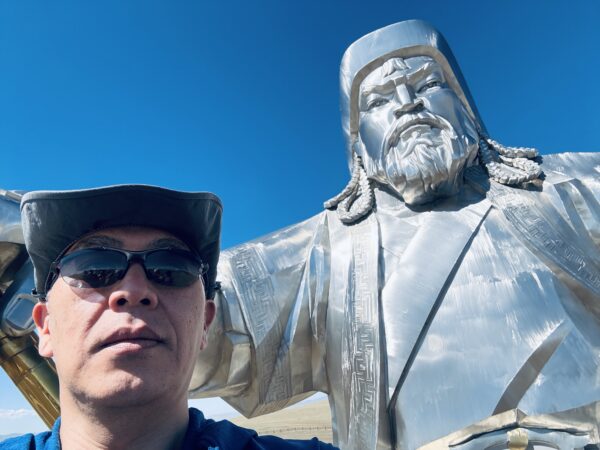
It's this big!
The horse's mane serves as an observation deck, so I took a selfie from there, but it's hard to tell how big it is, lol.
Have him stop every time we see a boulder along the way
Whenever we came across a big rock while we were on the road, I had the driver pull over.
I'm sure the driver probably didn't have a clue what I was talking about lol
But this is what's on my mind.
How have the rocks been preserved?
How is the surrounding soil being eroded?
Fracture patterns, surface weathering, color, and hardness.
When I see things like that, I feel like I get a little sense of the atmosphere of that place.
Among the boulders I saw there, some looked like chert based on their appearance and the way they were fractured.
However, since I haven’t checked each one against the local geological maps, I won’t make a definitive statement here.
From what I could see, it seemed as though the hard rock remained firmly in place even as the surrounding soil and sediment were eroded by rain and wind.
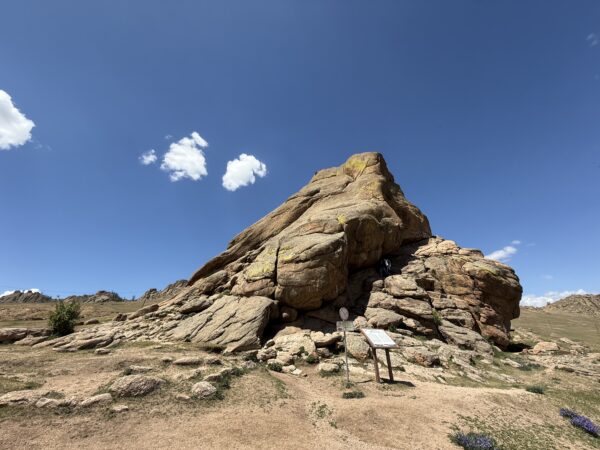
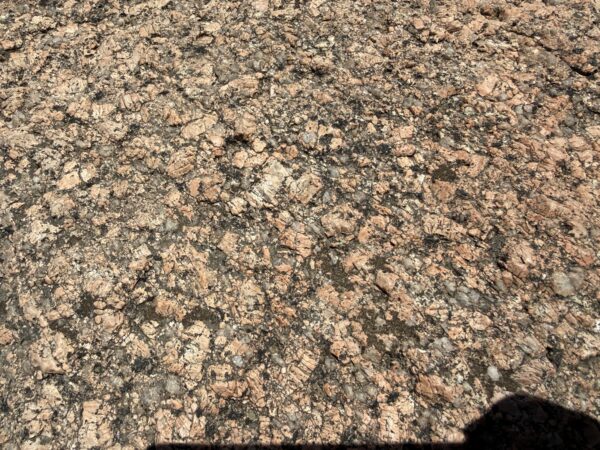
I also went to see the famous Turtle Rock.
Next, we saw the Turtle Rock.
Turtle Rock is a famous rock formation found around Gorkhi-Terelj National Park; it seems to be known locally as “Melkhii Khad.”
According to the tourist information, it is described as a granite outcrop approximately 24 meters high.
This is incredibly huge.
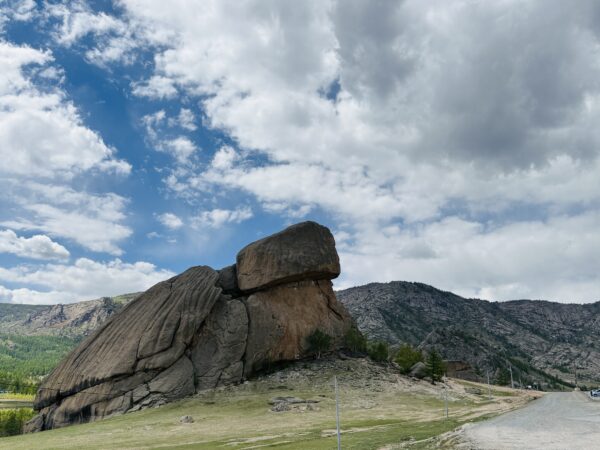
It really does look like a turtle, doesn't it?
That said, for people who aren't interested in rocks, it'll probably just end with a "Hmm" lol.
So, if you're just sightseeing, I think it's enough to just look at it from a distance.
If you like rocks, you should go a little closer to take a look.
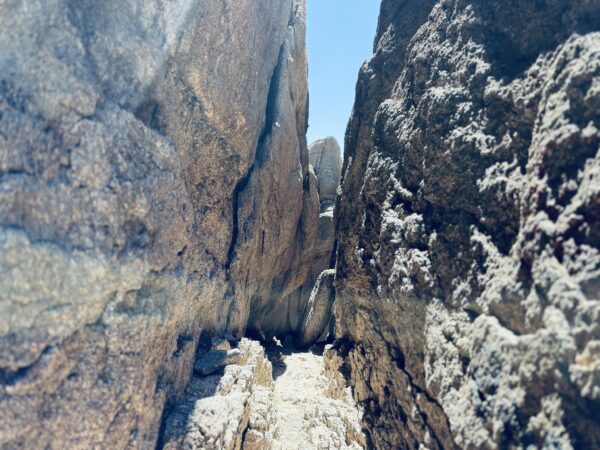
It's interesting to look at the degree of weathering on the surface, the cracks, and how the rock has eroded.
The granite looks nicely weathered—maybe civil engineers should check it out!?
Nature is vast, but the ground is covered in poop.
By the way, the vast natural surroundings are truly amazing.
The sky is vast, the mountains are far away, and the grasslands stretch on and on.
In the photos, it’s simply a beautiful natural landscape.
But here's the thing.
My feet are covered in poop lol
Horses, cows, sheep, goats, and various other animals.
Chances are, there's probably something lying around at the foot of that vast-looking natural landscape, lol.
How to walk without stepping on things.
This is a very important skill for traveling in Mongolia.
If you notice a strange odor inside your car...
Is anyone doing this? lol
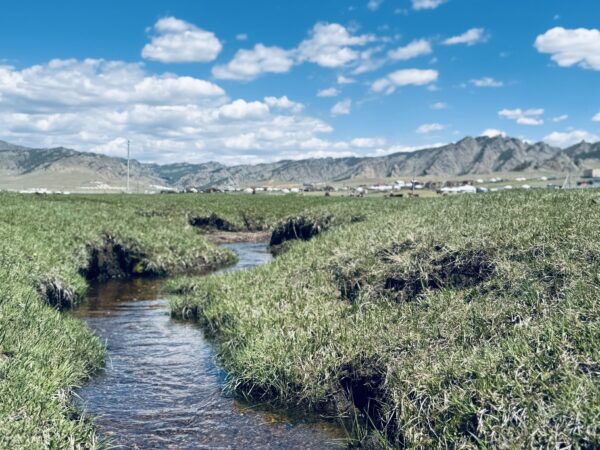
Mongolia: Driving on Roads Where There Are No Roads
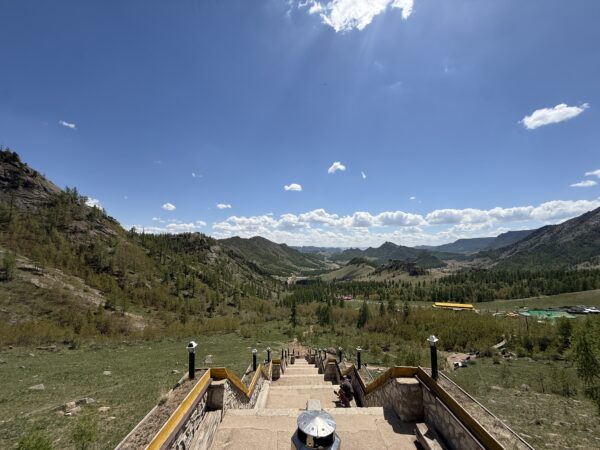
After that, we also visited a small temple.
But the journey to get there is amazing.
There's no path, lol
Anyway, the car just keeps shaking and shaking.
If you live a normal life in Japan, you almost never drive on roads that aren't actually roads.
But in Mongolia, it’s a common occurrence.
This will definitely get you drunk.
Absolutely!! lol
It's not about the driver's technique or anything like that.
It's just the nature of the terrain.
It just keeps shaking.
There are also many banks.
If I were to look at my phone while driving, I think I'd get caught right away lol
If you're planning a trip to Mongolia, I recommend training your inner ear before you go.
I'll be spinning around at home and working out before heading to Mongolia lol
I'm used to mountain roads from working on slope stabilization projects, you see.
It's a piece of cake!! lol
Part 2 was about Mongolia, which really resonated with civil engineers.
This second installment of my Mongolia series might be a little different from your typical travel article.
Abandoned coal mine, old concrete, boulders, weathering, and paths where there are no paths.
Rather than a day of glitzy sightseeing, it was a day where I found myself drawn to the terrain, the structures, and the act of moving around.
But this is actually really fun.
Mongolia is vast.
The rock is huge.
My sense of distance feels off.
And you can't let your guard down when it comes to your feet, lol.
In Part 3, we'll delve deeper into the scenery and way of life that are uniquely Mongolian.
And I think both civil engineers and slope engineers will end up saying, “We want to go to Mongolia!” lol
See you later.
What to Do About That Boulders? 7 Solutions | Slope Stabilization Work