Hello, everyone.
This is Enta.
My back is healing well.
Those lower back exercises are something else.
By the way, this is all I do lol

But that's beside the point.
What should be done about exposed stones (rocks) on slopes?
I get asked that a lot.
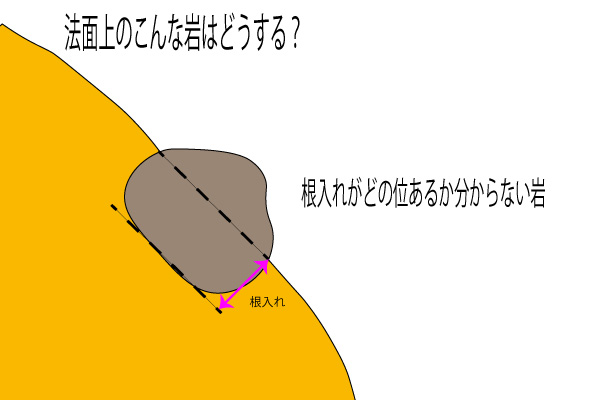
You often see rocks on slopes that are half-buried, don’t you? You can’t even tell how big they are.
As a general rule, if a stone is loose, you should remove it.
However, since it doesn't float and it's impossible to gauge its depth, and considering the potential damage, harm, and impact it could cause below if it were to fall, it would be wiser not to drop it.
So what should we do?
As an option
1. Shave
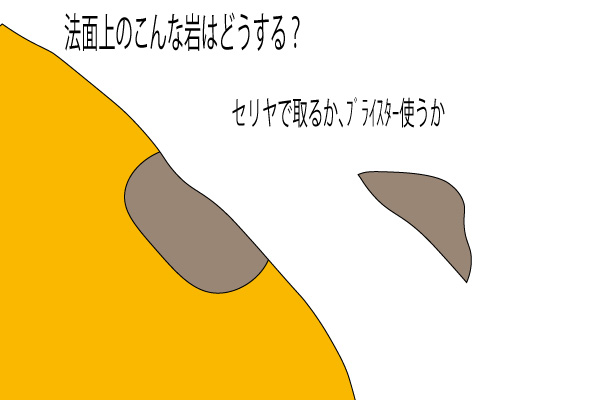
For rock drills and similar equipment, should we use a pick or a chisel to break the rock into smaller pieces, or should we use chemicals?
As described above, remove only the top layer and apply a surface protection coating.
It's fairly common, but it can get quite troublesome when there are a lot of them.
This method is often used at sites where there are rocks in the mountains and machinery can’t get in, so the work can only be done manually on a small scale.
This construction method involves cutting the material into small pieces so that, even if it were to fall, the damage would be minimized.
Rockfall protection nets and other measures will be installed along the road surface.
2. Strengthen the roots
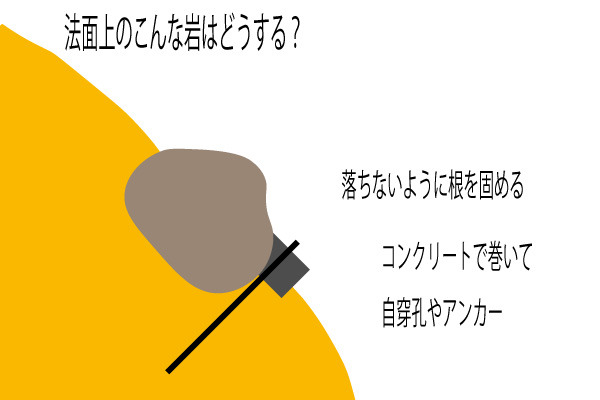
This is also a fairly common practice: the larger the boulder, the more likely it is that the base will be filled with concrete or sprayed concrete to prevent it from rolling. Depending on the size of the boulder, methods such as ground anchors, other types of drilling, or self-drilling rock bolts are used to provide counterforce.
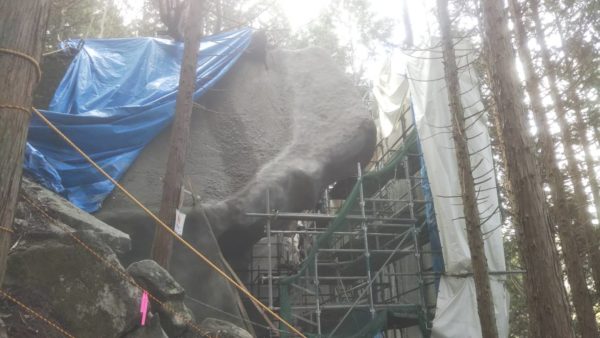
It's the same as the root reinforcement work we did on the boulders before.
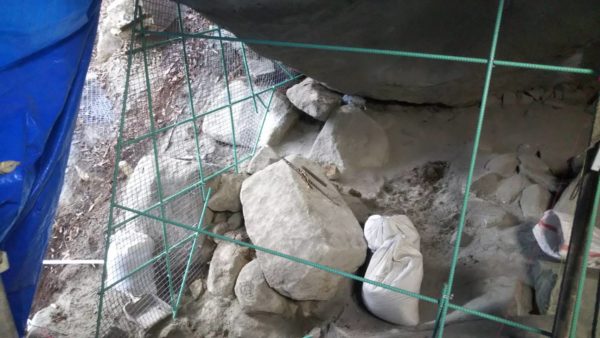
(I was supposed to fill this in with spray, but the rock was so huge that I ended up using a ton of it lol)
3. Wrap it around the frame
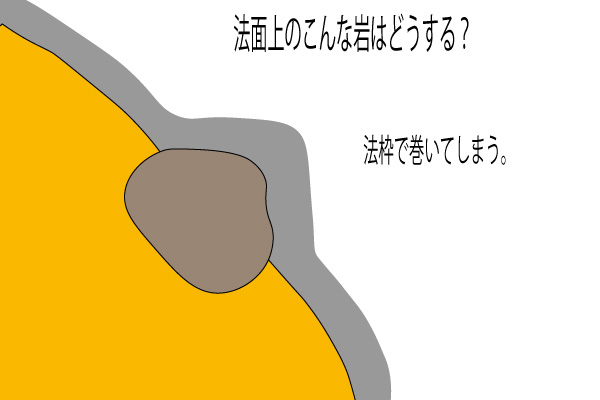
To be honest, this might actually be the quickest way.
However, if it's too big, I think the most common method is still to trim it down first and then wrap it around the frame.
4. Winding with a rope-winding machine
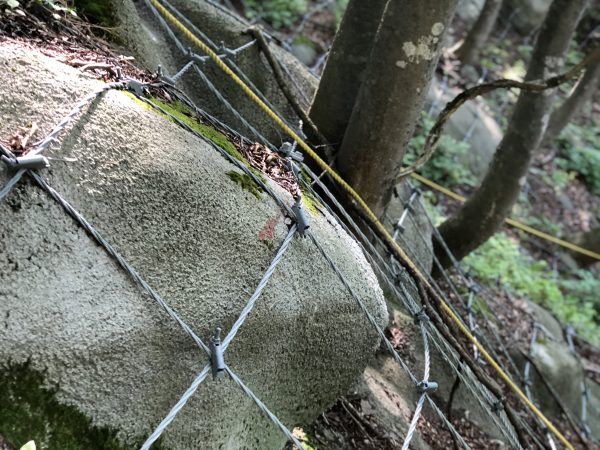
If possible, applying a mortar spray might help slow down the deterioration of the rock.
As long as it's covered with rope, it probably won't move, so it should be fine for now.
In most cases like this, rockfall protection nets and other measures are installed along the road surface.
5. Break Through with a Rebar Insertion Tool!
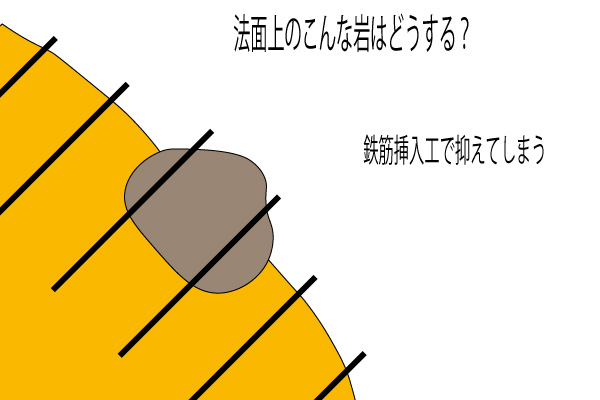
In rare cases, a construction method is used in which the rock is not removed but is left in place, and tension is applied using techniques such as rebar insertion or ground anchors to contain the rock’s energy.
Surprisingly, it’s often used in combination with foundation reinforcement, but it’s possible as long as the rock is solid.
If there are concerns that rocks might shift during construction, this method may be used in conjunction with techniques such as rope anchoring.
6. Depending on the construction method, remove all of them.
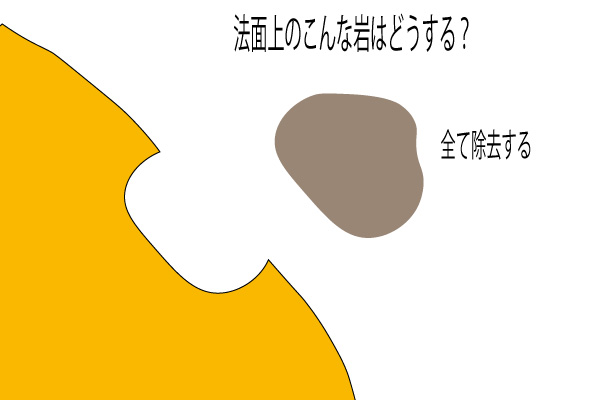
After removal, the hole is filled by packing sand mixed with cement into sandbags, or by replacing the area with small pieces of rock mixed with mortar, followed by surface finishing.
Since removing a large rock makes it highly likely that the surrounding area will become unstable, this practice is rarely performed these days. (Rock removal work used to be quite common in the past.)
If the only issue is the rock and everything else is fine, we leave it as is; however, in most cases, we install retaining walls or similar structures. Additionally, if the area to be cleared is at a high elevation, rockfall protection netting or similar measures are installed, as described above.
7. High-Energy Rockfall Mitigation Measures
This is a rockfall protection netting system designed to prevent the fall of large boulders.
These days, there are many different types available, and patented products—which can only be installed by companies that have obtained the installation rights—are the mainstream.
If you search for terms like "rockfall high energy" on Google, you'll find it.
I’ve only been through this once myself, so I don’t know the details.
If I’m just thinking about the construction cost, I do know that it would be cheaper to use a combination of partial removal, rope installation, and rockfall prevention netting to reinforce the foundation, lol.
I guess the design ends up using high energy due to on-site conditions and other factors. Not that I know, lol.
I often hear that if energy costs get too high, the general contractor could end up operating at a loss.
This project involved measures to address boulders, rocks, and loose rocks in slope stabilization work.
See you later.