Hello, everyone.
This is Enta.
June is coming to an end.
This year’s rainy season has been just like a typical rainy season—I’ve been at the mercy of the rain the whole time lol
Our trainees from Nepal also say every year, “The rain in Japan is incredible!” ^^
But that's beside the point.
The other day, I read an article on Toyo Keizai Online about labor shortages and productivity in the construction industry.
It started with the fact that there are apparently only about 5,600 high-altitude workers involved in power line construction nationwide, and it was quite thought-provoking.
(Original article:Why Can’t the Construction Industry Escape Its Labor Shortage? … The Limits of the Japanese Procurement System, Where Skilled Workers Are Rarely Rewarded Even When Productivity Rises(/Toyo Keizai Online, Toshihiro Chiba, June 26, 2026)
In this post, I’ll read that article from a frontline perspective and consider whether “this will actually be effective on the front lines.”
The "Per-Person-Day Rate Trap" Mentioned in the Article and CCUS × Volume
A quick summary of the article.
It appears that the Japan Construction Industry Federation (Nikkenren) released the “Productivity Improvement Guidelines 2.0” in December 2025, setting a goal to increase productivity by 251 TP3T by fiscal year 2035 compared to fiscal year 2025.
The same long-term vision also states that there will be a shortage of 1.29 million skilled workers by fiscal year 2035.
That's quite a number.
In other words, it means that ”one out of every three people needed on the job site is missing.”
For us slope workers, this means that a five-person team is always down to four people.
On top of that, what the article identifies as the “root of the problem” is the way labor costs are calculated.
Labor costs in construction are calculated in "man-days."
If a project takes 10 days with 5 workers, that’s 5 × 10 = 50 person-days. Multiply this by the labor rate to calculate the total cost.
However, if we increase productivity and complete the project in 5 × 7 = 35 person-days, labor costs will drop by 30 percent.
In other words, it's a system where the people who finish early end up at a disadvantage.
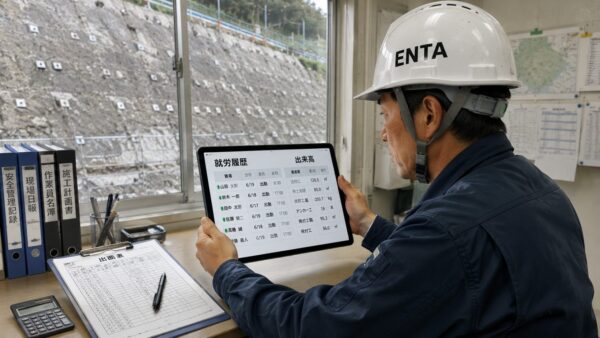
That is why the article proposes the following solution: “By cross-referencing employment history data from the CCUS (Construction Career Up System) with construction progress data, we can objectively measure the productivity of each team. Then, we can simply pay wages based on ability.”
It also appears to state that they plan to appoint a “coordinator” who is on equal footing with the client in order to even out construction orders, which tend to be concentrated at the end of the fiscal year.
It's a neat theory.
But as someone who’s been working in the field for 30 years, there are just a bunch of things that bother me, lol.
To begin with, why aren't people coming in?
The reason it’s problematic is simple: it focuses entirely on “measurement” and fails to address the issue of “people not coming.”
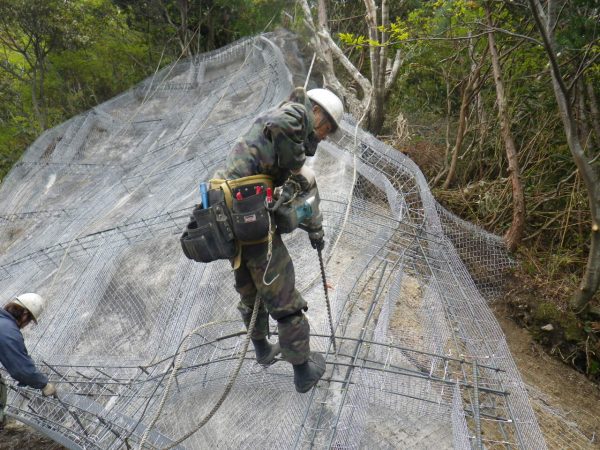
No matter how sophisticated the evaluation system is, if there are zero people hanging from a rope on a slope, the output will also be zero.
Even when it comes to streamlining, you still need people to make that streamlining work.
At the end of the day, you need a large enough sample size.
So why aren't Japanese people coming in?
I think it's because my perception of this job has hit rock bottom.
This is just my personal impression, but there was a period—starting around the time of the Koizumi administration—when public works projects were cut back and the media portrayed the construction industry as if it were the villain.
Then, under the Democratic Party administration’s slogan of “From Concrete to People,” public works spending was cut even further, and the number of contractors continued to decline.
From what I’ve observed, the number of young people aspiring to enter the industry dropped sharply around that time.
Once a certain image has been established, it doesn't easily go away, even if you tinker with the system.
It's important to change the way wages are paid.
However, I don’t think the “harsh, dirty, and dangerous” image that has already taken root can be reversed by CCUS scores alone.
Even with CCUS in place and salaries made transparent, the pay gap between major general contractors and small and medium-sized subcontractors remains three to five times as wide.
While major companies are posting record-high sales, small and medium-sized businesses are seeing a record number of bankruptcies.
No one's coming in?
No, no—if we hire people, won't that put small and medium-sized businesses out of business?!?
Huh? Do they want to shut it down??
I sometimes hear people say, “Robots are used for slope work,” but hanging from an irregular slope to drill holes and apply shotcrete…
To be honest, the day when a machine can do that task all by itself is still a long way off—or perhaps it will never happen (at least for now).
It’s a whole different story from those rebar-tying robots used on flat surfaces, after all.
Given that situation, Japan today has no choice but to rely on foreign workers.
In fact, the Japan Construction Industry Federation’s Long-Term Vision 2.0 also states that “foreign workers are just as important as Japanese workers.”
We, too, rely on our interns from Nepal and Vietnam.
Let's be honest: there are already a ton of companies that simply can't operate without them.
I feel that insisting on hiring Japanese job seekers is actually counterproductive and inefficient.
What is efficiency...
Before streamlining, start by “cutting back”
And there's one more thing that's bothering me.
The article says to "use" the CCUS data.
But for those on the front lines, CCUS is, first and foremost, a “burden of registration.”
Even though it’s the same CCUS, the perspectives are completely opposite.
Before we even think about measuring productivity or implementing AI, there’s a mountain of waste right in front of us that we can eliminate.
Documentation and system registration.
Compared to the past, both drawings and documents have been digitized, and there are certainly areas where efficiency has improved.
On the other hand, however, the number of systems requiring registration has continued to increase.
Green Site, Buildee, CCUS. And many more!
Each general contractor tells me, “Sign up for this” and “Sign up for that,” so I have to register for each one separately, and I get charged for each one.
Where did all that efficiency go? lol
It’s just that efficiency has been replaced by a subscription model (the right to use the service for a set period).
What's more, even though we coordinate with the general contractor, basic information still needs to be updated separately in each system.
According to explanations provided by Green Site and CCUS (including information from MC Data Plus Co., Ltd. and the CCUS operators), the two are separate services; while employment history can be synchronized, basic information regarding businesses and skilled workers must be added or updated separately on each platform.
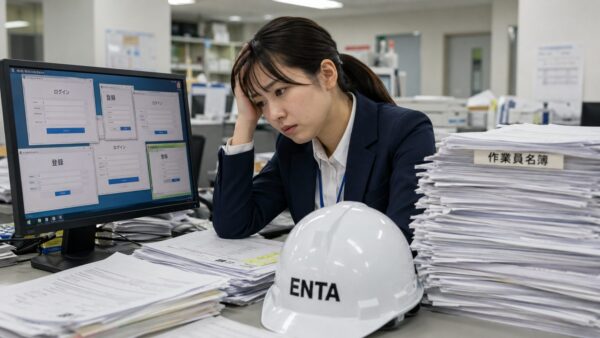
Entering the same company name, the same address, and the same social insurance information over and over again on different screens.
If the information is even slightly off, an error occurs and the update fails, causing the process to get stuck there indefinitely.
Everyone in the administrative department on the front lines is wondering what exactly is so efficient about this.
Rather than adding another layer to “measure” productivity, it’s far more effective to eliminate the hassle of having to “enter data two or three times.”
Ideally, registration should be consolidated, and inspections should be standardized.
Whether it's Green Site, Buildy, or CCUS, we'll have a single entry point—once you're in, you'll have access to all of them.
Inspection documents should use a standard format rather than having different formats for each client.
If we don't do that kind of "streamlining," the front-line staff will spend all day just entering data into the system.
If anything, I could just send the invoice by email, but instead I have to enter it into some system or other...
That varies from company to company, too...
I’m in favor of both smoothing out orders and having a coordinator, in principle.
I’m not saying that efficiency and transparency are bad, either.
It's just that I think the order is wrong.
The underlying image problem that keeps people from coming, and the waste caused by duplicate registrations and duplicate billing that is putting a strain on the front lines.
If you leave this unresolved and then say, “Let’s measure productivity,” the people on the front lines will respond, “Wait, there are other things we need to do first, right?”
Subtraction before addition.
If you have the energy to create a new system, I want you to start by getting rid of the old, time-consuming processes.
It doesn't have to be a drastic reform.
Eliminate one unnecessary registration; standardize all forms to a single format.
Veteran employees are seeing their workload increase steadily as they handle not only their existing paperwork but also systems designed to improve efficiency.
Who on earth would come to an industry like this?
And people say that introducing AI makes things more efficient, right?
Going forward, the more experienced you are, the more work you’ll have once AI is introduced. After all, you’ll be forced to make decisions and judgments.
General contractors have separate departments, and each individual’s responsibilities are clearly defined, so they probably don’t face the same challenges as small and medium-sized companies like ours. (Small and medium-sized companies can’t fully understand the challenges faced by large firms.)
We small and medium-sized businesses have to do eeeeeeeverything!
If efficiency improvements—the kind that make the news—just keep piling up, then no matter how many people you have, it’s never going to be enough.
That was really a thought-provoking article.
See you later.