Hello, everyone.
This is Enta.
Now that the rainy season has begun, we spend our days keeping a close eye on the weather forecast to plan our work on-site.
We'll stop when it rains, and push through quickly once it clears up.
It happens every year, but this time of year really does bring all sorts of headaches, lol.
Well, today I’ll be covering two topics: a follow-up on the CAIF (Conference on AI Applications in the Construction Industry) that I mentioned the other day, and something else I really want to write about afterward.
CAIF will be held in Nagoya, not Tokyo.
As for the CAIF we announced the other day, the venue for the first event has been changed from Tokyo toNagoyaIt looks like it will be...
The reason is simple: we received more expressions of interest from people in western Japan.
In that case, it’s easier to get together in Nagoya, and things around the venue are cheaper overall.
Since this is the first one, I’d like to keep things light and casual to start with.
So far, civil engineers, bridge engineers, slope engineers, scaffolding contractors, road contractors, and design engineers have volunteered to help.
To be honest, at first I hadn't even considered hiring a design firm.
But the more I think about it,Civil engineering designers are a mustI've come to think that...
I just feel like if the construction team and the design team teamed up, it could create some incredible synergy.
To begin with, what do I want to do at CAIF?
To put it simply, we in the construction industry have been spending an outrageous amount of money on IT system companies.
It's still the same today.
Even if we simply find a way to overcome this or reduce costs while coexisting with it, we’ll still see a profit.
Beyond that, I want to explore a system that ensures participants actually make a profit.
Our strength lies in the fact that when we build a system using AI, we can determine whether it is correct or incorrect.Can make decisions on the spotThat's the thing.
We’ll quantify the skills and experience we’ve honed over the years and turn them into a system.
A professional systems engineer would probably say, “It’s not that simple.”
But I don't think we're in an era where we can keep saying things like that anymore.
The date has already been set, so please limit this to people who are absolutely sure they can make it lol
If you're interested, please sign up via the link in the announcement.
But that's beside the point.
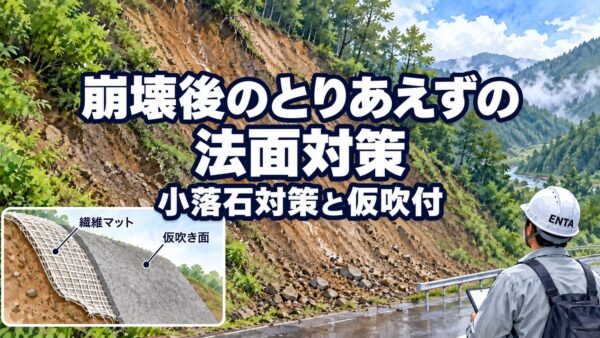
The other day, there was a tragic accident at a slope construction site.
The other day, a tragic accident occurred at a slope construction site, resulting in the loss of a precious life. I’ve included a link to the news report below. I offer my heartfelt condolences to the family of the deceased.
I wasn’t at the scene, so I don’t have any reliable firsthand information about the exact details of the accident.
That’s why I can’t write things like “I think it was like this” based on speculation.
If I were to write that, it would be disrespectful to both the deceased and their bereaved family, and it could also cause trouble for those at the scene.
Still, as someone who works on slopes for a living, I just can’t help but feel that this isn’t just someone else’s problem, can I?
I always wonder if there isn’t a way to publicize these kinds of accidents more thoroughly so that construction companies across Japan can learn from them.
Accidents probably happen somewhere every day.
Why did it happen? In which trade, and under what circumstances?
If we can share that information accurately, we should be able to avoid repeating the same mistake at another site, right?
Looking at the “numbers,” accidents in the construction industry are indeed frequent.
Let’s take a moment here to look at the numbers, rather than relying on emotional arguments. The source is data published by the Ministry of Health, Labor and Welfare.
Looking at the Ministry of Health, Labor and Welfare’s “Status of Occupational Accidents in Reiwa 7” (published in May 2026),The number of deaths from workplace accidents in Reiwa 7 (2025) was 700.Apparently, that was the lowest number on record, down by 46 people, or 6.2%, from the previous year.
The number of people killed or injured who were unable to work for four or more days is reported to be 135,333.
So, even though the number of fatalities is declining, more than 130,000 people a year are injured and have to take at least four days off work, right?
By industry, although these figures are from Reiwa 6 (2024)—a few years ago—according to data released by the Ministry of Health, Labor and Welfare, the industry with the highest number of deaths was232 people in the construction industry...followed by 142 people in the manufacturing sector and 108 in land freight transportation, according to the report.
Fatal accidents account for just over 60 percent of the total in these three industries—construction, manufacturing, and land transportation—and this trend appears to have remained largely unchanged over the past 10 years.
Furthermore, when looking at the “types” of accidents, it is reported that falls, traffic accidents, and being trapped or caught up in machinery account for more than half of all fatal accidents.
Falls from Heights……For those of us who work on slopes, this is definitely the danger we face most often. High places and steep, unstable slopes—that’s our everyday workplace.
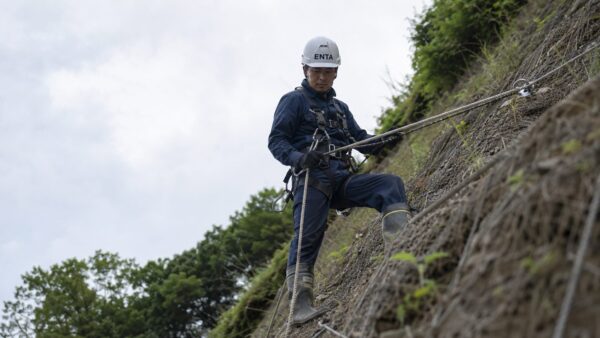
In the end, “reporting” accidents rather than “hiding” them protects everyone.
It’s definitely better to have fewer accidents.
This is a fundamental premise.
But in reality, as long as the work is done by people, near-misses and minor injuries are bound to happen.
What I think is, at the very least...A system that allows people to recognize the problem while it’s still mildThe point is that we want the entire industry to adopt this approach.
If the injury is minor, you can take a few days off and then return to work.
That way, fewer people will be sad.
That’s exactly why I think accidents that do occur should be publicized more widely.
In the field of occupational safety, there has long been a concept known as “Heinrich’s Law.”
There is a rule of thumb that behind every serious accident lie 29 minor accidents and 300 near-misses.
I've written about this many times on my blog, you know.
I think the numbers themselves are just a rough guide, but the point is"Before a serious injury, there are many small warning signs."That's the story.
If we could share those small signs across different work sites, we could certainly prevent a certain percentage of serious accidents.
That’s why I truly believe there’s meaning in “putting it out there.”
Actually, the government has already laid the groundwork for releasing this kind of information.
The Ministry of Health, Labor and Welfare’s “Workplace Safety Website” features statistics and case studies on workplace accidents, and it appears that they have recently started organizing and publishing open data on reports of injuries, illnesses, and fatalities in Excel format.
In terms of direction, I really appreciate it.
But… to be honest,It's hard to read.Haha. As for whether the guys on the job site can quickly use their smartphones to look up “recent accidents involving their specific trade,”
It's pretty tough. I feel like we're not making the most of this treasure trove we have.
And one more thing—and this is my honest opinion—I feel that there’s still an atmosphere in the industry where people don’t want accidents to “get out.”
Ideally, it is the large, influential companies that should take the lead in disclosing accidents.
If those at the top lead by example, it becomes easier for those below to follow suit.
If the culture of keeping things hidden were to fade, I’m sure there would be lives that could be saved. Unfortunately, I often feel that we’re not quite there yet.

That’s exactly why I think this is where AI comes in.
Now, let’s return to the topic of CAI.
"The government's data is great, but it's hard to read." Isn't that exactly the kind of thing AI excels at?
They organize accident data—which is otherwise scattered and hard to read—by work type and cause, so that when you ask for something like “recent cases of falls from slopes,” they can provide the answer right away.
I think that if workers had tools like that right there on the job site, it would make a difference even in something as simple as the hazard prediction (KY) session during the morning briefing.
One of our strengths is that we can immediately determine whether the answers we come up with are “right or wrong” in the field.
We’re creating tools to reduce accidents with our own hands—as the people directly involved. This is exactly one of the things we want to do at CAI.
It might sound like empty rhetoric, but to me, creating new ways to make a living and creating tools to protect the lives of my comrades are one and the same.
It's profitable, and it also reduces accidents.
If even one such system were to be created, that would be the best possible outcome.
It's not some flashy fireworks display or anything, lol.
We take a hands-on approach, converting our on-the-ground insights into concrete metrics one by one and turning them into practical tools.
It may seem modest, but I believe it’s the most realistic step we can take.
I would like to once again express my condolences to the family of the deceased.
See you later.