Hello, everyone.
This is Enta.
We’re now in the latter half of July, and the sweltering heat continues day after day.
Or rather, these days have been hell. (I’m just doing research, but even so, it’s exhausting.)
But that's beside the point.
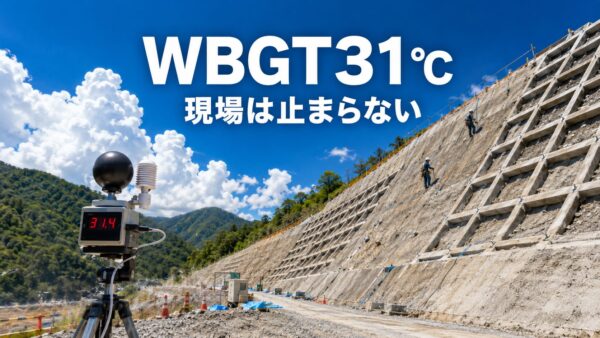
This time, we'll be discussing WBGT values and heatstroke.
But I’m not going to end this article with just “Make sure to stay hydrated,” though! lol
The one thing I was curious about was how the rule stating “Work must be suspended when the WBGT reaches 31°C” is actually implemented on-site.
So, I went through and compared every single piece of publicly available documentation from 50 general contractors, as well as the rules handed out at the job sites where we’re working, lol.
To cut to the chase, the rules for temperatures over 31°C are the same everywhere—basically, just be careful while working! LOL (Work on site never stops!)
One year after the mandate took effect in June 2025—what does 2026 hold?
With the revised Occupational Safety and Health Regulations taking effect on June 1, 2025, and the addition of Article 612-2, implementing heatstroke prevention measures in the workplace has become a mandatory requirement subject to penalties.
This applies to work performed in environments where the WBGT index is 28 or higher or the air temperature is 31°C or higher, for a continuous period of at least one hour or for a total of more than four hours in a single day.
Whether it's spraying the slope or drilling holes for anchors, in the summer, pretty much everything gets caught up in this lol.
The key point to keep in mind here is that only the following three items have become mandatory.
・Establish a system for reporting individuals who exhibit subjective or objective symptoms of heatstroke (such as morning temperature checks or changes in complexion?)
・Developing procedures for implementing measures to prevent the worsening of symptoms
・Ensure that all relevant personnel are made aware of the system and procedures
Failure to comply is punishable by imprisonment for up to six months or a fine of up to 500,000 yen.
Have you noticed?
There’s no provision anywhere in the ministerial ordinance that says, “Stop work when the WBGT reaches 31°C.” It just says, “It’s dangerous!” lol
Then, on March 18, 2026, the Ministry of Health, Labor and Welfare announced that"Guidelines for Preventing Heat Stroke in the Workplace"A new one has been released.
In 2025, the number of heatstroke-related casualties (requiring at least four days of sick leave) in the workplace was 1,803, which appears to be the highest since records began in 2005. (Data from the Ministry of Health, Labor and Welfare)
On the other hand, the number of deaths is reported to have fallen to 19, a decrease of about 40 percent from the previous year's figure of 31.
The number of people collapsing has increased, while the number of deaths has decreased. Could this be due to the standardization of initial response procedures?
WBGT Thresholds | Four Levels: 25, 28, 31, and 33
The WBGT value is a heat index calculated based on three factors—air temperature, humidity, and radiant heat—and quantifies the physical strain on the body caused by solar radiation and humidity, which cannot be determined by air temperature alone.
The following four levels are commonly used for classification.
| WBGT value | Category | General Guidelines for Handling Situations |
|---|---|---|
| Less than 25 | Note | Generally, the risk is low, but it can occur during strenuous work. |
| 25 or older but under 28 | Caution | Take regular breaks to replenish fluids and electrolytes |
| 28 or older but under 31 | High Alert | A production line where the number of workers is rising rapidly. Increase the frequency of breaks. |
| 31 or older | Danger | A level at which, as a general rule, physical activity and work are suspended |
| 33 or older | — | Criteria for Issuing Heat Stroke Alerts |
| 35 or older | — | Criteria for Issuing a Special Heatstroke Alert |
Items 25, 28, and 31 are from the Japan Society for Bio-meteorology’s “Guidelines for Preventing Heat Stroke in Daily Life,” while items 33 and 35 are based on the Ministry of the Environment’s heat stroke warning criteria.
However, these four stages are merely guidelines based on daily life.
In the world of labor, WBGT reference values are set separately for each level of physical work intensity based on JIS standards, and “the more strenuous the work, the lower the reference value.”
Since spray-applying material to slopes and drilling holes for anchors are considered physically demanding tasks, the actual temperature at which they become hazardous is lower than the “31°C is dangerous” guideline used in daily life.
A Comparison of Heatstroke Prevention Measures at Various General Contractors
Based on the published materials, two things stood out: the mandatory requirement for equipment and the move to shift the schedule itself.
Obayashi Corporation announced on May 21, 2026, that it will begin an initiative to change the working hours at construction sites from July through August to 7:00 a.m. to 1:00 p.m.
Since the standard work hours are from 8:00 a.m. to 5:00 p.m., this means that the 9-hour workday is reduced to 6 hours.
According to reports, since last fiscal year, the company has required all personnel engaged in on-site work to wear work clothes equipped with fans and wearable devices that detect and alert them to risks associated with extreme heat.
It appears that Shimizu Corporation is implementing a system at its construction sites in Tokyo where weather sensors are installed on-site to measure WBGT values, which are then color-coded into four levels—“Danger,” “Extreme Alert,” “Alert,” and “Caution”—and continuously displayed on monitors in the office.
Instead of making people read numbers, let them understand through color.
It's good that it's easy to understand, especially since there are so many foreign workers.
However, I’d like to be honest about one thing here.
From what I've seen across 50 companies, almost none of them actually publish the specific internal threshold for "stopping work at a certain WBGT temperature" lol.
All we hear about is equipment, facilities, and organizational structure.
They don't disclose the criteria for termination. That's the reality of the industry these days.
Even if it's dangerous, be careful at work lol
The company-wide policy stated that events would be "canceled as a general rule" when temperatures exceeded 31°C.
So, does that mean we don't have any within the company? Not exactly.
It’s clearly stated in the health and safety management plans distributed on-site and in the documents read aloud during morning briefings.
And the wording is almost identical across all 50 companies.
According to materials from the “STOP! Heat Stroke: Cool Work Campaign,” sponsored by the Ministry of Health, Labor and Welfare, the Central Association for the Prevention of Industrial Accidents, the Construction Industry Accident Prevention Association, and others,
If the WBGT index significantly exceeds the threshold,As a general rule, suspend workThere is a statement to that effect.
The documents from each general contractor basically just repeat this sentence almost verbatim.
That's why it will be the same company-wide.
That's because it's a copy of the wording issued by the government, not a standard we came up with on our own.
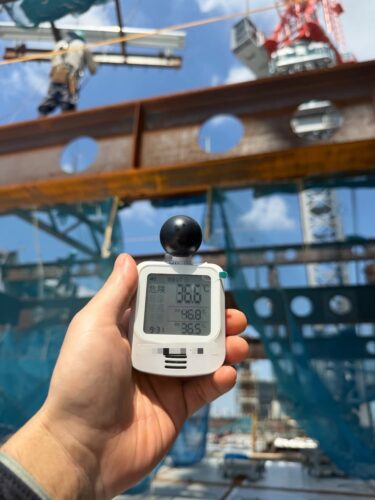
Even if the WBGT exceeds 31°C, work on-site will absolutely not stop.
In the materials for the same Cool Work Campaign, immediately following the phrase “cancellation in principle,” there is a list of precautions to take when work must be performed at locations where the threshold values are significantly exceeded.
There are two key points: set longer break times when working alone, and frequently monitor your physical condition—such as heart rate, body temperature, and the frequency and color of your urine—as well as your fluid and salt intake while working.
Right next to the "General Suspension" policy, there are procedures in place from the start for "cases where work must be carried out unavoidably."
The system is designed with the option to not stop in mind!!! lol
This is where the issue of the ministerial ordinance comes into play.
It became mandatoryEstablishing Systems, Developing Procedures, and Raising AwarenessThere is no provision in any of these three that specifies stopping work when the WBGT reaches 31°C.
That’s why work doesn’t stop even when the temperature exceeds 31°C, and not stopping work doesn’t constitute a violation of the law.
And here’s the most alarming part: 31°C is not a safe threshold.
According to data from the Ministry of Health, Labor and Welfare, the WBGT values for the 30 heatstroke-related fatalities in 2024 ranged from 27°C to 33°C.
It seems that quite a few people have died at 27°C. (This includes the elderly.)
If there’s a site supervisor who thinks 31°C is the “it’s still okay” threshold, that’s a pretty dangerous way of thinking, isn’t it?
To be honest, the reason work on-site doesn't stop isn't because of the temperature readings.
Construction time and money.
Life < Construction Schedule
I can't stop because no one will cover for me during the days I'm off.
I, too, was once on the side of those who made such decisions as a general contractor.
Inside the air-conditioned room.
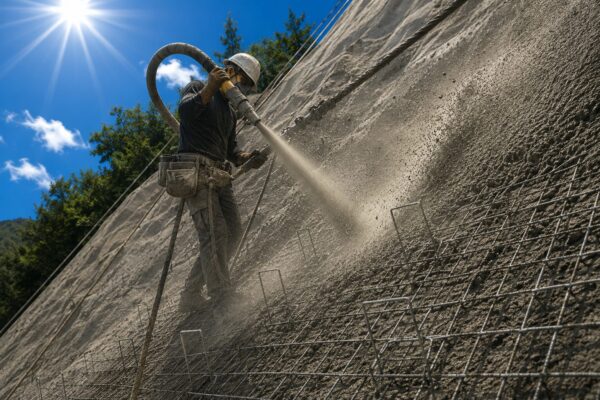
Pitfalls Unique to Slope Construction Sites
I believe there are four specific risks associated with slope sites that aren’t present on flat ground.
The wind doesn't blow across the slope.
Cut slopes often take on a pocket-like shape due to the topography, and when ridges jut out on both sides, wind entering from the valley side cannot escape.
Furthermore, if the frame has a grid structure, air will become trapped within the grid.
Since slopes covered with sprayed mortar absorb heat from the sun, radiant heat is reflected back from them.
The wind can't circulate because it's trapped by surfaces that have absorbed heat. These conditions are among the worst.
Full-body harnesses andWork Clothes with a FanCompatibility
It’s not something people talk about very often, but full-body harnesses and work clothes with fans don’t mix well.
The harness straps tighten against my clothes from my chest to my waist, blocking the airflow from the fan.
Especially on the back and around the waist, there’s almost no airflow directly under the belt.
I don’t think the notion that “it’s safe because I’m wearing work clothes with a fan” holds water when it comes to slope safety.
It's just a little comfort, really.
Also, please be aware that work clothes with fans are not a fundamental solution for preventing heatstroke.
It's really just the kind of clothing that makes you feel cool because of the heat of vaporization, lol.
It doesn't actually reduce the body's core temperature.
If someone were to suffer from heatstroke on a slope, it would take time to rescue them.
On flat ground, it takes a minute or two to carry it to the rest area, but it’s not that easy on a slope.
If you have to lower someone who’s become unresponsive partway down a slope using a rope and carry them to level ground, that alone takes several minutes.
I suspect that many people skip this step when creating the “Procedures for Implementing Measures to Prevent the Worsening of Symptoms,” which has now become mandatory.
It's easy to write "Move to a cool place" in the instructions.
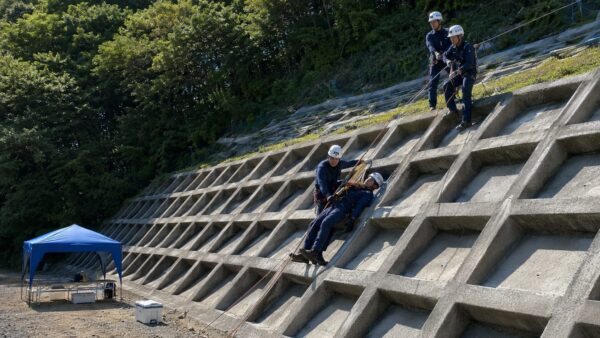
How many sites have actually unloaded the equipment to measure exactly how many minutes that move takes?
Emergency procedures for slopes can only be implemented in conjunction with the procedures for lowering people down, right...?
In the worst-case scenario, we might even have to prepare a sling and use a crane or something similar to lower it down.
Where to Place the WBGT Meter
A WBGT meter is useless unless it is placed in the area where workers are actually working.
This is because measurements taken under the eaves of the field office or in the shade of a flat area do not reflect the conditions on the slope.
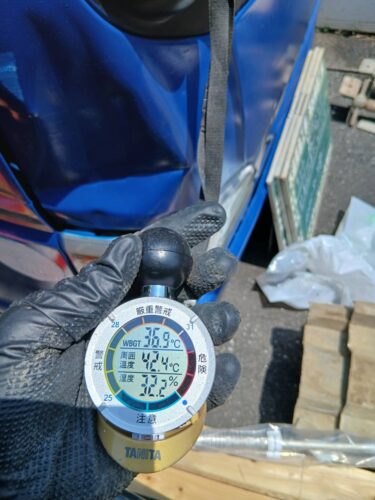
According to my experimental results, there is a difference of about 10 percent between the values measured on a flat surface and those measured on a slope.
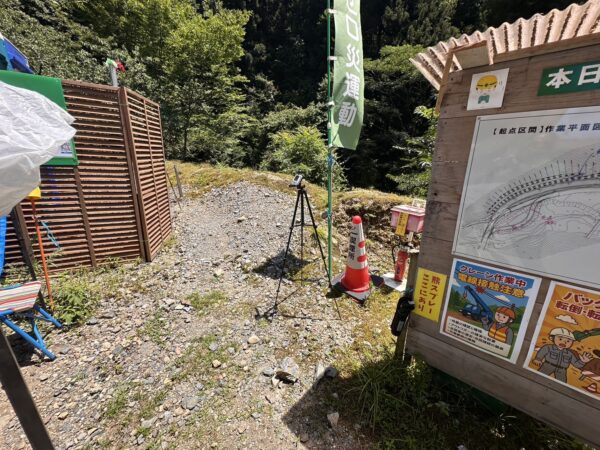
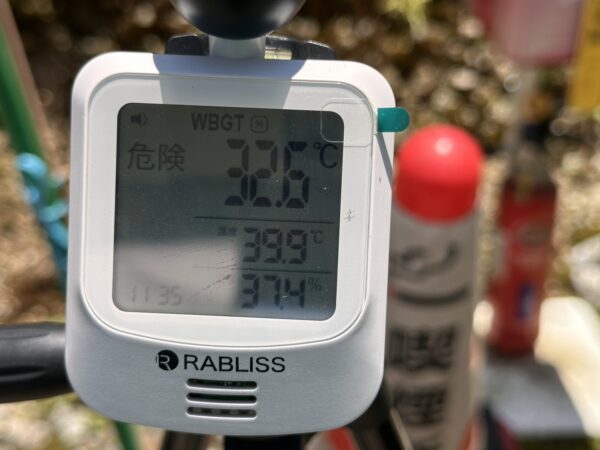
The above shows the WBGT readings for the construction site where work is currently underway.
Flat Ground
Time: 11:35
Humidity: 37.4%
Temperature: 39.9 degrees
WBGT: 32.6 degrees
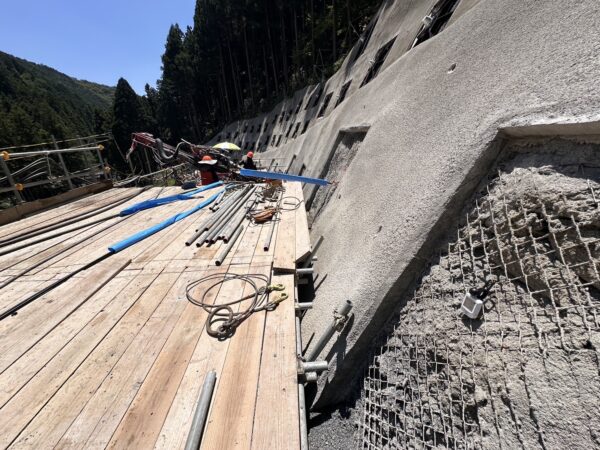
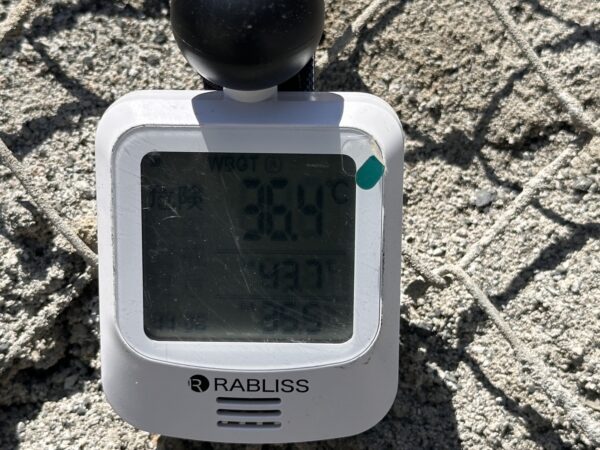
Slope
Time: 11:35
Humidity: 35.5%
Temperature: 47.3 degrees
WBGT: 36.4 degrees
The slope side will be higher.
The photo is from the 1st, but I’ve actually been taking readings every day for the past few days. (The readings have been more than 10% higher every day.)
I believe this is because the angle at which the sun's rays strike the surface, the radiant heat from the sprayed surface, and the lack of airflow all coincide.
*Please note that these are measurements I took at my own site and are not based on data from other sites. Please try taking measurements at your own site—both on flat ground and on a slope—and compare the results.
Please note that we use a measuring instrument that complies with JIS standards and is equipped with a black sphere.
Since a thermometer and hygrometer without a black globe cannot detect radiant heat, it cannot be used to calculate the WBGT value.
Negotiate payment terms with the general contractor by factoring “non-working days” into the construction schedule
The reason work on-site doesn't stop isn't because of the heat; it's because no one will pay us for the days we stop working. In short, it's a money issue.
Conversely, if the shutdown date is factored into the construction schedule from the outset, the site can, in theory, be shut down.
My approach is simple: I just set my unit rates based on the assumption that there will be fewer working days from July through August—that's all.
The evidence for this actually comes from the general contractors themselves.
This refers to the change in working hours announced by Obayashi Corporation—the shift from 8:00 a.m. to 5:00 p.m. to 7:00 a.m. to 1:00 p.m.
In terms of total time, 9 hours minus 6 hours means one-third is eliminated.
I’m just going to take this to mean that the general contractor itself is admitting that “operations drop by around 30% during the peak summer heat” lol (how convenient).
In that case, the numbers won't add up unless someone covers that 30 percent.
There’s really no reason for subcontractors to just take it in silence.
・Actual working hours drop by 30% during periods of extreme heat (according to data released by the general contractor)
・The cost of work clothes with fans and wearable equipment must be covered for each person
・As the frequency of breaks increases, the actual time spent working decreases even further.
・The company will absorb any labor capacity left over when work cannot be performed on certain days
That could be a bargaining chip, right?
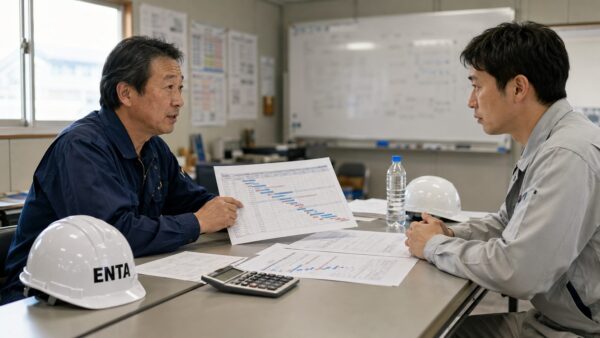
I know this is a difficult topic to bring up.
But if we keep saying, “Let’s put safety first,” without addressing the issue of unit prices, the construction companies on-site will just end up getting worn out.
The construction industry today is allowing temperatures to rise above 31°C by relying on sheer willpower, while failing to address the structural issues that make this situation unstoppable.
Even though everyone knows it's dangerous, we have to go to work.
Well, I guess there’s not much we can do about it, really.
I do think there are some areas where we just have to be careful, though.
It’s too late to say, “We followed the standards,” after a worker has collapsed.
I like to think of the 31°C figure not as a reason to stop, but as a signal to start negotiating, lol.
Furthermore, the WBGT figure is merely a guideline and is not absolute.
Be even more careful than usual.
From the general contractor's perspective, they are giving instructions to the government agency and taking measures.
It's nothing more than a publicity stunt, and the government knows it.
And the subcontractors know that, too.
I guess it's just a matter of taking theoretical ideas and putting them into practice on the ground, then turning them into paperwork...
Let's keep up the good work despite the heat!
See you later.